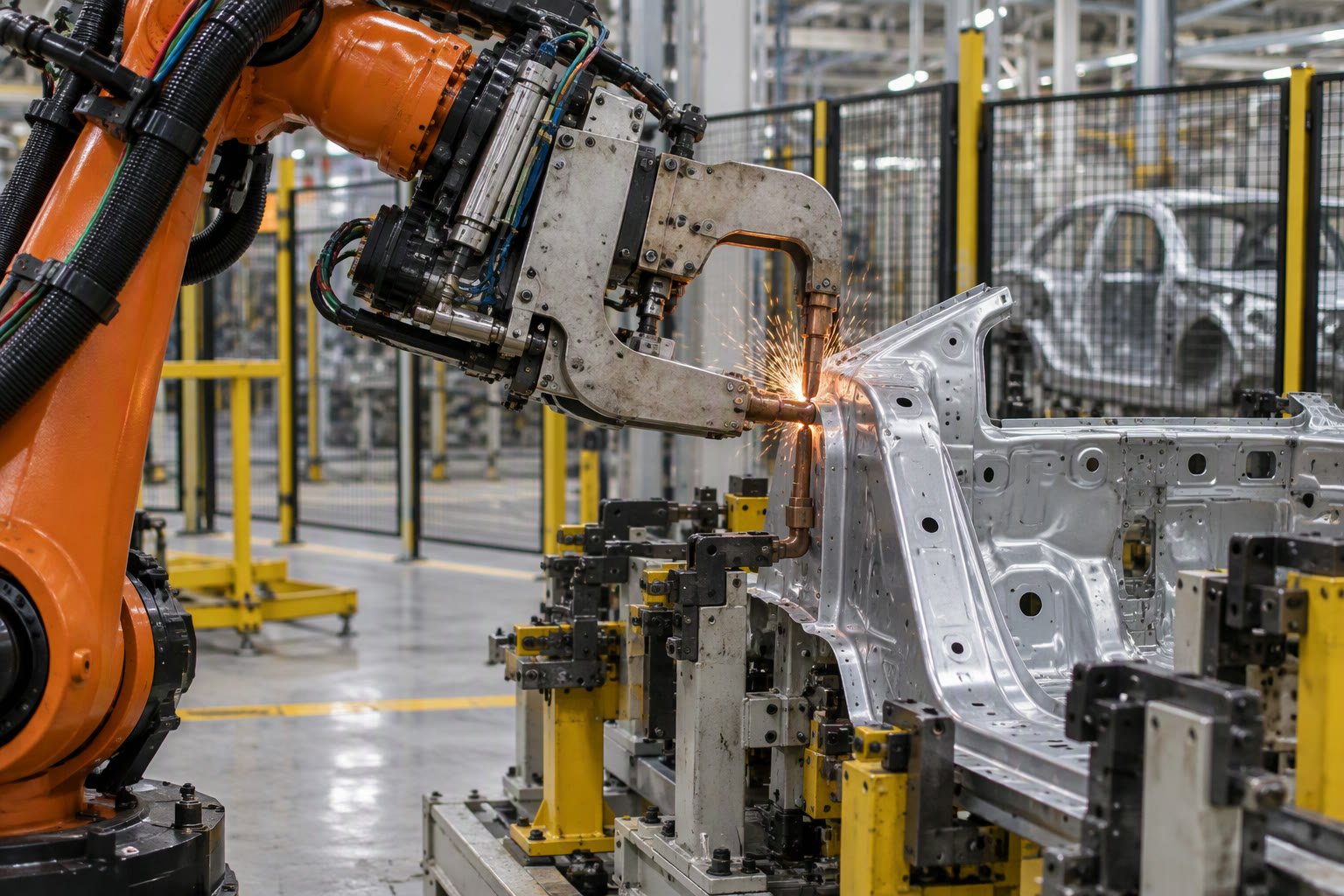
Spot welding is the cheapest weld per joint and the hardest to get right with a robot. The robot only carries the gun. The weld is made by current, force and time, and all three have to be right at the same instant.
This guide covers how a robotic spot welding cell works, the gun types used in Indian plants, the parameters that decide nugget quality, why servo guns changed cell design, and what the equipment costs.
How a spot weld is actually made
The gun clamps two or three sheets between copper electrodes, applies force, and passes a large current for a few hundred milliseconds. Resistance at the sheet interface turns that current into heat, and a nugget forms. The robot’s job is to position the gun accurately, square to the surface, and hold still while the weld completes.
Four variables decide the result: electrode force, weld current, weld time, and the condition of the electrode tips. Get the force wrong and the sheets do not touch properly, which causes expulsion and a weak nugget. Let the tips wear and the contact area grows, current density falls, and welds go cold without any visible sign.
Gun types and what they change
| Gun type | Actuation | Best fit | Practical note |
|---|---|---|---|
| C-type gun | Pneumatic | Open access to a flat panel | Heavy, needs a 100 kg+ robot |
| X-type gun | Pneumatic | Reaching into a box section | Better clearance, less force |
| Servo gun | Servo motor | Variable thickness, mixed models | Programmable force and position |
| Stationary gun with robot transfer | Pneumatic or servo | Small parts, high volume | Robot moves the part, not the gun |
| Multi-gun setup | Pneumatic | Several joints per stroke | Faster but harder to maintain |
The parameters that decide nugget quality
A weld schedule is a recipe: squeeze time, weld time, hold time, current and force, sometimes with a pre-pulse or a current up-slope. The schedule is developed on the actual material stack, not copied from a table, because coating, sheet thickness and shunting all change the result.
Spot weld schedule check (two 1.2 mm mild steel sheets)

Electrode force          : 2.5 kN
Weld current             : 9.0 kA
Weld time                : 12 cycles at 50 Hz = 240 ms
Hold time                : 10 cycles = 200 ms

Current density check
  tip diameter 6 mm, contact area = pi * 3^2 = 28.3 mm2
  current density = 9,000 A / 28.3 mm2 = 318 A/mm2
  Typical range for mild steel is 250-400 A/mm2

Edge distance rule
  minimum distance from nugget centre to sheet edge
  is roughly 1.5 * tip diameter = 9 mm for a 6 mm tip.
  Closer than that and the sheet deforms and expels.

Weld spacing (pitch)
  minimum pitch is about 3 * tip diameter = 18 mm
  to avoid shunting current through the previous nugget.

As tips wear, contact area grows. At 8 mm effective
diameter, current density falls to about 179 A/mm2 and
the weld goes cold. This is why tip dressing is scheduled
by weld count, not by shift.
Why servo guns changed cell design
A pneumatic gun closes at one force, set by a regulator. If a line runs three sheet combinations, an operator changes the regulator or accepts a compromise. A servo gun closes to a programmed position and force per weld, so one gun can weld a thin closure panel and a thick pillar in the same program.
The servo gun also reports. Because the motor knows its position and current, the controller can measure how far the electrodes moved before contact, which is a proxy for stack thickness. That reading catches a missing sheet, a double sheet or a misfed part before the weld is made. In practice this single feature prevents more scrap than any camera.
Fixturing and gun alignment
- Square to the surface. A gun that arrives at an angle concentrates force on an edge, and the nugget forms off-centre. The fixture must present the joint so the gun approaches normal to the surface.
- Backing support. Thin panels deflect under electrode force. A backing bar or a clamp directly behind the weld stops the panel flexing away from the electrode.
- Repeatable location. If the part moves between welds, every weld in the sequence moves with it. Locate on holes or features, not on edges.
- Gun cable routing. Transformer and water cables are heavy and stiff. A dress pack that fights the wrist will cause position errors at the tip.
Cycle time and line balancing
Spot welding cycle time is dominated by robot travel between welds, not by weld time. A 12-cycle weld takes 240 ms; moving 300 mm between welds can take 600 ms. That is why weld sequencing matters as much as robot speed: group welds by proximity, minimise wrist reorientation, and keep the gun on the same side of the part where possible.
For high-volume lines the arithmetic is unforgiving. If a body has 400 welds at an average of 1.4 seconds each including travel, that is 560 seconds of welding per body. Splitting it across four robots brings it to 140 seconds, which is why automotive lines use several robots on the same station rather than one fast robot.
Quality monitoring that earns its cost
Three measurements cover most of the risk. Weld current and time from the weld controller prove that the schedule ran. Electrode displacement from a servo gun proves the stack was what you expected. And periodic destructive tests on coupons prove the nugget diameter is still in specification as tips wear.
Do not rely on a post-weld inspection camera alone. Surface appearance tells you almost nothing about nugget size, and the failures that matter are internal.
What a robotic spot welding cell costs in India
| Item | Indicative price | Notes |
|---|---|---|
| Robot, 165 kg payload | ₹35–65 lakh | Gun weight and reach decide payload |
| Pneumatic C-gun with transformer | ₹3–8 lakh | Force fixed by regulator |
| Servo gun with transformer | ₹8–25 lakh | Programmable force and displacement |
| Weld controller and timer | ₹2–8 lakh | Per gun |
| Fixture and backing | ₹5–20 lakh | Part complexity dependent |
| Tip dressing unit | ₹1.5–5 lakh | Automatic dressing saves tips |
| Cooling and water system | ₹1–4 lakh | Electrode life depends on it |
| Turnkey one-robot cell | ₹1.2–2 crore | Robot, gun, fixture, controls |
What is the difference between a pneumatic and a servo spot welding gun?
A pneumatic gun closes at a fixed force set by a regulator. A servo gun closes to a programmed position and force per weld and reports electrode displacement, which lets one gun weld different sheet stacks and detect missing or double sheets.
How much does a robotic spot welding cell cost in India?
Indicative ranges: a 165 kg robot ₹35–65 lakh, a pneumatic C-gun with transformer ₹3–8 lakh, a servo gun ₹8–25 lakh, fixtures ₹5–20 lakh, and a turnkey one-robot cell ₹1.2–2 crore.
Why do spot welds go cold after a few hours?
Electrode tips wear and the contact area grows, which lowers current density at the same current setting. Dress or change tips on a weld-count schedule, not a time schedule.
How far apart should spot welds be?
A practical minimum pitch is about three times the tip diameter, roughly 18 mm for a 6 mm tip. Closer spacing shunts current through the previous nugget and weakens both welds.
Can a robot weld aluminium with spot welding?
Yes, but aluminium needs much higher current, better cooling and more frequent tip dressing, and electrode life is far shorter than on steel. It also needs a schedule developed specifically for the alloy.
Sources and further reading
- American Welding Society — resistance welding fundamentals and qualification guidance.
- ISO 10218-1 — safety requirements for industrial robots.
- A3 Association for Advancing Automation — robotic welding cell integration resources.
- ISO 9283 — industrial robot performance criteria.