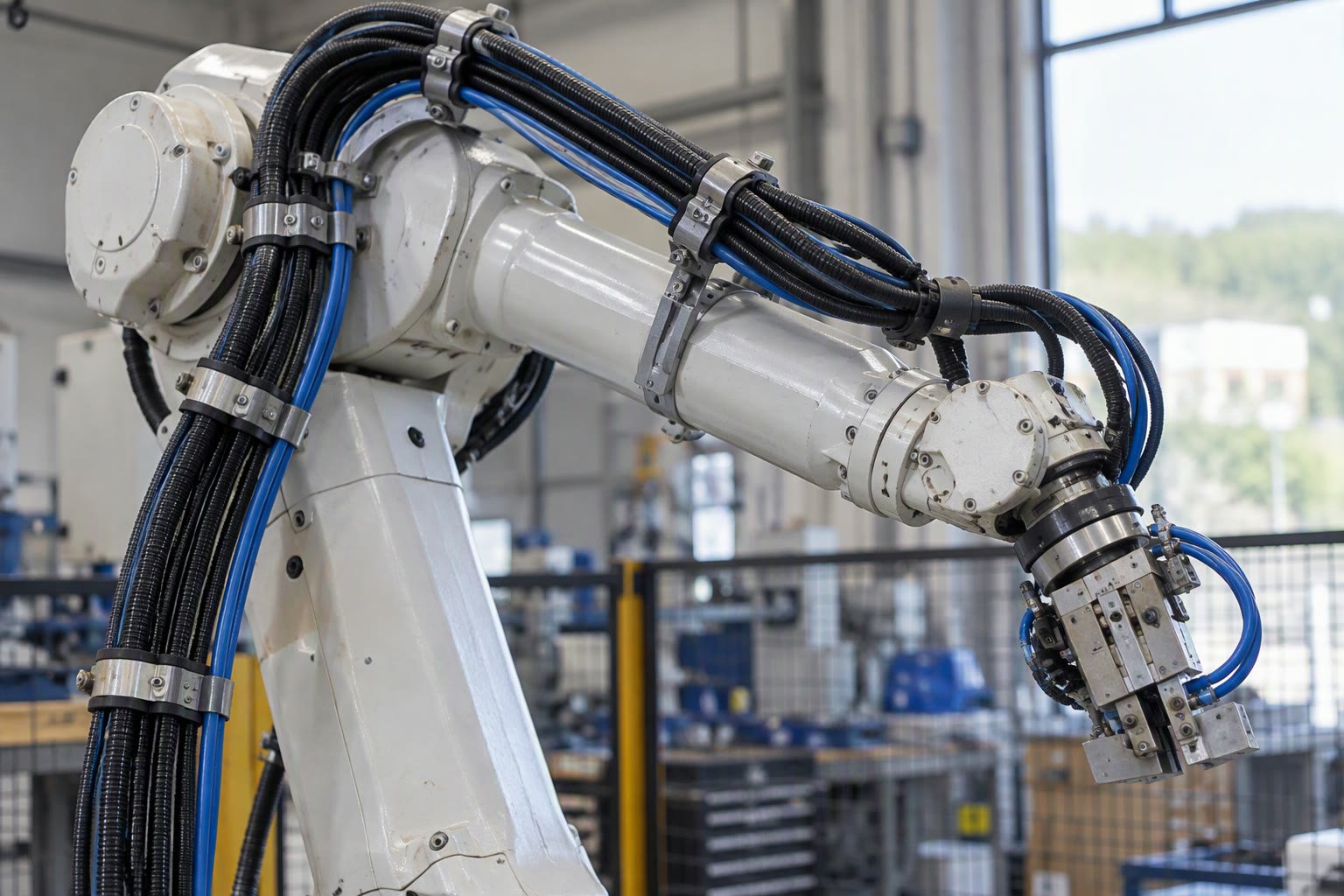
Most robot cell failures that are not mechanical start in the dress pack: the bundle of cables, hoses and tubing strapped to the arm. It is the part everyone designs last and replaces most often.
This guide covers what a dress pack has to survive, how to route it, the brackets and clamps that actually work, and the inspection points that catch a failure before it stops production.
What the dress pack actually carries
- Power and signal for the tool: gripper valves, servo cables, camera and light cables.
- Air or vacuum lines for grippers, venturi generators and blow-off.
- Water or coolant for welding torches, spindles and high-current tools.
- Sense lines for part-present sensors, force sensors and tool changers.
Each has a different failure mode. Cables fail from repeated flexing and fatigue. Air lines fail from abrasion and kinks. Coolant lines fail from heat and pressure cycling. A dress pack design that treats them all as one bundle is a design that fails in the middle.
The motions that destroy a dress pack
Axis 6 rotation is the main killer. A cable that twists with the wrist accumulates strain in one direction and eventually breaks individual strands. Axis 4 rotation adds a second twist. Long linear moves on axis 1 stretch and relax the bundle. In a welding cell, radiant heat adds a slow degradation on top.
The fix is not a tougher cable; it is a routing that converts twist into controlled bend. That means clamps at fixed intervals, a service loop where the wrist rotates, and a defined path that does not change shape as the arm moves through its envelope.
Routing rules that hold up in production
- Follow the arm, do not shortcut it. The bundle should run parallel to the arm segments, not cut across joints.
- Clamp before and after every joint. Movement must be absorbed in a designed loop, not in a random section of cable.
- Respect minimum bend radius. For a 10 mm cable, treat 8 to 10 times the diameter as the floor, and more for continuous flex.
- Give the wrist a service loop. The loop takes the rotation instead of the connector.
- Separate power from signal. Run servo and welding cables away from camera and sensor cables where the geometry allows.
- Mount the bundle off the arm surface. A standoff bracket lets the cable move without rubbing paint and metal.
In a typical arc welding cell the torch cable, the wire feeder conduit and the air line run together, with the camera and its light separate. That separation is worth designing in, because welding current induces noise into unshielded signal lines.
Brackets, clamps and the parts that matter
| Part | What it does | Failure if cheap |
|---|---|---|
| Clamp with rubber insert | Holds the bundle without crushing | Cable sheath cut, strands exposed |
| Standoff bracket | Keeps the bundle off the arm | Rubbing, paint wear, abrasion |
| Swivel or rotary union | Lets the wrist twist without cable strain | Twist accumulates, connector breaks |
| Drag chain section | Guides linear movement | Cable kinks at the fixed end |
| Heat sleeve | Protects against spatter and radiant heat | Insulation hardens and cracks |
Cable selection: the parts you cannot retrofit
Use continuous-flex cable rated for the cycle count, not standard fixed-install cable. The datasheet should quote a torsion rating and a bend-life figure in cycles. For a cell running 20 cycles a minute, two shifts, 300 days a year, that is about 11.5 million cycles annually, which rules out most general-purpose cable.
Shielding matters on servo and encoder lines, and on anything that shares a route with welding current. Shielded pairs with a drain wire terminated at one end, plus a separate ground conductor, are standard practice. Do not rely on the connector shell for grounding.
A dress pack bill of materials that works
Item                          Qty   Typical Indian price
Continuous-flex cable          as req  ₹350–₹900 / m
Air line, PU 6–8 mm            10 m    ₹40–₹90 / m
Heat sleeve, 1 m section       2       ₹700–₹1,800 each
Clamp with rubber insert       8–12    ₹250–₹700 each
Standoff bracket, machined     2–4     ₹1,500–₹4,000 each
Rotary union or swivel         1       ₹8,000–₹35,000
Drag chain, 1 m                1–2     ₹4,000–₹12,000 / m
Spiral wrap or conduit         10 m    ₹150–₹400 / m
A complete dress pack for a six-axis cell typically lands between ₹45,000 and ₹1.8 lakh in parts, depending on whether coolant and rotary unions are involved. That is small next to a stopped line, which is why the specification deserves a drawing rather than a fitter’s judgement on installation day.
Inspection: catching failure before downtime
- Look for shiny patches on the sheath, which mean abrasion against a bracket or the arm.
- Check clamp tightness quarterly; rubber inserts compress and lose grip.
- Inspect the wrist service loop for permanent deformation after a program change.
- Measure insulation resistance on servo cables annually if the cell runs high cycle counts.
- Check the air lines for bubbles under a soap solution at joints, not just at the tool.
Record the dress pack layout in the cell documentation, with photographs of every clamp. When the bundle is replaced, the technician has a reference instead of an opinion. For the wider maintenance rhythm, use our robot maintenance checklist, and for cable-level integration see the industrial Ethernet guide.
When to redesign instead of repair
If the same cable fails twice in a year, the route is wrong. If the wrist connector fails, the service loop is too short. If the sheath abrades in one spot, a standoff is missing. Repairs treat the symptom; the route treats the cause. A dress pack redesign on an existing cell is a day of work and usually pays back with the first avoided stop.
What is a robot dress pack?
The bundle of cables, air lines, coolant hoses and sensors routed along the robot arm to the tool. It carries power, signal and media to the end effector and moves with every axis.
How often should a dress pack be replaced?
Inspect quarterly and replace when the sheath shows abrasion, the service loop deforms, or insulation resistance drops. In high-cycle cells, plan replacement on a cycle-count basis rather than waiting for a failure.
Can I use ordinary flexible cable?
Not for continuous flexing on a robot arm. Use cable with a published torsion and bend-life rating, because standard flexible cable fails early under repeated wrist rotation.
Why does axis 6 rotation damage cables?
Rotation twists the bundle repeatedly in one direction. Without a service loop or rotary union to absorb it, the twist accumulates at the connector and breaks strands.
What does a dress pack cost in India?
Parts typically run from about ₹45,000 to ₹1.8 lakh for a six-axis cell depending on coolant, rotary unions and heat protection. Labour and programming add to that.
Once a robot carries more than one tool, the dress pack has to route through the changer, and the robot tool changer guide covers utility plates and strain relief.
Cable routing on a moving robot gets harder once the arm rides a linear track, so allow for a cable chain in the design.
Spot welding adds a transformer and water lines to the arm; the cell requirements explain why cable routing matters more here.
Sources and further reading
- igm Robot Systems — welding torch and dress pack documentation.
- chainflex by igus — continuous-flex cable ratings and bend-life data.
- igus India — cable carrier and dress pack components.
- ISO 10218-2 — robot system and integration safety requirements.