A good final-year robotics project is not the most ambitious idea you can imagine. It is the most ambitious idea you can build, test, explain and finish in one semester. These ten projects are chosen because each has a clear demo, a measurable result and a budget a student can defend. The ranges are parts only, in Indian rupees, and exclude tools, shipping and a laptop.
Ten projects with real budgets
| Project | Parts budget | Hardest part | Best fit |
|---|---|---|---|
| 1. PID line follower with wheel encoders | ₹4,000–₹7,000 | Tuning on the actual track and logging lap times. | ECE, Mech, first robotics project |
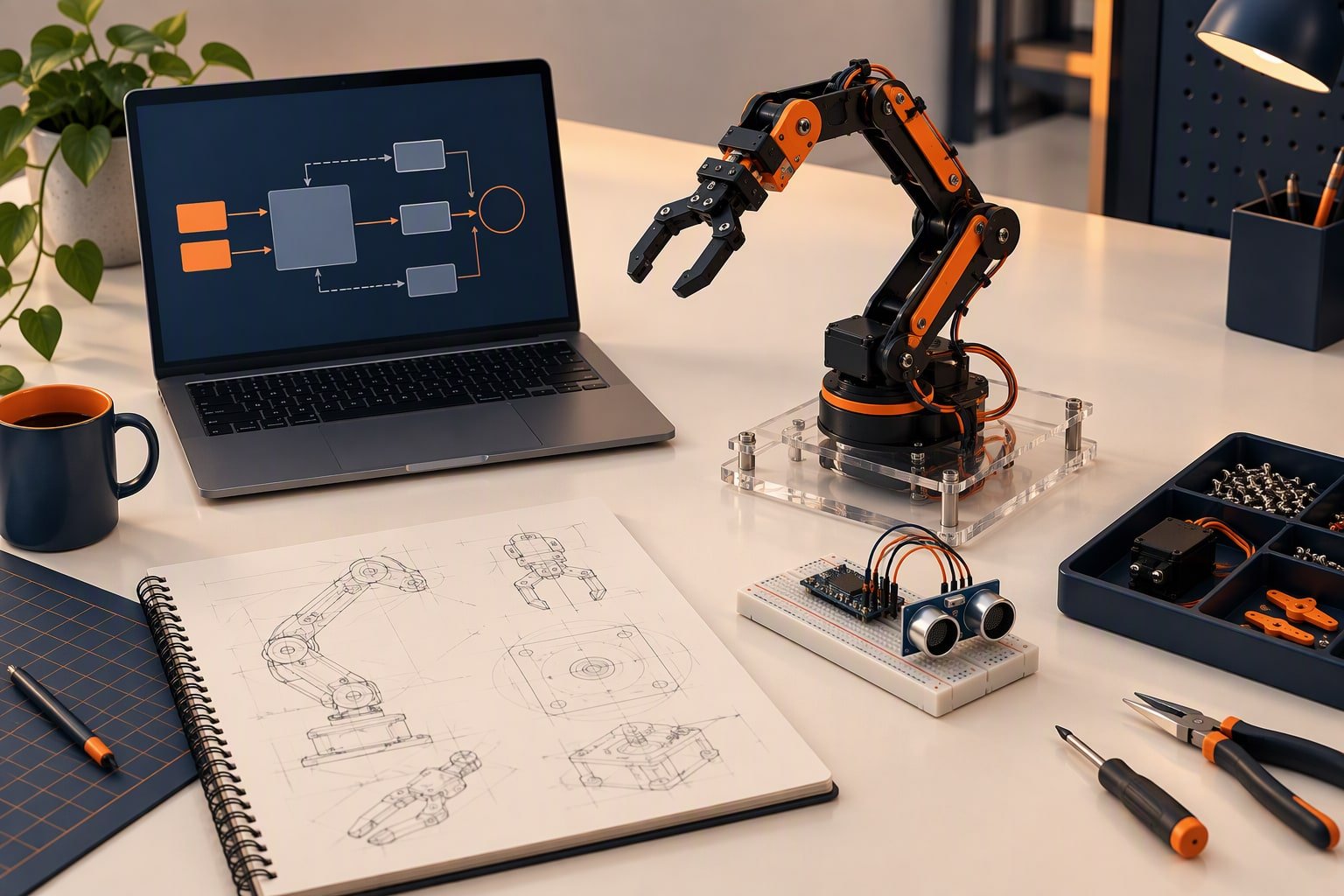
| 2. 3-DOF pick-and-place arm with a mini conveyor | ₹8,000–₹13,000 | Repeatability under load and a gripper that does not drop the object. | Mech, Mechatronics |
| 3. Vision-based object sorter | ₹10,000–₹16,000 | Lighting, camera calibration and a dataset that generalises beyond ten samples. | CSE, ECE |
| 4. ROS 2 differential-drive robot with mapping | ₹18,000–₹30,000 | Odometry, TF frames and keeping the lidar and wheel data consistent. | CSE, Mechatronics |
| 5. Smart agriculture rover | ₹8,000–₹14,000 | Waterproofing, soil-sensor calibration and an honest power budget. | ECE, Agricultural engineering |
| 6. Warehouse AGV with QR-station navigation | ₹10,000–₹16,000 | Stopping accuracy at a station and recovery when a marker is missed. | Mechatronics, Industrial |
| 7. Gesture-controlled prosthetic hand prototype | ₹6,000–₹10,000 | Sensor calibration across users and a mechanical fit that does not pinch. | Biomedical, Mechatronics |
| 8. Solar-powered environment monitoring robot | ₹7,000–₹12,000 | Energy budget: the solar panel rarely provides what the label claims. | EEE, ECE |
| 9. Fire-detection and suppression rover prototype | ₹7,000–₹11,000 | False alarms and safe testing without a real fire. | ECE, Mech |
| 10. Voice-controlled service robot | ₹8,000–₹14,000 | Wake-word reliability in a noisy room, and latency the user will tolerate. | CSE, ECE |
If the ceiling is closer to ₹2,000, start with the three robot builds under ₹2,000 and use one as a proof of concept before scaling up.
What each project can honestly claim
- PID line follower: a measured lap-time improvement and a repeatable completion rate on a defined track. It cannot claim “autonomous navigation” in general.
- Pick-and-place arm: a stated payload, repeatability in millimetres and cycle time. It cannot claim industrial-grade precision.
- Vision sorter: accuracy on a defined object set under defined lighting. It cannot claim general object recognition from ten photographs.
- ROS 2 mapping robot: a map and a trajectory in a defined room. It cannot claim SLAM performance in a dynamic warehouse without testing there.
- Agriculture rover: soil-moisture readings against a reference and a watering decision. It cannot claim crop-yield improvement.
- Warehouse AGV: station-to-station accuracy and recovery behaviour. It cannot claim fleet coordination.
- Prosthetic hand: gesture recognition rates for a small user set. It cannot claim clinical suitability.
- Solar robot: measured energy balance over a test period. It cannot claim a payback period without real tariff and lifecycle data.
- Fire rover: detection latency and a water-pump demonstration on a controlled heat source. It cannot claim firefighting capability.
- Voice robot: command accuracy in quiet and noisy conditions. It cannot claim conversational intelligence.
How to choose final year robotics projects without regretting it in week ten
Pick the project whose hardest part you can actually test in your lab. A vision project needs controllable lighting; a mapping project needs a space large enough to map; a prosthetic hand needs a person willing to wear prototypes. If the test environment does not exist, the project becomes a demo, and examiners can tell.
- Start from a measurable outcome. “Sort 20 objects with at least 85% accuracy” is a project. “AI-powered smart sorting” is a title.
- Buy the risky part first. The sensor or actuator that decides whether the idea works should be ordered in week one, not week six.
- Keep a fallback. If the camera pipeline fails, can the project still demonstrate a working conveyor and a manual classification? A fallback protects the grade.
- Do not choose a project that needs a workshop you do not have. A metal frame with precise joints is not a semester project for a team without machining access.
- Check the safety and ethics rules. Fire, high voltage, human contact and medical claims need supervision and, in some cases, approval.
A twelve-week delivery plan
| Weeks | Focus | Deliverable |
|---|---|---|
| 1–2 | Problem, literature, component choice and ordering | Objectives, block diagram, BOM with prices |
| 3–4 | Test every module separately | Sensor and actuator test log |
| 5–6 | Electronics integration and power | Pin map, schematic, measured voltages |
| 7–8 | Software integration and first full demo | Working prototype, video |
| 9–10 | Test plan, tuning and failure fixes | Raw data and a results table |
| 11 | Report chapters and figures | Full draft |
| 12 | Viva practice and final demo | Final report, spare parts, demo checklist |
Red flags in a final-year plan
- “We will train a custom AI model” with no dataset, no labelling plan and no GPU time.
- “We will make it fully autonomous” without a defined environment or a stop condition.
- A budget with no shipping, batteries or spares. The cost calculator exists because this is the most common gap.
- No test plan until the last week. Then the report has photos but no evidence.
- Every part ordered from a different seller with no arrival buffer. A single delayed parcel can cost a week.
- Claims about medical, safety or industrial use that the prototype cannot support. State the prototype boundary explicitly.
If the project is a robot car or arm, start from a build sheet rather than a blank page. The line follower, obstacle avoider and 3-DOF arm give you a tested wiring and code baseline you can extend. Then use the report format guide to turn the build into a submission.
How many people should be on a final-year robotics team?
Follow your department's limit. Three to four is common. Split mechanical, electronics, software and testing, but make sure every member can explain the whole system in the viva.
Can I reuse a project from a previous batch?
No. You can learn from a reference design, but the implementation, testing and report must be yours. Check your institute's plagiarism policy.
What if my budget is only ₹5,000?
Choose the PID line follower, a smart dustbin or a sensor-logging project. A narrow project with strong test data scores better than an ambitious one that never works.
Do I need ROS 2 for a final-year project?
No. It is valuable for a mapping or multi-node project, but it adds a steep setup cost. Use it only if the project genuinely needs it.
Related: report format, project cost calculator, Arduino vs Raspberry Pi, ROS 2 for beginners.
Keep reading
- Pick and place robot arm with Arduino — Torque first, then code, then a safe test sequence.
- Gesture controlled robot with Arduino — An MPU6050 build with a demo that survives a viva.
- Bluetooth controlled robot car with Arduino — Phone control with a serial protocol you can explain.
- Wall following robot with Arduino — Sensor placement and steering code that can be tuned.
- Smart dustbin with Arduino — A small project with a clean bill of materials.
- PID for line followers — The control theory most final-year reports leave out.
Projects that pick and place need an end effector that actually holds the object; the gripper design guide gives the force calculation and a ₹1,500 build.
See also: robotics competitions in India and the eight-week preparation plan.
Most final year teams discover the equipping a project lab problem halfway through the semester, when the equipment budget is already fixed.
Related reading: Automatic plant watering system build · 12 ESP32 project ideas with rupee BOMs.
Before the final review, run through the project viva questions examiners ask most often.
Sources and further reading
Documents used to check the numbers on this page:
- TI L293D datasheet page — a comparable dual H-bridge for current and drop-out numbers.
- Pololu brushed DC motor driver comparison — drop-out voltage and current.
- Arduino servo motor guide — wiring and power notes.
Last reviewed: October 2026. Budgets are parts-only Indian retail ranges and exclude tools, shipping and laptops. Always check your department’s scope and safety rules.
Newer builds and guides
- Robotics project ideas for diploma students — Scope, parts, budgets and what examiners actually ask.
- Arduino sumo robot — A ₹2,900 competition build focused on grip and push force.
- Maze solver robot — Flood-fill logic, sensor layout and calibration.