Assembly is the last process most Indian manufacturers automate, and the one where robots fail most often. Not because the robot cannot move accurately, but because the parts it has to join are not accurate enough.
This guide covers robotic assembly methods, why compliance and force control decide success, how parts should be fed, how to calculate whether assembly is worth automating at all, and what a line costs in India.
Why assembly is different from handling
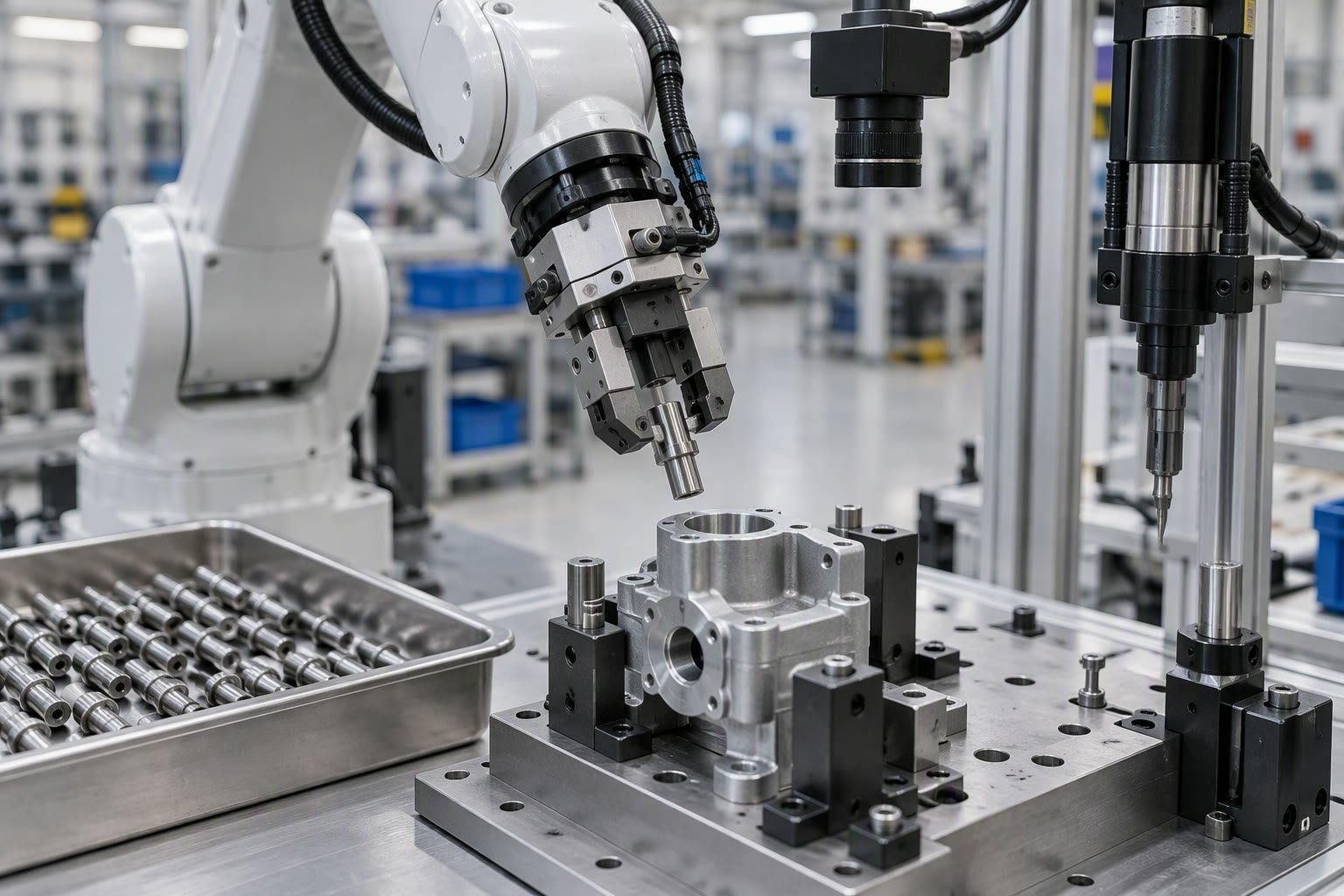
In pick and place, a small position error means the part sits slightly off centre and nobody notices. In assembly, a 0.2 mm error means the pin does not enter the hole. The robot’s repeatability is fine; the tolerance stack of the part, the fixture and the gripper is not.
So assembly projects succeed or fail on the tolerance budget. Add up the variation from each source, compare it with the clearance in the joint, and you know whether a blind approach can work or whether you need sensing. Doing this calculation before the robot is chosen prevents most failed assembly projects.
Assembly methods and what each demands
| Method | Clearance | What makes it work |
|---|---|---|
| Peg in hole, blind | 0.2 mm or more | Chamfered lead-in, accurate fixture |
| Peg in hole, searched | 0.05–0.2 mm | Force sensing and a spiral search pattern |
| Press fit | Interference | Force control with a hard stop and a force limit |
| Screwdriving | Thread engagement | Torque control, float holder, cross-thread detection |
| Riveting | Hole alignment | Compliance and a backing tool |
| Adhesive dispensing | None | Speed control and bead geometry |
| Snap fit | Designed interference | Controlled force and a defined end position |
| Flexible part assembly | Variable | Vision and force together, plus slow approach |
Compliance: the cheapest fix
Before buying a force-torque sensor, consider passive compliance. A remote centre compliance device allows the gripper to tilt and shift slightly under contact, which lets a chamfered pin find its hole without any sensing. It costs a fraction of a sensor and solves many moderate-clearance problems.
Compliance has limits. It does not work for press fits, it does not detect a cross-thread, and it cannot tell you that the part is not there. Use it where the clearance is marginal but the insertion is shallow. Move to active force control when you need the force data as well as the forgiveness.
Feeding decides your uptime
- Bowl feeder. Fast and reliable for small, non-tangling parts. Needs tooling built for each part, and it is a mechanical project of its own.
- Tray and nested fixture. Cheapest. Works when an operator loads a tray, and the robot picks from fixed positions.
- Tray plus vision. Handles parts presented in a loose layer with moderate variation, without dedicated tooling per part.
- Tape and reel. Excellent for small electronics, but limited part shapes.
- Vibratory linear feeder. Good for continuous flow of similar parts in one orientation.
- Magazine or stack. Simple and dense for flat or cylindrical parts.
Whatever feeder you choose, measure its reliability in parts per jam, not parts per minute. A feeder that runs at 60 parts per minute but jams every 400 parts will stop the cell more often than a slower, simpler tray.
Error proofing that pays for itself
An assembly cell that cannot detect a wrong part will produce a wrong assembly at full speed. Three cheap measures cover most of the risk. A presence sensor at the pick point, so the robot never tries to close on air. A part-specific mechanical feature that only fits one way. And a torque or force signature limit at the insertion step, so a cross-thread or a missing component stops the cycle instead of passing through.
Traceability is a separate decision. If the customer requires it, the cell needs a station-level ID reader and a record per assembly. Build that into the controls scope; retrofitting traceability later means touching every station.
Does the volume justify assembly automation?
Assembly automation break-even

Manual assembly
  cycle time per unit            = 45 s
  operator cost per hour         = Rs 180
  labour per unit                = 45/3600 * 180 = Rs 2.25
  units per year                 = 60,000
  annual labour                  = Rs 1,35,000

Quality benefit from manual
  scrap and rework rate          = 3.5%
  cost per rejected unit         = Rs 120
  annual quality loss            = 60,000 * 0.035 * 120 = Rs 2,52,000

Automated cell
  cell cost                      = Rs 55,00,000
  cycle time per unit            = 28 s
  annual running cost
    (maintenance, power, spares) = Rs 3,60,000
  assumed scrap rate             = 1.0%
  annual quality loss            = 60,000 * 0.01 * 120 = Rs 72,000

Annual saving
  labour avoided                 = Rs 1,35,000
  quality improvement            = Rs 2,52,000 - Rs 72,000 = Rs 1,80,000
  gross saving                   = Rs 3,15,000
  less running cost              = Rs 3,60,000
  net                            = -Rs 45,000 per year

At 60,000 units a year the cell does not pay back on
labour and quality alone. It pays back only if the
cell also raises output, removes a bottleneck, or the
quality gain is larger than assumed. Re-run the same
numbers at 150,000 units before approving the project.
This is the calculation that kills most small-batch assembly projects, and it is better to run it before the enquiry than after the quote. Automation at 60,000 units a year has to be justified by consistency, capacity or a customer requirement, not by labour savings.
What a robotic assembly cell costs in India
| Item | Indicative price | Notes |
|---|---|---|
| Assembly robot, 6–10 kg | ₹12–22 lakh | Repeatability and stiffness matter |
| Assembly robot, 20 kg with SCARA option | ₹18–30 lakh | SCARA is often faster for planar work |
| Force-torque sensor | ₹4–12 lakh | Plus controller integration |
| Passive compliance device | ₹60,000–3 lakh | Cheapest way to handle clearance |
| Screwdriving spindle with torque control | ₹1.5–5 lakh | Per spindle |
| Bowl feeder with tooling | ₹2–8 lakh | Part-specific |
| Vision alignment | ₹4–15 lakh | Camera, lighting, software |
| Fixtures and tooling | ₹3–12 lakh | Often under-budgeted |
| Turnkey single-station cell | ₹40 lakh–85 lakh | Robot, feeder, fixture, controls |
| Multi-station assembly line | ₹85 lakh–2 crore | Depends on stations and testing |
What is the minimum volume for robotic assembly to pay back?
As a rough guide, plan for at least 100,000–150,000 units a year for a single-station cell to pay back on labour and quality alone. Below that, automate only if the cell removes a bottleneck, improves consistency the customer demands, or runs multiple part variants.
How do I handle tight tolerances in robotic assembly?
Use passive compliance first if the clearance is above about 0.2 mm and the insertion is shallow. For tighter fits, use a force-torque sensor with a search pattern, or vision alignment. Also fix the tolerance stack: fixture, gripper and part variation all contribute.
Do I need a force sensor for assembly?
Not for every job. Compliance devices solve moderate clearance cheaply. A force-torque sensor is justified when you need force control for press fits, force signatures for error proofing, or active search for tight clearances.
What robot is best for assembly?
A 6–10 kg six-axis robot covers most work. A SCARA is often faster and cheaper for planar assembly where the motion is mostly X, Y and rotation, and it holds payload better at speed.
How much does a robotic assembly cell cost in India?
Indicative ranges: assembly robot ₹12–30 lakh, force-torque sensor ₹4–12 lakh, screwdriving spindle ₹1.5–5 lakh, bowl feeder ₹2–8 lakh, vision alignment ₹4–15 lakh, and a turnkey single-station cell ₹40–85 lakh. Fixtures and feeding usually cost more than the robot.
Sources and further reading
- ISO 10218-1 — safety requirements for industrial robots.
- ISO 9283 — performance criteria and test methods for industrial robots.
- A3 Association for Advancing Automation — robotic assembly and force control resources.
- ISO — standards catalogue for robotics and automation.