Most Indian shops do not need a new robot. They need the robot they already own to run again. A retrofit is often half the price of a replacement and takes a fraction of the downtime.
This guide covers when retrofitting an industrial robot makes sense, what a retrofit actually replaces, how to assess mechanical wear before you commit, the safety standard problem nobody budgets for, and what the work costs in India.
When a retrofit beats a replacement
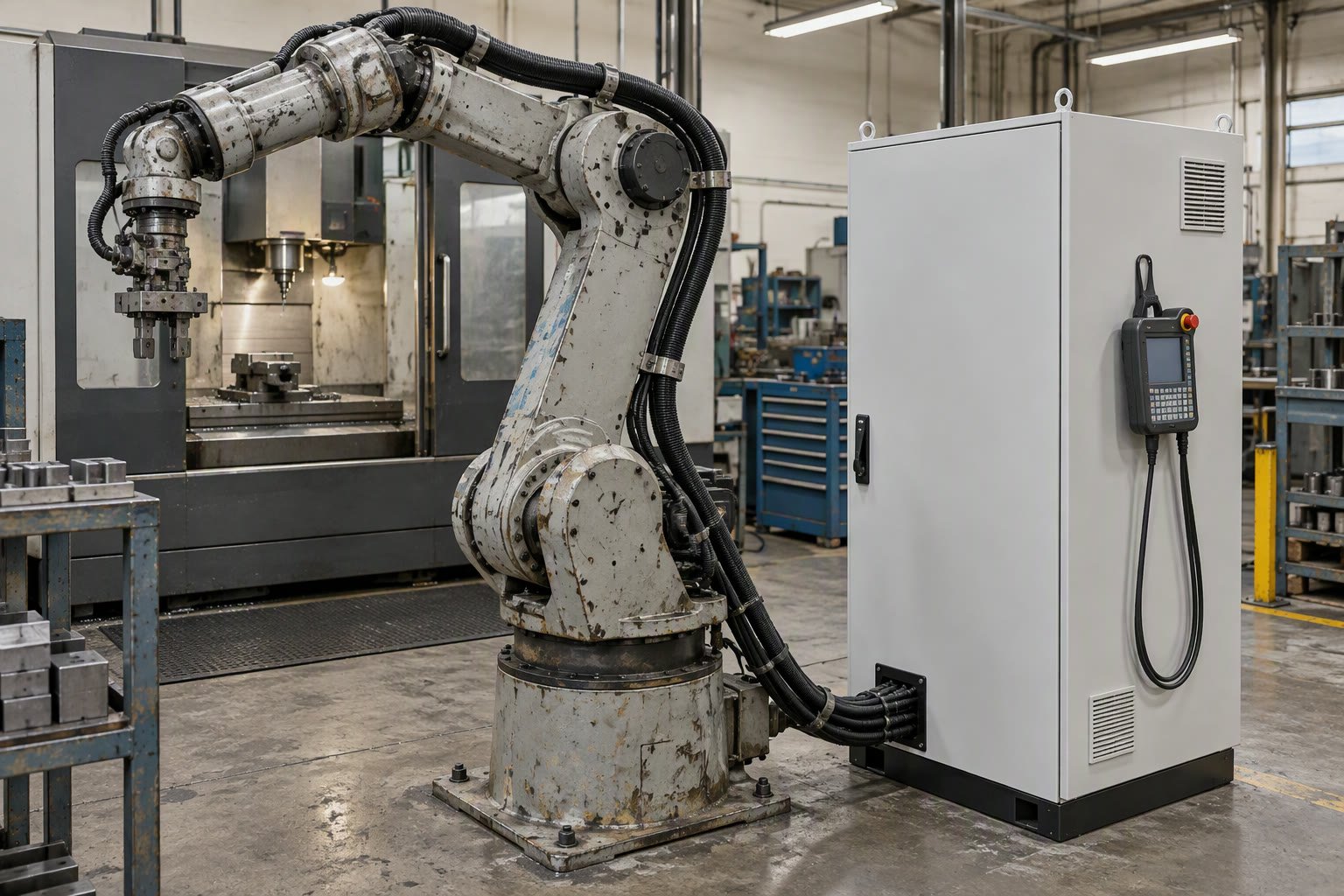
The mechanical structure of a robot is usually the part that lasts. Castings, arms and gearboxes survive decades of production. What fails is the controller, the cables, the encoders and the spares supply. When a 2008 controller cannot be repaired because the manufacturer stopped stocking boards, the arm is still perfectly good.
A retrofit is the right answer when the arm passes a mechanical inspection, the application has not changed, and a replacement would cost two to three times more. It is the wrong answer when the reach or payload is marginal for the job, when gearbox backlash is already out of tolerance, or when the whole cell layout needs to change anyway.
What a retrofit replaces
| Subsystem | Replaced in a full retrofit | Often reused |
|---|---|---|
| Controller | Yes, new generation | Cabinet frame only |
| Servo drives | Yes, matched to new controller | — |
| Motors and encoders | Usually, because old encoders are incompatible | Motors if a compatible interface exists |
| Gearboxes | Rebuilt or replaced if backlash is out of spec | Reusable after inspection |
| Dress pack and cables | Yes, always | — |
| Brakes | Tested, replaced if holding torque has dropped | Reusable if test passes |
| Teach pendant | Yes, new | — |
| Safety circuit | Upgraded to current standard | Some hardware |
The hidden problem: motor feedback
Old robots use resolvers, incremental encoders with proprietary commutation, or absolute encoders on a manufacturer-specific protocol. New controllers expect a different feedback type. That single incompatibility is what pushes a “controller swap” into a motor replacement, and it is the most common reason a retrofit quote comes in higher than expected.
Ask the integrator to state, in writing, which motors and encoders will be reused and which replaced. If the answer is “we will see when we open it”, the price is not fixed.
Mechanical inspection before you commit
- Backlash at each joint. Measure at the output, not the motor. Compare with the manufacturer’s tolerance for that axis.
- Repeatability test. Cycle a fixed point 50 times and record the spread. This is the cheapest predictor of whether the arm is worth saving.
- Brake test. Apply rated load and check that the brake holds without slip.
- Gearbox oil analysis. Metal content tells you whether the reducer is wearing out.
- Structural cracks. Inspect castings around the wrist and the base, especially on robots that have had crashes.
- Frame and mounts. A bent base makes every subsequent alignment harder.
A robot that fails repeatability but passes everything else is still worth retrofitting if the job tolerance is loose. A robot with a worn wrist gearbox usually is not, because wrist repairs dominate the cost.
The safety standard nobody budgets for
A robot built to an older safety standard does not become compliant because it has a new controller. If the retrofit touches the safety circuit, the cell has to meet the current requirements, including performance level for the safety functions and a documented risk assessment.
In practice this means a retrofit is often also a cell safety upgrade: new fence interlocks, a safety relay or safety PLC, possibly light curtains, and a fresh validation. That work is worth doing, but it belongs in the budget from day one, not six weeks into the project. The requirements are set out in the robot safety standards guide.
The arithmetic that decides it
Retrofit vs replace (10 kg payload, 1.6 m reach)

Replacement robot, installed                Rs 28,00,000
Retrofit, full control system + cables      Rs 12,00,000
Retrofit, gearbox rebuild (2 axes)           Rs  4,00,000
Retrofit, safety upgrade                     Rs  5,00,000
--------------------------------------------
Retrofit total                               Rs 21,00,000

Saving versus replacement                    Rs  7,00,000  (25%)

But add the risk items:
  downtime for retrofit, 3 weeks at
  Rs 1,50,000 per week lost contribution     Rs  4,50,000
  spare parts bridge during transition       Rs    50,000
--------------------------------------------
True retrofit cost                          Rs 26,00,000

Saving shrinks to about Rs 2,00,000, or 7%.

At that margin, the decision turns on soft factors:
remaining mechanical life, spare availability for the
new controller, and whether the new robot brings a
better warranty and lower energy use.

If the robot is a 50 kg or 165 kg machine, the ratio
improves sharply because the replacement price rises
much faster than the retrofit price.
What the work costs in India
| Item | Indicative price | Notes |
|---|---|---|
| Third-party controller and drives | ₹6–18 lakh | Depends on axes and brand |
| Motor and encoder replacement | ₹1.5–4 lakh per axis | The most common surprise |
| Gearbox rebuild | ₹1.2–4 lakh per joint | Wrist joints cost more |
| Dress pack and cabling | ₹1.5–4 lakh | Always replaced |
| Safety upgrade | ₹3–10 lakh | Fence, interlocks, validation |
| Programming and commissioning | ₹1.5–5 lakh | Existing programs usually rewritten |
| Full retrofit, 10 kg class | ₹15–25 lakh | Turnkey, excluding downtime |
| Full retrofit, 165 kg class | ₹25–45 lakh | Still well below replacement |
Questions to settle before signing
- Which motors and encoders will be reused, in writing.
- What repeatability the integrator guarantees after the retrofit, and how it will be measured.
- Whether the safety circuit will be upgraded, and to which standard.
- Who supplies spare parts for the new controller, and for how many years.
- Whether existing robot programs can be converted or must be rewritten.
- What happens if the arm fails the mechanical inspection after the controller is ordered.
If you are buying a used robot to retrofit, read the used industrial robot guide first, and price the retrofit before you buy the arm.
Is retrofitting an industrial robot worth it in India?
Often yes for larger robots, where a replacement costs two to three times a retrofit. For small 6–10 kg robots the saving can shrink to under 10% once downtime and risk are counted, so the decision should be made on numbers, not on the headline quote.
What does a robot retrofit include?
A new controller, matched servo drives, usually new motors and encoders, always a new dress pack, gearbox repair where backlash is out of tolerance, and a safety circuit upgrade to the current standard.
Why does a retrofit cost more than quoted?
The usual reason is motor feedback incompatibility. Old resolvers or proprietary encoders cannot talk to a new controller, so motors that were assumed reusable must be replaced. Get the reused-parts list in writing.
How much does an industrial robot retrofit cost in India?
Indicative ranges: a third-party controller and drives ₹6–18 lakh, motors ₹1.5–4 lakh per axis, gearbox rebuild ₹1.2–4 lakh per joint, safety upgrade ₹3–10 lakh, and a turnkey retrofit ₹15–25 lakh for a 10 kg class robot or ₹25–45 lakh for 165 kg.
Will a retrofitted robot meet current safety standards?
Only if the safety circuit is upgraded and validated. A new controller does not make an old cell compliant. Budget for fence interlocks, a safety relay or PLC, and a documented risk assessment with performance level verification.
Decide with the numbers in the maintenance cost guide rather than waiting for a failure.
Sources and further reading
- ISO 10218-1 — safety requirements for industrial robots and systems.
- ISO 9283 — performance criteria and test methods, including repeatability.
- ISO 3691-4 — safety requirements for driverless industrial trucks.
- A3 Association for Advancing Automation — robot integration and refurbishment resources.