A press brake still needs an operator, and the operator spends most of the shift holding a heavy sheet. That is the job a bending robot takes over, not the bending itself.
This guide covers how robot bending cells work, what they cost in India, which part families suit them, and the gauge and gripper decisions that decide whether the cell runs at rate.
What the robot actually does
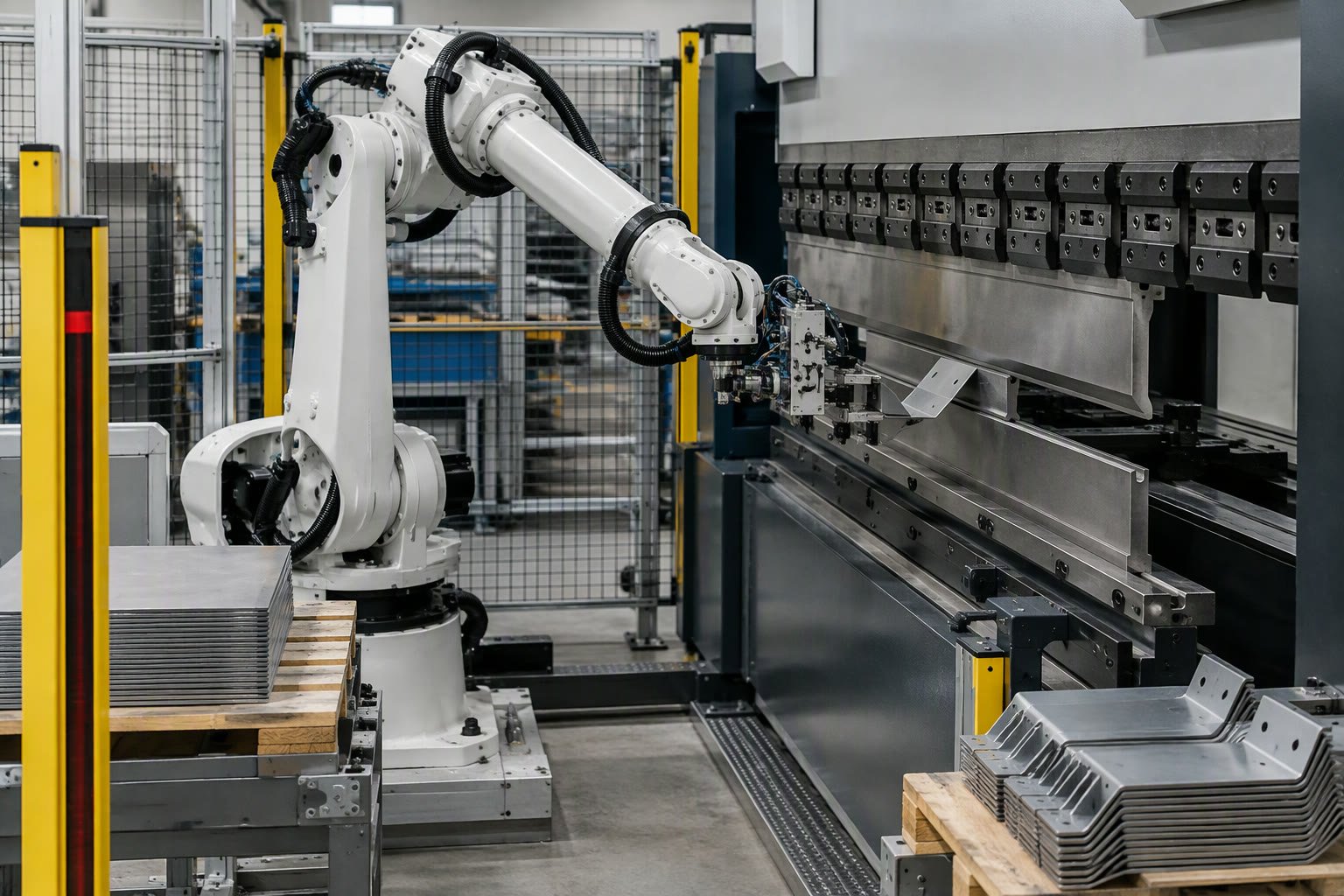
The robot picks a blank, presents it to the back gauge, holds it through the stroke, then rotates the part for the next bend. The press brake does the forming; the robot handles, positions and sequences. A cell with a tool changer can run several bend programmes unattended.
That description hides the hard parts. Sheets sag under their own weight, bends accumulate tolerance, and the part must be flipped without scratching. A bending cell is mostly a handling problem, and the robot is the easy part.
Three levels of automation
| Level | What it includes | Indicative cost (India) |
|---|---|---|
| Assist | Manipulator or lift to hold the sheet; operator still bends | ₹3–8 lakh |
| Semi-automatic cell | Robot, gripper, simple stack and one gauge position | ₹28–55 lakh |
| Flexible cell | Robot, tool changer, part flipper, sheet separator, cell controller | ₹60 lakh–₹1.4 crore |
The assist level is underrated. A pneumatic sheet lifter that takes the weight out of the operator’s hands costs a fraction of a robot and often recovers a large share of the lost time. Automate in steps and measure.
Which parts suit a bending robot
- Part families with consistent size and a repeatable bend sequence.
- Batch sizes between roughly 50 and 2,000, where setup time can be amortised.
- Sheets from about 0.8 mm to 4 mm in mild steel; thinner sheets need special handling to avoid buckling.
- Parts up to 6–10 kg, above which gripper and sag control get difficult.
- Repeat orders, because programming and gripper design are one-time costs per part.
High-mix, low-volume shops with a new part every day are usually better served by a second brake and a good operator than by a robot. The economics flip when the same part runs every month.
The gripper is the whole design
A bending gripper must hold the sheet firmly enough not to slip during the stroke, thin enough to clear the punch and die, and shaped so it does not collide with the machine frame as the part rotates. Most failures are collisions, not grip loss.
- Vacuum cups suit flat, clean sheets and allow a low profile, but fail on oily or perforated material.
- Magnetic grippers work well on steel and are compact; they do not hold aluminium or stainless.
- Mechanical clamps handle any material but add thickness that can collide with the die.
- Dual grippers let the robot regrip mid-sequence without putting the part down, which is often the difference between making rate and not.
Gauging and bend accuracy
The robot positions the part against the back gauge, but the gauge and the bend programme still determine the angle. Modern brakes with angle measurement and automatic crowning compensation reduce scrap; without them, the robot will faithfully reproduce a bad first bend for the rest of the batch.
Allow for springback in the programme and verify the first part of each batch. A robot does not sense a bad bend; it only repeats it. That is why most cells keep an operator for first-piece inspection and pack-out.
Safety and layout
A press brake is one of the most dangerous machines in a sheet metal shop, and adding a robot does not remove the hazard for the people who still load blanks and inspect parts. Keep the light curtain and the two-hand control on the brake, and fence the robot’s own envelope separately.
The usual layout is a linear arrangement: blank stack, robot on a floor track or fixed base, brake, finished-part stack. Sheet separators matter more than they look, because two sheets picked together produce a double-thickness bend and a scrapped part.
Payback maths
Manual cycle      = 45 s per part (single operator)
Robot cycle       = 35 s per part (typical, small part)
Saving            = 10 s per part
Parts per shift    = 8 h × 3600 / 45 = 640 manual
Robot parts/shift  = 8 h × 3600 / 35 = 823 (at rate)
Labour saved       = 1 operator per shift (₹25,000–₹35,000/month)
Additional output  = 183 parts/shift
The labour saving alone rarely justifies a ₹40 lakh cell. The case rests on extra output from an existing brake and on consistency, especially where the brake is the bottleneck. If the brake has spare capacity and the part runs monthly, the numbers are much harder to make.
Commissioning checklist
- Run the first article through every bend and measure against the drawing.
- Check gripper clearance through the full stroke on the deepest bend.
- Verify sheet separation with the real stack, not a sample of five.
- Confirm the tool changer sequence and recovery after a fault.
- Time a full batch, including load and unload, and compare with the quoted cycle.
- Train the operator on recovery, because a stopped cell is the main cost of automation.
For the robot selection side, see how to choose an industrial robot. The gripper trade-offs are covered in our end effector guide, and the wider cell safety case in safety PLC vs safety relay.
How much does a robot bending cell cost in India?
A semi-automatic cell with robot and gripper runs ₹28–55 lakh before the press brake. A flexible cell with tool changer and part flipper is ₹60 lakh to ₹1.4 crore. A new 100-tonne brake adds ₹18–45 lakh.
Can a robot load an existing press brake?
Yes, most retrofit cells reuse the existing brake if it has a compatible back gauge and a safe interface. The brake age, control type and guarding determine whether the retrofit is practical.
What part sizes suit robot bending?
Roughly 0.8–4 mm sheet up to 6–10 kg, with a repeatable bend sequence and batch sizes from about 50 pieces. Very thin sheets and one-off parts are better handled manually.
Why do bending cells fail at commissioning?
Usually gripper collisions with the punch, die or machine frame, or poor sheet separation causing double picks. Check clearance through the full stroke and test with a real stack.
Is robot bending safer than manual bending?
It removes the operator from the stroke during automatic cycles, but the brake still needs light curtains and two-hand control for manual work. Fence the robot envelope separately.
Sources and further reading
- ISO 10218-2 — robot cell integration safety.
- ISO 16092 — press safety requirements.
- The Fabricator — sheet metal forming and automation practice.
- TRUMPF India — bending automation reference material.