A laser welding cell is not a better arc welder. It is a different process with different preparation, speed and cost, and it only pays when the part geometry and volume suit it.
This guide explains what a fibre laser welding cell costs in India, which jobs justify it, what preparation the parts need, and the safety requirements that catch first-time buyers.
How laser welding differs from arc welding
A laser concentrates energy into a small spot, which produces a narrow heat-affected zone and low distortion. Typical weld widths are measured in fractions of a millimetre, and the process can run several times faster than arc welding on thin material.
That precision is also the constraint. Joint fit-up must be tight, often within 0.1 to 0.2 mm for thin sheet. Gaps that MIG would bridge become burn-through or incomplete fusion. The fixture, not the laser, decides whether the cell works.
Where laser welding makes sense
- Thin sheet and tube assemblies where distortion from arc welding is unacceptable.
- Stainless steel and aluminium parts where heat tint and post-cleaning add cost.
- High-volume parts with a repeatable joint and a fixture that closes the gap.
- Seam or spot welds in battery, motor and sensor assemblies.
- Dissimilar metals or reflective materials, with the right wavelength and process control.
It is a poor fit for thick sections, large gaps, low volumes and parts made on a press brake with wide tolerances. In those cases a conventional arc welding cell remains cheaper and more forgiving.
Cell configuration
| Element | Typical specification | Share of cost |
|---|---|---|
| Fibre laser source | 1–3 kW single mode, 3–6 kW multi-mode | 30–45% |
| Welding head | Fixed optics or scanner (galvo) | 10–20% |
| Robot | Six-axis with high path accuracy | 15–25% |
| Fixture and clamping | Tight fit-up, often pneumatic | 10–20% |
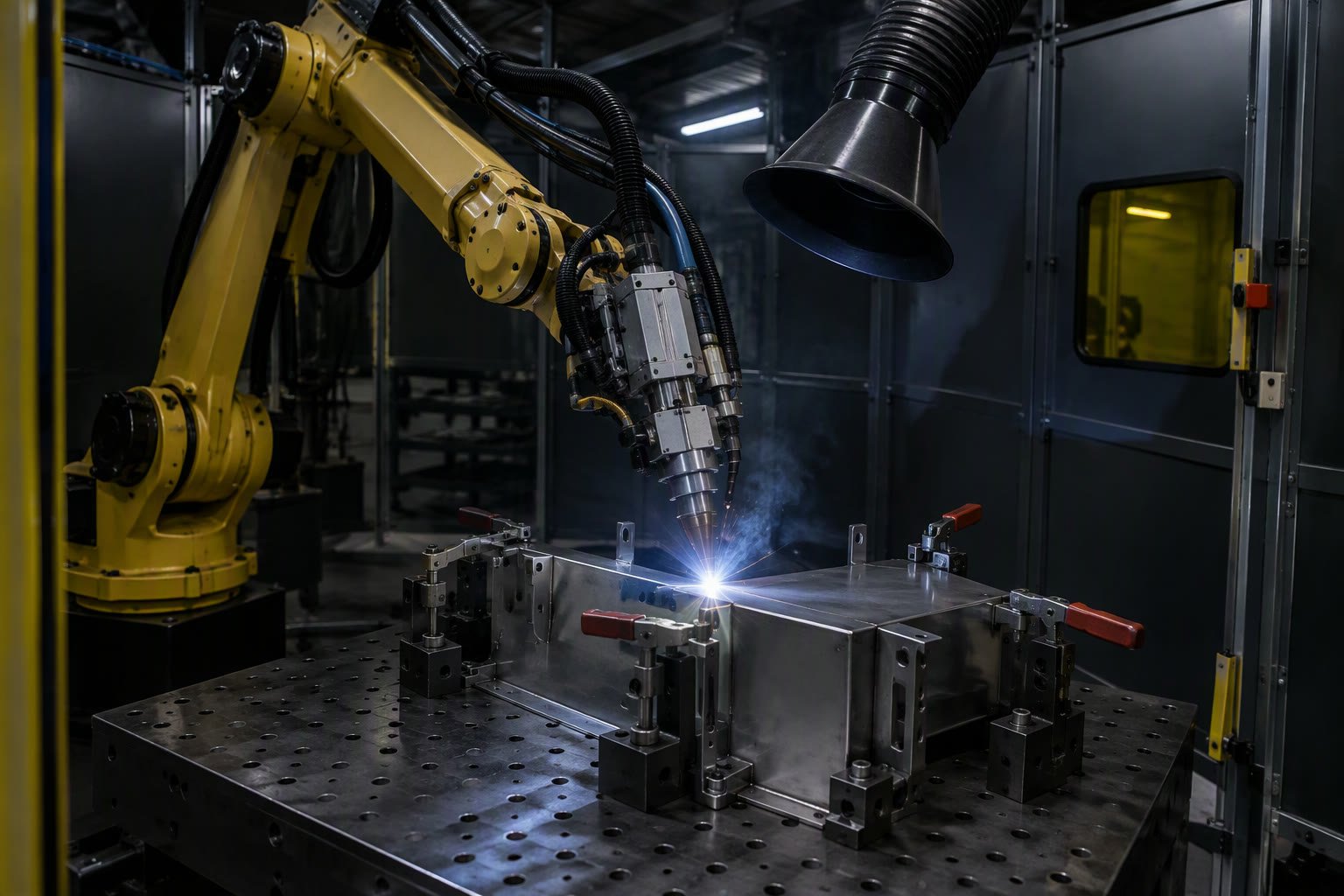
| Safety enclosure | Laser-safe Class 1 enclosure with interlocks | 8–15% |
| Chiller and services | Water chiller, extraction, power | 5–10% |
What it costs in India
| Configuration | Indicative installed cost | Typical use |
|---|---|---|
| 1 kW fibre laser, fixed head, 2 m robot | ₹55–₹85 lakh | Thin sheet spot and seam welds |
| 2 kW fibre laser with scanner head | ₹80–₹1.3 crore | Battery tabs, sensor cans, small enclosures |
| 4–6 kW multi-mode, robot with external axis | ₹1.3–₹2.5 crore | Thicker sections, tube and frame welding |
| Laser hybrid (arc-assisted) | ₹1.5–₹2.8 crore | Shipbuilding, heavy fabrication |
Source power is the biggest lever. Doubling power increases cost by roughly 40 to 60 percent, so specifying more than the joint needs is expensive. A process trial on real parts, run by the laser supplier, is the cheapest way to size the source correctly.
Fixture and fit-up requirements
Laser welding tolerates almost no gap. Design the fixture to close the joint under clamp pressure and hold it during the weld. Copper backing bars help on thin sheet by conducting heat away and supporting the melt pool.
Clamp placement matters more than clamp force. A clamp directly over the seam blocks the beam; a clamp 10 mm away controls the gap without obstructing the path. Our welding fixture design guide covers locating principles that transfer directly to laser cells.
Process monitoring is not optional
Laser welds fail quietly. A gap, a dirty surface or a misaligned joint produces a weld that looks acceptable and fails a leak or pull test. Most production cells include at least one monitoring method: plasma light sensing, back-reflection measurement, or a camera checking the seam before and after.
If the part is safety-critical, plan for destructive or non-destructive testing on a sample basis as well. Monitoring reduces scrap; it does not replace validation.
Safety: laser class changes everything
- The cell must be a Class 1 enclosure: interlocked doors, no direct or reflected beam escape, and warning signage at every entry.
- Interlocks must be safety-rated and validated, not a door switch wired to a PLC input.
- Reflective materials can send the beam in unexpected directions; the enclosure must account for it.
- Fume extraction is required, because laser welding produces very fine particulate.
- Personnel need laser safety training and, where the risk assessment requires it, eye protection for maintenance inside the enclosure.
The safety architecture follows the same logic as any robot cell: see our safety relay versus safety PLC comparison for how to structure the stop circuits.
When the payback works
Laser welding wins on three levers: speed, post-processing and distortion. If arc welding needs straightening, pickling or rework on 20 percent of parts, those costs belong in the comparison. If the part is thin and heat-sensitive, the distortion saving alone can justify the cell.
Build the case on cost per good part, not cost per weld. Include consumables, chiller power, laser source lifetime and the fixture cost per variant. Our robot ROI guide shows the structure, and the numbers usually make the decision obvious once rework is counted.
A sensible evaluation sequence
- Send real parts to two laser suppliers for a weld trial with a gap study.
- Measure distortion and post-processing savings against the current process.
- Design the fixture with the laser supplier, not after the order.
- Specify monitoring and the acceptance test in the purchase order.
- Plan operator and maintenance training before installation week.
- Run a production trial at rate for two weeks before final acceptance.
How much does a laser welding robot cell cost in India?
A 1 kW fixed-head cell starts around ₹55–85 lakh, a 2 kW scanner cell ₹80 lakh to ₹1.3 crore, and 4–6 kW systems ₹1.3–2.5 crore installed. Fixtures and part trials add to that.
Is laser welding faster than MIG welding?
On thin sheet it is often several times faster with far less distortion. On thick sections and poorly fitting joints, arc welding remains more practical and cheaper.
What joint gap can laser welding tolerate?
Typically 0.1–0.2 mm on thin sheet, and less for autogenous welds. The fixture must close the gap under clamp pressure; the laser cannot bridge it.
Do I need a laser-safe enclosure?
Yes. Production cells must be Class 1 enclosures with safety-rated interlocks, signage and fume extraction, validated during commissioning.
Can laser welding replace TIG on stainless steel?
Often yes for repeatable thin sections, with less heat tint and distortion. For sanitary or code welds, the procedure must be qualified and often still finished by hand.
Laser welding has a much narrower joint window, so seam tracking matters even more than it does for arc welding.
Sources and further reading
- Laser Institute of America — laser safety standards and training.
- ISO 11553 — laser processing machine safety.
- American Welding Society — welding qualification standards.
- Indian Welding Society — Indian welding practice and events.