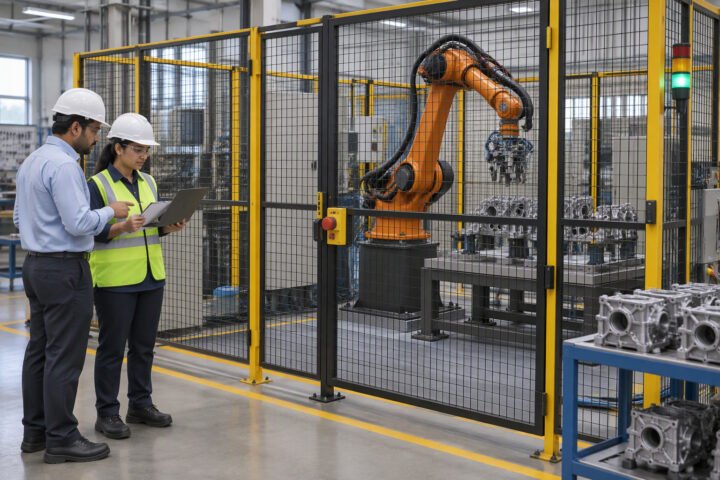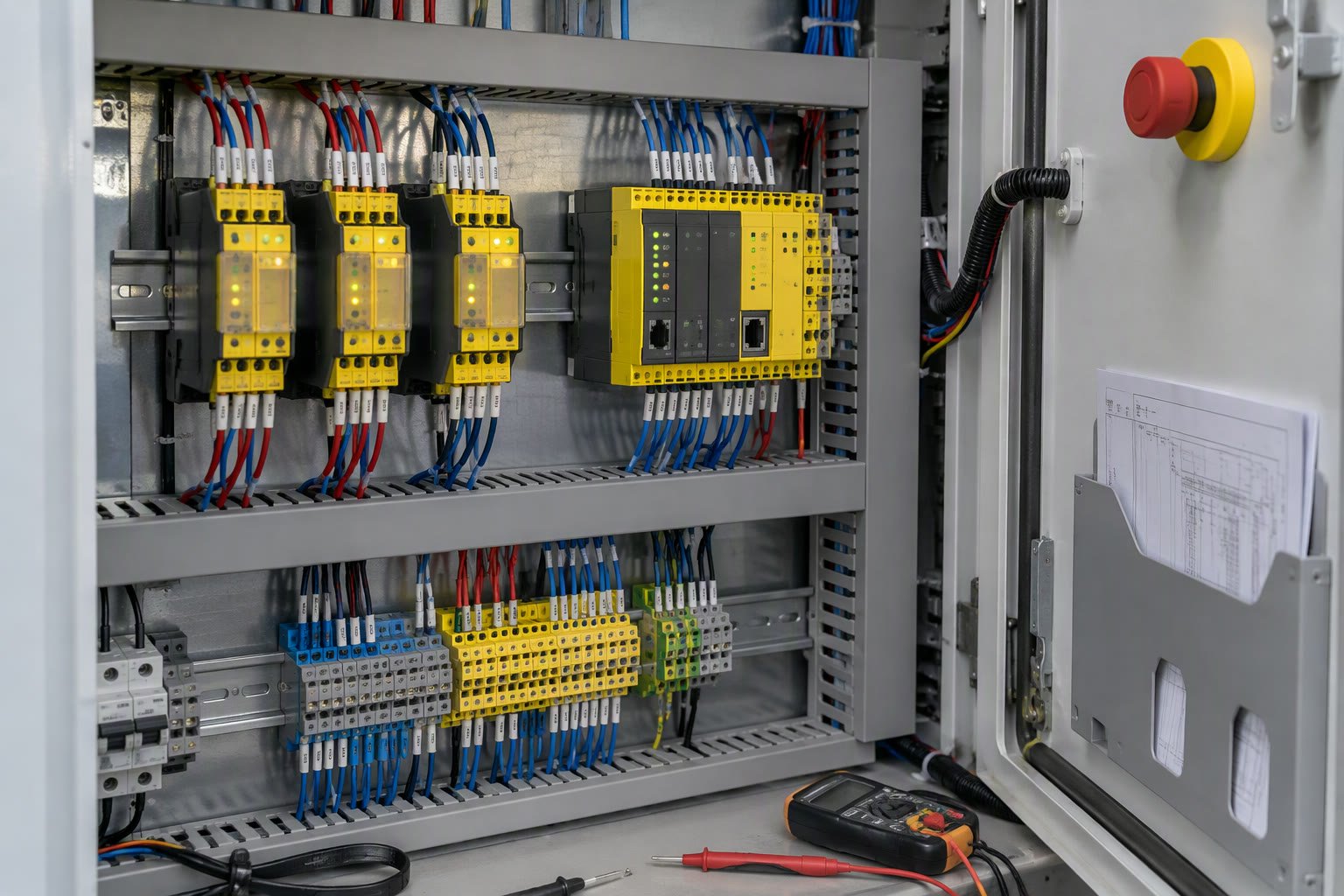
A safety relay and a safety PLC do the same job: they remove power when a guard opens. The choice is about how many devices, how much logic and how often the cell will change, not about which one sounds more modern.
Both are legitimate. Both can meet the required performance level when specified and wired correctly. This guide explains where each fits, what the cost difference buys, and the mistakes that make either one non-compliant.
What each device actually does
A safety relay takes inputs from devices such as E-stops, gate switches and light curtains, performs fixed logic, and drops its safety outputs when a channel opens. The logic is set by the model and the wiring, not by a program.
A safety PLC runs a certified program with safety functions, multiple zones, muting, diagnostics and communication. It can do everything a relay bank does, plus logic that would need a cabinet full of relays.
| Factor | Safety relay | Safety PLC |
|---|---|---|
| Best device count | 1–4 safety functions | Many, across zones |
| Logic changes | Rewire and replace | Program change |
| Diagnostics | Basic LEDs | Detailed, often networked |
| Muting and sequencing | Limited or add-on modules | Built in |
| Cost | ₹8,000–40,000 | ₹1.5–8 lakh plus software |
| Engineering effort | Low | Higher, needs trained staff |
The cost gap is real, but compare it with the cabinet, wiring and engineering time for an equivalent relay solution. A complex cell often costs more in relays, terminals and panel space than a small safety PLC.
When a safety relay is the right answer
- One robot cell with an E-stop, a gate switch and a light curtain.
- Simple AND logic: all guards closed before reset is allowed.
- A small panel with limited space and a maintenance team familiar with relays.
- A machine that will not change for years.
- A retrofit where the existing cabinet already has a relay architecture.
Relays are also easier to verify by inspection. An auditor can trace the wiring without a laptop, which has practical value in a small plant.
When a safety PLC earns its price
- Multiple zones with different stop categories and reset rules.
- Muting for conveyors or pallet transfer through a light curtain.
- Diagnostics that tell maintenance which gate opened first.
- Integration with a standard PLC or plant network for status, not safety.
- Frequent layout changes where rewiring would be constant.
Diagnostics are the underrated benefit. A relay LED tells you a channel is open. A safety PLC tells you which device, at what time, and often why, which shortens downtime and prevents bypassing.
The architecture is the same either way
Whatever the logic device, the safety function has the same shape: input device, logic, output device, monitored for faults. The performance level depends on the architecture, the component reliability and the diagnostic coverage, not on the brand of the logic block.
E-stop (dual channel)
   |
   +-- gate switch (dual channel) --+
   |                                |
   +-- light curtain OSSD pair -----+--> safety logic --> contactor pair
                                                          |
                                                          +--> drive STO
Notice the outputs. Safety logic must remove energy at the actuators, usually through redundant contactors with feedback monitoring or through a drive’s safe torque off input. A safety PLC that only signals a standard PLC is not a safety function.
Validation is not optional
ISO 13849-1 requires verification that the achieved performance level meets the required one, and validation that the safety functions work as intended. That means a documented test of every input, every output and every reset path.
For relays, validation is mostly wiring checks and functional tests. For a safety PLC, it also includes verifying the program, the configuration and the communication if used. Budget time for it; a cell cannot be handed over without it.
The safety standards overview explains how the required performance level is determined from the risk assessment.
Common mistakes
- Using a standard PLC for a safety function, even with a “safe” program.
- Wiring a gate switch as a single channel, halving the achievable performance level.
- No feedback monitoring on the contactors, so a welded contact goes unnoticed.
- Reset button inside the guarded area, where a person can press it while trapped.
- Muting configured without the correct sequence and timeout.
- No test of the stop category: is it controlled stop or immediate removal of power?
The reset location is the mistake most often missed. Reset must be outside the hazard zone with a clear view, and it must not restart the cell automatically when the guard closes.
A decision sequence
- Complete the risk assessment and list every safety function.
- Determine the required performance level for each function.
- Count the functions and zones; this is the main driver.
- Check the maintenance team’s skills and the panel space.
- Price both options with wiring, engineering and validation included.
- Choose the simpler option that meets the requirement.
If the relay option meets the performance level with fewer than about four functions, it is usually the better engineering choice. Beyond that, the wiring and diagnostics burden tips toward a safety PLC.
For wiring detail, see the safety relay wiring guide. For the guarding side, the fencing cost guide and the light curtain guide cover device selection.
The realistic outcome
A single robot cell with three guards is usually a relay job, commissioned in a day and validated in an afternoon. A line with four zones, muting and networked diagnostics is a safety PLC job, and the engineering time is measured in weeks, not hours.
Both outcomes are correct when the risk assessment drives the choice. Neither is correct when the choice is driven by a preference for new technology or a wish to save on wiring.
Can a normal PLC be used for safety functions?
Not unless it is a certified safety PLC with a safety-rated program and I/O. A standard PLC can handle status and sequencing, but it cannot provide the safety function itself.
What performance level can a safety relay achieve?
Relays are available for categories up to PL e with the right dual-channel wiring, feedback monitoring and device selection. The achieved level depends on the whole circuit, not just the relay.
Is a safety PLC harder to maintain?
It needs trained staff and software backups. In exchange it gives better diagnostics, which often reduces downtime compared with tracing a relay fault.
Do I need a safety PLC for muting?
Not always; muting modules exist for relays. For complex muting sequences with several sensors and timing rules, a safety PLC is usually clearer and easier to validate.
Who can validate the safety function?
A competent person with the risk assessment, the circuit documentation and the test procedure. For higher-risk cells, an independent assessor is worth the cost.
Laser cells add enclosure and interlock requirements, which the laser welding robot guide summarises.
Even a cobot cell may need a safety controller; the ISO/TS 15066 assessment decides what functions it must cover.
Sources and further reading
- ISO 13849-1 — safety-related parts of control systems, performance levels.
- IEC — IEC 62061 and functional safety standards.
- Pilz — safety relay and safety controller documentation.
- Siemens — safety PLC architecture and validation guides.