Painting is the robot application with the clearest health case. Operators working a spray gun in a booth breathe solvent all day, and no respirator fully solves it. It is also the application where a badly specified cell fails fastest.
This guide covers the robot and application equipment used for painting and coating, why explosion protection changes the specification, how the booth and airflow interact with the robot, and what a cell costs in India.
Why a painting robot is not a standard robot
Inside a spray booth, the atmosphere is a mixture of solvent vapour, paint mist and air. That mixture can ignite. So the robot, the cables, the motors and every junction box inside the zone must be built for a hazardous area. This is not a coating or a sealed cabinet; it is a different build of machine, with pressurised enclosures and purge systems, and it is priced accordingly.
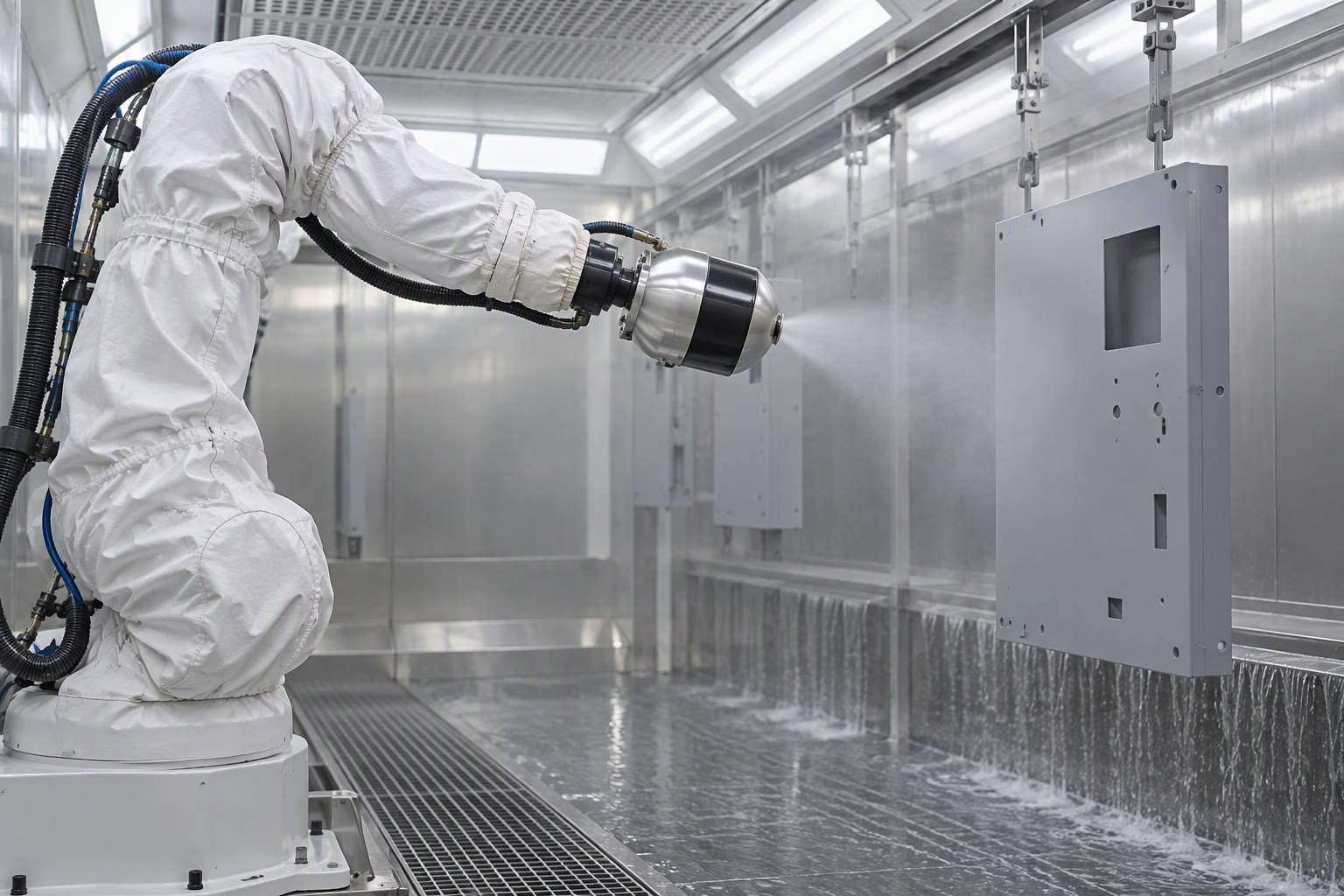
The second difference is the wrist. Paint robots use a hollow wrist so the paint line, solvent line and air lines run through the arm rather than looping outside it. That improves reliability of the hose pack and makes it easier to keep the wrist clean. It also means you cannot substitute a general-purpose robot and hope for the best.
Third, the task is a finish, not a position. Film build, overspray and pattern overlap matter more than repeatability in millimetres. A robot that repeats to 0.1 mm but lays a uneven coat is a failure.
Application equipment decides the finish
| Method | Transfer efficiency | Best fit | Notes |
|---|---|---|---|
| Conventional air spray | 25–40% | General industrial coating | Simple, cheap, high overspray |
| HVLP | 50–65% | Where solvent use is regulated | Lower pressure, slower coverage |
| Airless | 40–55% | Thick coatings, primers | High pressure, wear on tips |
| Air-assisted airless | 50–65% | Balance of finish and efficiency | Most common in Indian job shops |
| Electrostatic spray | 65–85% | Metallic parts, high volume | Needs conductive part and grounding |
| Rotary bell (ESTA) | 75–90% | High-volume flat or simple parts | Higher capital, best paint saving |
The application equipment is usually chosen before the robot, because the gun or bell determines the working distance, the speed and the path spacing. A robot programmed for a spray gun will not run a rotary bell correctly; the bell needs a consistent standoff and a specific path overlap.
Booth, airflow and the robot’s place in it
A paint booth is a controlled airflow box. Air enters through filtered ceiling plenums, moves downward past the part, and exits through a floor grating into a water curtain or dry filter. The airflow has to be fast enough to carry overspray away from the part and slow enough not to disturb the spray pattern.
The robot sits inside that airflow, which creates two design problems. Its body creates a wake that can deposit paint on the part from the wrong direction, and its own surfaces collect overspray that eventually flakes off onto work. Robots are usually mounted on a pedestal or a track so the arm stays out of the main downflow, and the arm is covered with a removable protective suit that is cleaned on a schedule.
Hazardous area classification and Indian approvals
Solvent-based paint creates a flammable atmosphere, so the booth interior is a classified hazardous zone. The zone type determines what equipment is permitted inside it. Equipment must carry the appropriate explosion protection marking for the zone, and the marking must be visible on the machine, not just in the datasheet.
In India, storage of flammable solvents and paints falls under the Petroleum and Explosives Safety Organisation, and the factory as a whole falls under the Factories Act and state factory rules. The practical implication is that a painting cell is a regulated installation. Get the classification done by someone competent to do it, keep the drawings, and expect the factory inspector to ask for them.
Water-based paints reduce but do not remove the problem: the flash point and the mist concentration still matter, and the classification must be based on the actual material you will use, not on the material the supplier assumed.
Programming, colour change and the real cycle time
Painting paths are usually generated offline from CAD, because teaching inside a booth is unpleasant and slow. The robot program defines the path, the gun trigger points, the atomisation settings and the colour. A well-built program is parameterised: the same path can run at different speeds and film builds for different colours.
Colour change is where cycle time disappears. A single-gun system with a manual colour change can lose ten to twenty minutes per change. A automatic colour changer with a solvent flush line brings that down to a minute or two, at a cost. If you run more than a handful of colours per shift, price the colour changer into the project from the start.
Paint consumption and path spacing check

Dry film thickness (DFT) target: 40 micrometre
Paint solids by volume: 50%
Transfer efficiency: 60%
Wet film thickness = DFT / solids = 40 / 0.5 = 80 micrometre

Path spacing (mm) for a given spray pattern width W and overlap o:
  spacing = W * (1 - o)

Example: 250 mm pattern, 50% overlap
  spacing = 250 * 0.5 = 125 mm

Paint per square metre of part:
  wet volume = 80 micrometre * 1 m2 = 80,000 mm3 = 0.08 litre
  applied volume = 0.08 / 0.60 = 0.133 litre per m2

At Rs 600 per litre, one square metre of coated surface
costs about Rs 80 in paint before solvent and flush losses.
Double the transfer efficiency and you halve that.
What a painting cell costs in India
| Item | Indicative price | Notes |
|---|---|---|
| Explosion-proof painting robot | ₹25–55 lakh | Hollow wrist, purge system, hazardous-area build |
| Robot on linear track | +₹8–25 lakh | Long parts, multiple booth positions |
| Spray gun package | ₹1.5–6 lakh | Gun, regulator, hoses |
| Rotary bell (ESTA) | ₹4–12 lakh | Highest transfer efficiency |
| Booth with air handling | ₹8–30 lakh | Size and filtration dependent |
| Automatic colour changer | ₹3–12 lakh | Number of colours drives cost |
| Offline programming software | ₹3–10 lakh | CAD-based path generation |
| Explosion-proof electrics and purge | ₹2–8 lakh | Never value-engineer this out |
| Turnkey single-robot cell | ₹60 lakh–1.1 crore | Booth, robot, gun, controls |
| Turnkey line with two robots | ₹1.2–1.8 crore | Primer and topcoat stations |
Checks before you sign
- Confirm the explosion protection marking is suitable for your zone, and that it is on the machine, not only on paper.
- Get the airflow figures from the booth supplier and confirm they suit the gun and the part size.
- Agree the film build and appearance specification, plus the inspection method and sampling rate.
- Confirm grounding of the part, the conveyor and the robot, especially for electrostatic application.
- Decide the colour change strategy and who supplies the flush solvent.
- Ask for the paint consumption guarantee, since paint is the largest running cost.
- Plan the maintenance routine for the protective suit, filters and the water curtain.
The surrounding cell safety requirements do not change because the robot is explosion-proof. Guarding, interlocks and the risk assessment still follow the robot safety standards.
Why are painting robots so expensive?
They are built for hazardous areas, with pressurised and purged enclosures, special motors and cabling, and a hollow wrist for paint lines. That build roughly doubles or triples the price of a comparable general-purpose robot.
Can I use a normal industrial robot inside a spray booth?
No. A standard robot is not rated for a flammable atmosphere. Use a robot with the correct explosion protection marking for the zone classification of your booth.
What is the difference between a spray gun and a rotary bell for robots?
A spray gun atomises paint with air pressure and gives 25–65% transfer efficiency depending on type. A rotary bell atomises with a spinning cup and reaches 75–90%, saving paint but costing more and needing a consistent standoff.
How much does a robotic painting cell cost in India?
Indicative ranges: explosion-proof robot ₹25–55 lakh, booth with air handling ₹8–30 lakh, automatic colour changer ₹3–12 lakh, and a turnkey single-robot cell ₹60 lakh to ₹1.1 crore. A two-robot line runs ₹1.2–1.8 crore.
Does water-based paint remove the explosion risk?
No. Water-based paints still produce a mist that can ignite, and the flash point and mist concentration must be assessed. The zone classification has to be based on the actual material you use.
Sources and further reading
- ISO 10218-1 — safety requirements for industrial robots.
- IEC 60079 series — equipment and classification for explosive atmospheres.
- NFPA 33 — spray application using flammable or combustible materials.
- A3 Association for Advancing Automation — robotic finishing and coating resources.