Deburring and grinding are the jobs everyone wants to automate and the jobs most likely to disappoint. The reason is rarely the robot. It is that nobody defined what a finished edge looks like.
This guide explains what makes robotic deburring different from pick and place, the force-control options available, how to program the path when the burr is not in a CAD model, and what the hardware costs in India.
Why deburring is harder than it looks
In machining and welding, the robot follows a path defined by the part geometry. In deburring, the goal is to remove material until the edge is acceptable, and the starting condition varies. A laser-cut edge, a milled edge and a hand-ground edge all need different pressure, different tool speed and sometimes a different tool.
Burr size also varies along the same part. The exit side of a milling cut has a different burr from the entry side. Castings have flash in some places and none in others. A robot running a rigid path at fixed feed will over-grind where the burr is small and under-grind where it is large. The operator then spends the shift touching up the parts the robot was supposed to finish.
So the first decision is not which robot. It is whether the process needs force control, or whether a well-defined chamfer on a consistent part is enough.
Force control options compared
| Method | How it works | Best fit | Limitation |
|---|---|---|---|
| Rigid path, fixed feed | Robot follows a taught or CAM path | Consistent parts, defined chamfer | No tolerance for burr variation |
| Passive compliance holder | Spring or pneumatic holder absorbs small deviation | Light deburring, low cost retrofit | Fixed stiffness, limited travel |
| Force-torque sensor on the wrist | Closed-loop force control in the robot | Variable burrs, mixed parts | Cost, calibration, slower moves |
| Active compliant spindle | Spindle body holds constant contact force | Grinding and heavy deburring | Bulk, needs air or hydraulic supply |
| Vision-guided path | Camera locates the edge before grinding | Castings and weld seams | Programming effort, lighting dependence |
The spindle decides the finish
The robot provides position and feed. The spindle provides surface speed, and surface speed is what determines whether the edge is clean or smeared. A 50 mm grinding wheel needs roughly 30 to 35 m/s at the contact point for steel, which means the spindle has to turn at the right rpm for that diameter. A small burr tool needs far higher rpm.
Two practical rules apply. First, buy a spindle with constant-speed control rather than a fixed-speed motor, because a spindle that sags under load changes the cut. Second, run a tool that is matched to the material: a coarse wheel on aluminium loads up and burns the surface, while a fine wheel on steel glazes and stops cutting.
Surface speed and feed check

Surface speed (m/s) = pi * D * rpm / 60,000   with D in mm

Example: 100 mm grinding wheel on mild steel
  target 32 m/s
  rpm = 32 * 60,000 / (3.1416 * 100) = 6,111 rpm

Feed per tooth (mm) = feed rate (mm/min) / (rpm * teeth)

Example: 6,111 rpm, 4 teeth, target 0.05 mm per tooth
  feed = 0.05 * 6,111 * 4 = 1,222 mm/min

Material removal rate depends on depth of cut, which is
the contact force divided by the specific grinding energy.
This is why a force-controlled spindle holds a steadier
finish than a position-controlled robot: the removal rate
stays constant even when the burr changes.
Programming when the burr is not in the CAD model
CAD-based path generation works when the part is consistent and the chamfer is specified. You take the nominal geometry, offset the tool along the edge, and generate the path offline. That is the cheapest and fastest route, and it is what most suppliers will quote.
When parts vary, the path has to be found on the actual workpiece. Three approaches are used in India today. Teach-and-scan, where an operator guides the robot along the edge once and the path is recorded, is quick for small batches. Laser or camera scanning builds a point cloud of the edge and generates a path automatically, which suits castings. And force control, where the robot simply presses into the edge and slides along it until the force falls, needs no accurate path at all but depends on a clean approach direction.
Whichever route you take, validate it on fifty real parts from different batches. A path that works on the sample the supplier was given and fails on production is the standard failure mode of robotic deburring projects.
Part presentation matters more than the robot
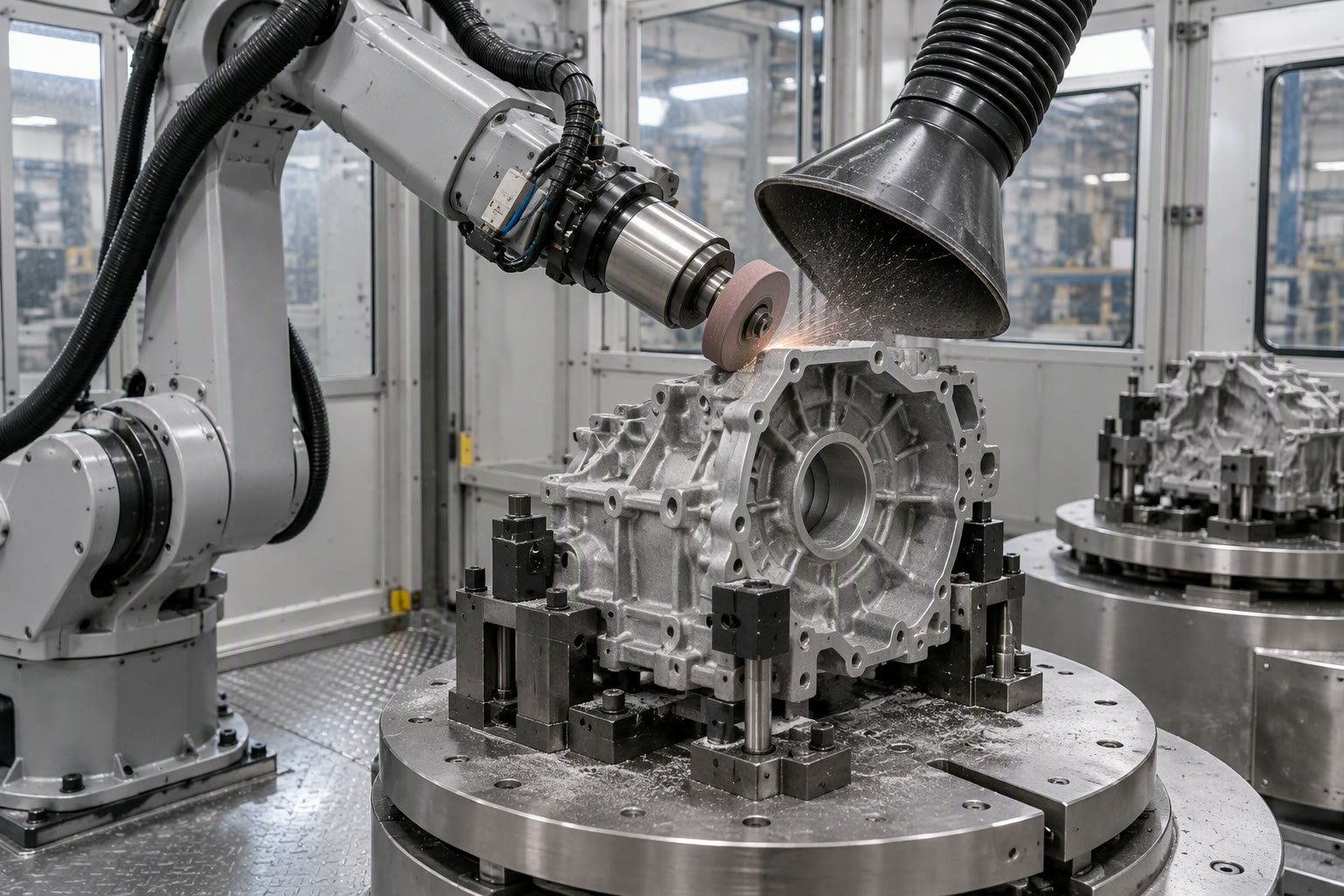
If the part is loaded at a different angle each time, the robot cannot repeat a finish. The fixture must locate on machined features, not on a rough casting surface. For thin parts, clamp near the edge being ground or the part will ring and chatter, which produces a worse finish than hand work.
A two-station table lets the operator load while the robot grinds, and it is usually the single biggest cycle-time win in a deburring cell. It also keeps the operator out of the dust zone.
Dust, sparks and safety
- Extraction at the source. Grinding dust is a health hazard and it settles on rails and into the robot’s joints. An extraction hood at the contact point is cheaper than repairing a robot.
- IP rating. Grinding dust is abrasive. Use a robot and spindle rated for the environment, and check the rating in the IP rating guide.
- Wheel burst containment. A bonded wheel can fail. Enclose the grinding zone so fragments cannot reach an operator.
- Noise. Grinding cells routinely exceed 85 dB. Noise becomes a safety control, not a comfort item.
- Fire risk. Metal dust from aluminium and titanium is combustible. Extraction ducting and filters must be specified for the material.
The cell still needs the full risk assessment and guarding required by the safety standards guide, and the fencing cost is covered in the safety fencing cost guide.
What robotic deburring costs in India
| Item | Indicative price | Notes |
|---|---|---|
| 6–10 kg payload robot | ₹12–22 lakh | Reach and stiffness matter more than payload |
| 20 kg payload robot | ₹20–35 lakh | Heavier spindles and larger parts |
| Grinding spindle, 1–4 kW | ₹1.5–8 lakh | Constant-speed control recommended |
| Passive compliance holder | ₹80,000–4 lakh | Cheapest way to tolerate variation |
| Force-torque sensor | ₹4–12 lakh | Plus controller integration |
| Active compliant spindle | ₹6–18 lakh | Heavy grinding, castings |
| Scan-based path software | ₹8–25 lakh | Castings and variable parts |
| Dust extraction and hood | ₹1.5–6 lakh | Material-dependent |
| Turnkey cell, one station | ₹35–60 lakh | Robot, spindle, fixture, guarding |
| Turnkey cell, two stations | ₹55–90 lakh | Best cycle time per rupee |
Before you approve the project
- Agree a written edge specification: chamfer size, surface finish, and how many parts will be inspected.
- Supply the supplier with parts from at least three production batches, including the worst burr.
- Decide the reject rule in advance, including who pays for parts damaged during trials.
- Confirm the fixture locates on a machined feature, not a rough surface.
- Check the extraction and fire strategy for your specific material.
- Plan operator training for tool change and path touch-up, because both will be needed weekly.
Is robotic deburring worth it for small batches?
Usually not below roughly 200–300 parts per month, because the programming and fixture effort is amortised over too few parts. For small batches, a compliant tool holder on a manual spindle or a cheap two-axis machine is often better value.
Why does a robot deburring cell produce inconsistent edges?
The usual cause is a rigid path with no force control on parts whose burr varies. Adding a compliance holder or a force-torque sensor keeps the contact force constant, which keeps the removal rate constant.
What robot payload do I need for deburring?
Payload is less important than stiffness and reach. A 6–10 kg robot handles most light deburring with a small spindle. Heavier grinding spindles, larger tools and longer reaches push you to 20 kg or more.
How much does a robotic deburring cell cost in India?
Indicative ranges: a one-station turnkey cell ₹35–60 lakh, a two-station cell ₹55–90 lakh, a force-torque sensor ₹4–12 lakh, and scan-based path software ₹8–25 lakh. The robot itself is typically 30–40% of the total.
How do I program a robot when the burr is not in the CAD model?
Use teach-and-scan for small batches, laser or camera scanning for castings, or force control where the robot presses into the edge and follows it. Validate the method on fifty real parts from different batches before accepting the cell.
Sources and further reading
- ISO 10218-1 — safety requirements for industrial robots.
- ISO 9283 — industrial robot performance criteria and test methods.
- A3 Association for Advancing Automation — robotic material removal and force control resources.
- US OSHA — combustible dust and abrasive wheel safety guidance.