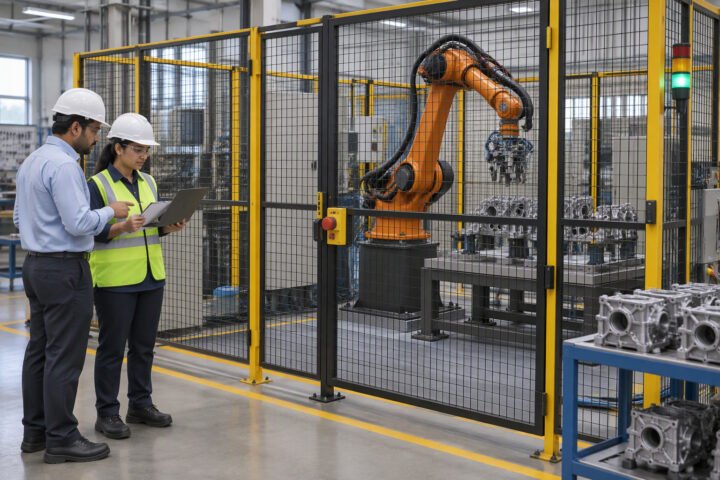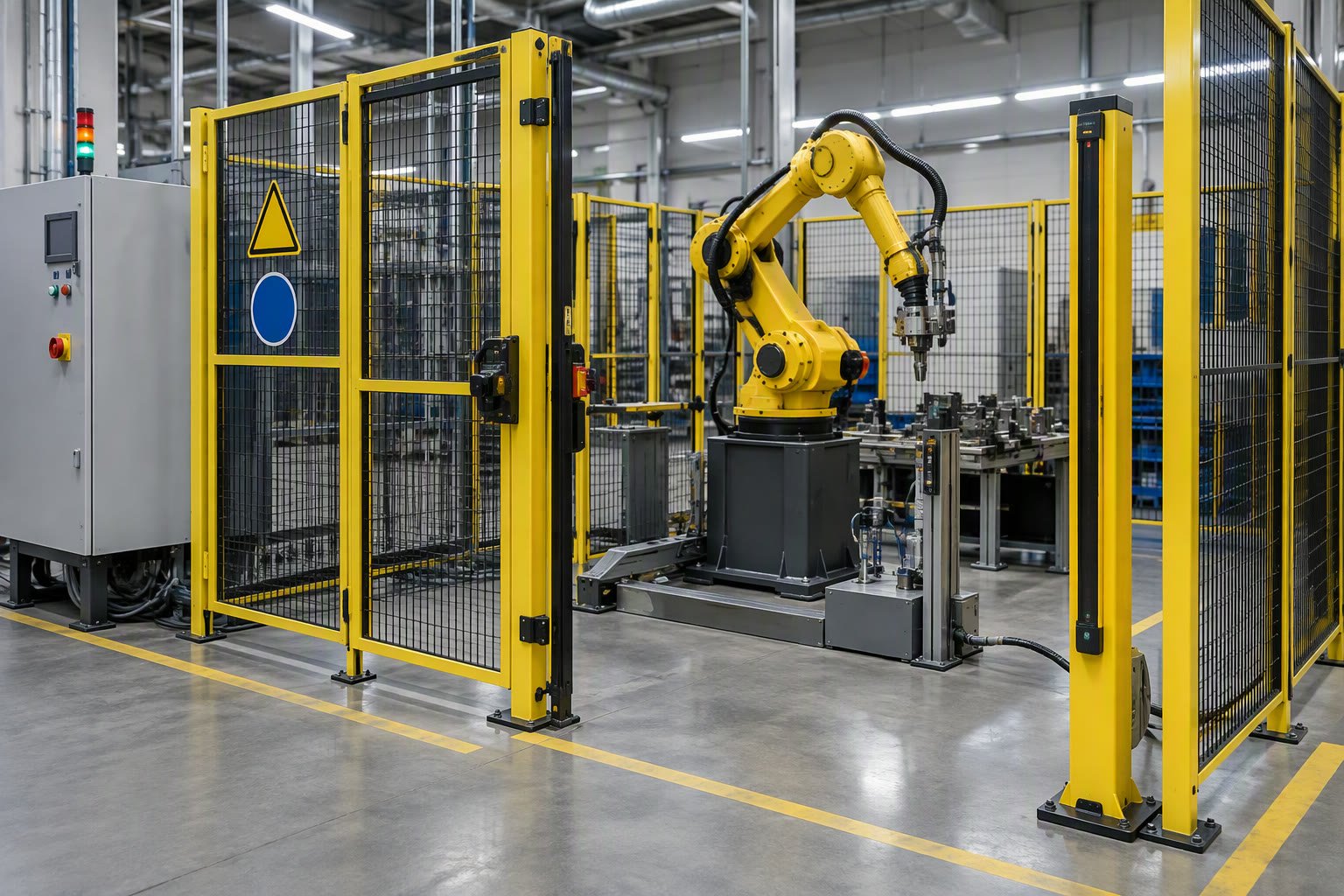
Robot safety is not a fence around a machine; it is a documented argument that the remaining risk is acceptable. That argument has a structure, a set of standards and a validation record. In India it also has to satisfy the Factories Act and the state factory rules. Missing any of those pieces is what turns an incident into a liability.
The standards that apply
| Standard | Covers | Who needs it |
|---|---|---|
| ISO 12100 | Risk assessment and risk reduction method | Every machine, including a robot cell |
| ISO 10218-1 | Safety requirements for the robot itself | Robot manufacturers and integrators |
| ISO 10218-2 | Robot systems and integration | Anyone building or modifying a cell |
| ISO/TS 15066 | Collaborative robot safety, power and force limits | Cobot applications without fencing |
| ISO 13849-1 | Safety-related control systems, performance levels | Safety circuits: e-stops, interlocks, light curtains |
| IEC 62061 | Functional safety of machinery, SIL | Alternative to ISO 13849 for complex systems |
| IEC 61496 | Electro-sensitive protective equipment | Light curtains and safety laser scanners |
| ISO 13850 | Emergency stop function | Every cell |
| ISO 14119 | Interlocking devices for guards | Fenced cells with access doors |
| ISO 14120 | Fixed and movable guards | Fencing and physical barriers |
| ISO 13857 | Safety distances to prevent reaching danger zones | Guard openings and fence placement |
ISO 10218-1 and -2 were revised in 2025; the 2011 editions are still widely referenced in older documentation and in tenders written before the revision. ISO/TS 15066 remains the reference for collaborative applications, and its body-model force limits are what a cobot risk assessment is measured against.
The risk assessment, in order
ISO 12100 gives a repeatable sequence. Skipping to “add a fence” before step three is the most common failure:
- Define the limits: intended use, space, time, duty cycle, payload, and who is allowed near the cell.
- Identify hazards: crushing, shearing, entanglement, impact, ejection, electrical, thermal, noise, and hazards from the process (welding fume, laser, sharp parts).
- Estimate and evaluate risk: severity, probability of occurrence and possibility of avoidance. Decide whether each risk is acceptable.
- Reduce risk, in this order: eliminate by design, add safeguarding, then warn with signs and training. Personal protective equipment is the last resort, not the strategy.
- Validate: prove the safety functions work, measure stop times and verify distances. Record the results.
- Review: repeat whenever the tool, fixture, layout, program or throughput changes.
Safety devices and how they fail
| Device | Function | Common failure |
|---|---|---|
| Perimeter fence | Prevents reaching the robot | Too short, climbable, or gaps wider than ISO 13857 allows |
| Interlocked gate | Stops motion when opened | Interlock defeated with a spare key or taped in place |
| Light curtain | Detects a person entering | Mounted too far from the danger zone, or muted incorrectly |
| Safety laser scanner | Detects approach in a field | Field configured to cover the aisle but not the robot’s actual reach |
| E-stop | Stops the cell in an emergency | Wired to a normal input, so a software fault disables it |
| Safety relay | Monitors the safety circuit | Bypassed during commissioning and never restored |
| Two-hand control | Keeps both hands out of the danger zone | Buttons placed so one person can press both with one hand |
Every one of these failure modes has a common root: the safety function was treated as an accessory instead of a control function with a required performance level. A gate switch wired to a PLC input is not a safety interlock, no matter how consistently it works in testing.
Stop time and safety distance
A light curtain must be far enough from the hazard that the machine stops before a person reaches it. The principle is:
minimum distance S = K × T + C

K = approach speed (typically 1600 mm/s for a person walking)
T = total stopping time, including the safety circuit and the robot
C = additional distance depending on detection capability and resolution
If a cell stops in 0.6 seconds and the approach speed is 1,600 mm/s, the person travels 960 mm before the robot stops. Any guard or curtain placed closer than that is decorative. This is why stop-time measurement is part of commissioning, and why adding a heavy end effector can invalidate an existing safety distance.
Cobots are not automatically safe
A collaborative robot is designed to limit force and power, but the application decides whether that is enough. A cobot holding a knife, a hot part or a sharp sheet is a hazard regardless of its force limits. ISO/TS 15066 requires an application-specific assessment that considers the tool, the workpiece, the speed, the approach direction and the body region that could be contacted.
In practice, most cobot cells still need some safeguarding: a reduced-speed zone, a scanner that slows the robot when a person approaches, or a physical barrier around the sharp end effector. The marketing image of a fenceless cobot working shoulder to shoulder is a valid use case, not a default.
The Indian legal layer
Factories in India fall under the Factories Act, 1948 and the corresponding state factory rules. The Act requires fencing of machinery, safe working conditions and measures against foreseeable injury, and state inspectors can require changes or stop work. Electrical installations are commonly assessed against IS 732 for wiring and IS 3043 for earthing. For a robot cell, the practical result is that the international standards become the technical evidence used to demonstrate compliance with the general duties in Indian law.
Keep the documentation in one place: risk assessment, layout drawing, safety circuit schematic with performance-level calculation, stop-time measurements, validation record, training records and the maintenance log. A cell without those documents is hard to defend after an incident, even if it was built well.
A pre-commissioning checklist
- Risk assessment signed off by someone competent, not just the integrator who built the cell.
- Guard height and openings checked against ISO 13857 for the actual reach.
- Interlocks wired through a safety relay or safety PLC with the required performance level.
- E-stops at every operator position, with the reset inside the guarded area.
- Stop-time measured under the heaviest payload and the fastest program.
- Light curtains and scanners tested with a test rod across the whole detection field.
- Restart after a stop requires a deliberate action, not just closing the gate.
- Operators trained on normal operation, emergency stop and lockout.
- Maintenance procedure includes lockout-tagout and a check that the robot is de-energised.
- Change control: any new tool, program or fixture triggers a review.
For the cell design side, see robotics in manufacturing. For the controls and wiring background, the power guide and battery guide cover low-voltage practice, though industrial panels follow different rules.
Common questions
Which standard covers industrial robot safety?
ISO 10218-1 covers the robot and ISO 10218-2 covers the robot system and integration. ISO 12100 provides the risk assessment method, and ISO 13849-1 or IEC 62061 covers the safety control system.
Are cobots exempt from guarding?
No. A cobot may operate without a fence only after an application-specific risk assessment under ISO/TS 15066 shows that force, speed and tool hazards are acceptable. Sharp or hot tooling usually still needs safeguarding.
How often should a robot cell risk assessment be updated?
Whenever the tool, fixture, layout, program or throughput changes, and periodically as part of the safety management system. An annual review is a common minimum.
What is a performance level in machine safety?
A rating (PL a to PL e) for how reliably a safety function performs, calculated under ISO 13849-1 from architecture, component reliability and diagnostic coverage. An e-stop on a robot cell is typically PL d or higher.
Is ISO 10218 law in India?
Not directly. Indian factories are regulated by the Factories Act and state rules; ISO standards are used as technical evidence of a safe design and are often required by customers, insurers and auditors.
Related: robotics in manufacturing, robotics skills roadmap, robotics jobs for freshers, what is robotics.
Budget for safety inside the project: industrial robot cost in India shows the share it takes.
See also: welding cobot safety and fixturing in practice.
A SCARA still needs guarding and a risk assessment, and India robot safety standards explain what applies.
Even a fast delta needs access control and a risk assessment, as robot safety standards in India set out.
Cobots still need a risk assessment; the cobot buying guide covers how ISO 10218 and ISO/TS 15066 apply in practice.
A tending cell needs guarding and interlocked doors just like any other robot cell; see machine tending robots in India.
Guarding and safety circuits only stay valid if they are inspected; use the robot maintenance checklist for the periodic checks.
Bipeds do not fit neatly into industrial robot standards; see humanoid robots and safety.
Safety obligations differ by robot type; start with cobot vs industrial robot.
Safety is phase three of the robot integration checklist, and the risk assessment must come before layout freeze.
Manual operation at the pendant has its own safety rules; see safe pendant practice.
Safety functions belong outside normal software; see why ladder is not a safety circuit.
Light curtains are the most common safeguard on a robot cell, and the light curtain guide covers device types and the ISO 13855 distance.
The layout numbers that follow from those standards are in the robot cell layout guide.
Scanner-specific distance and zone rules are in the safety laser scanner guide.
Conveyor guarding and interlocks fall under the same standards, which the conveyor integration guide summarises.
Robot selection and safety design run together, starting with these selection criteria.
The standard sets the distance and the fence meets it, so read the fencing cost guide alongside the standards overview.
Whichever device you choose, the standard asks for validation of the achieved performance level, which the device selection guide covers step by step.
In GMP areas the safety file is audited alongside the machine, and the pharma robotics guide covers what that adds.
ISO/TS 15066 sits under the ISO 10218 family; our guide to collaborative safety explains where the two meet.
A new controller does not make an old cell compliant; the retrofit guide explains the safety upgrade most projects miss.
Sources and further reading
- ISO 10218-1 — safety requirements for industrial robots.
- ISO/TS 15066 — collaborative robot safety and force limits.
- UK HSE robotics guidance — practical risk assessment for robot cells.
- OSHA robotics — safeguarding and training guidance.
Last reviewed: October 2026. This is engineering guidance, not legal advice; confirm obligations with a competent safety assessor and the applicable state factory rules. Not bench-tested by this site.