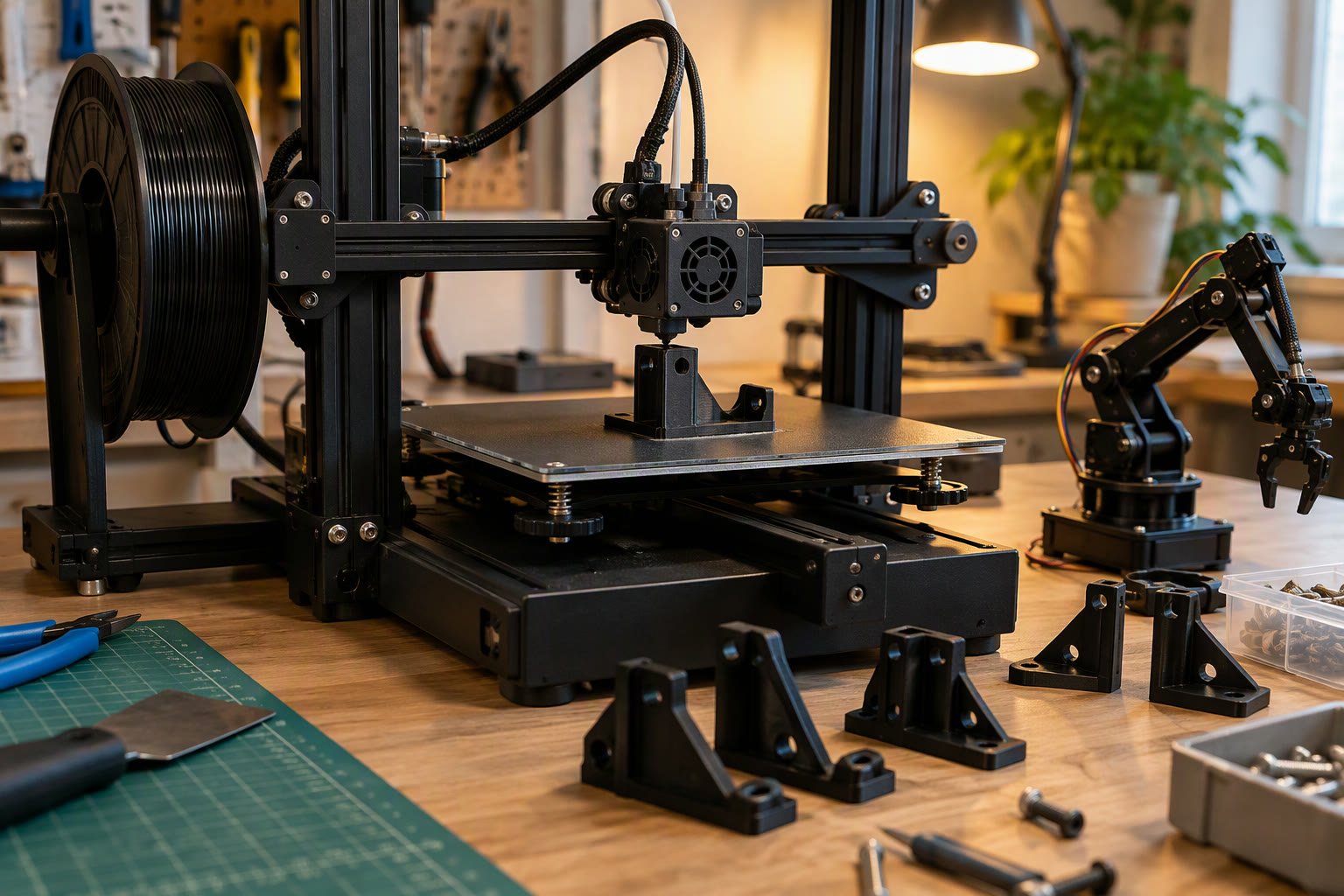
A 3D printer pays for itself in robotics faster than in almost any other hobby. Brackets, sensor mounts, wheel hubs, gripper fingers, jigs and enclosures are exactly the parts that are annoying to source and easy to print. The question is not whether to buy one, but which type and how much to spend before you know what you are doing.
Prices below are indicative Indian retail ranges for 2026 and move with imports, discounts and model refreshes. Check current listings and warranty terms before ordering.
What robotics work actually needs
- Brackets and mounts for sensors, cameras, batteries and motor drivers.
- Chassis plates and standoffs for small rovers, where a printed frame is lighter and cheaper than aluminium.
- Gripper fingers and soft jaws that are quick to iterate.
- Jigs and fixtures for drilling, soldering and assembly.
- Enclosures for electronics that need protection from dust and fingers.
- Prototypes before committing to laser-cut acrylic or machined aluminium.
Most of these parts are small, functional and not visually critical. That changes the buying decision: dimensional accuracy and reliability matter more than maximum print speed or a colour touchscreen.
The three printer types worth considering
| Type | How it works | Strength | Indicative price |
|---|---|---|---|
| Bedslinger (moving bed) | Bed moves in Y, head in X and Z | Cheap, huge community, easy to repair | ₹12,000–30,000 |
| CoreXY or enclosed | Frame-mounted gantry, often enclosed | Faster, better for ABS and repeated parts | ₹30,000–90,000 |
| Resin (SLA/MSLA) | UV light cures liquid resin | Fine detail, smooth surfaces | ₹15,000–45,000 plus resin |
For robotics, a bedslinger in the ₹18,000–28,000 range is the sensible first machine. Resin printers produce beautiful small parts but the parts are brittle, the resin is messy and the working area needs ventilation. They are a specialist tool, not a first purchase.
Specifications that matter
- Build volume. At least 220 × 220 × 250 mm. Smaller machines will print most robot parts, but a chassis plate or a large bracket will not fit.
- Hotend temperature. 260 °C or more opens PETG and some nylon; 300 °C is needed for many engineering filaments.
- Heated bed. Essential for PETG and ABS. A bed that reaches 100 °C is more useful than one that stops at 60 °C.
- Auto bed levelling. A probe removes the single most common cause of failed first layers.
- Direct drive extruder. Better control with flexible filament and shorter retraction, useful for TPU grippers.
- Enclosure or the ability to add one. Needed for ABS, ASA and large parts that warp.
- Parts availability. Nozzles, hotends, belts and beds should be buyable in India within a week.
- Firmware and slicer support. Open, well-documented firmware is easier to fix than a locked appliance.
Materials for robot parts
| Material | Best for | Weakness | Indicative price |
|---|---|---|---|
| PLA | Prototypes, jigs, indoor brackets | Softens in a hot car, brittle under impact | ₹700–1,200/kg |
| PETG | Functional brackets, enclosures, outdoor parts | Stringing, weaker layer bonding if printed fast | ₹900–1,600/kg |
| ABS / ASA | Heat resistance, outdoor UV exposure | Warps, smells, needs enclosure | ₹1,100–2,000/kg |
| TPU | Gripper pads, bumpers, flexible mounts | Slow to print, needs direct drive | ₹1,500–2,800/kg |
| PA or PA-CF | High-strength structural parts | Moisture sensitive, abrasive, expensive | ₹2,500–6,000/kg |
Start with PLA for fit checks and PETG for anything that carries load or lives outdoors. Buy one spool at a time until you know what your projects need; filament absorbs moisture and degrades on a shelf.
Running costs
part cost ≈ (part mass in kg × filament price per kg)
          + (print hours × printer power in kW × electricity rate)

Example: 120 g PETG part at ₹1,200/kg
       = ₹144 material
       + 4 h × 0.15 kW × ₹8/unit
       = ₹4.80 electricity
       ≈ ₹149 per part
Material dominates. Nozzles, build plates and occasional repairs add a few thousand rupees a year. Compared with ordering custom brackets or waiting for a laser-cutting vendor, the economics are usually obvious after a handful of iterations.
Kit or assembled
Kits cost less and teach you how the machine works, which is genuinely useful when a robot needs a part at 11 p.m. before a competition. Assembled machines work out of the box and are the better choice if your time is worth more than the difference. Either way, budget a weekend for calibration and a few failed prints before you trust dimensional accuracy.
Buying and support in India
Buy from a seller who stocks spare hotends, nozzles, belts and beds domestically, and who will honour a warranty without a month of email. Ask whether the machine ships with an Indian power plug and a voltage-compatible supply, and confirm the slicer profile exists for the exact model. For robotics parts, a slightly slower printer with local spares beats a fast printer that is unusable for three weeks after a nozzle jam.
A realistic ₹25,000 setup
- Bedslinger printer with auto levelling: ₹18,000–22,000
- One spool of PLA and one of PETG: ₹2,000
- Spare nozzles and a filament dryer or sealed storage: ₹1,500
- Digital calipers: ₹800
- Budget for one roll of good double-sided tape and IPA for the bed: ₹300
That covers sensor mounts, small chassis and gripper prototypes. Add an enclosure later if you move to ABS or ASA.
When a print service is better
If you need one bracket a month, a local print service or an online service bureau is cheaper than owning a machine. If you need five iterations in a week, ownership wins. The break-even usually arrives at the second or third redesign of the same part.
For sourcing printed and machined parts, see where to 3D print robot parts in India and where to buy robotics parts.
Some links below are affiliate links. If you buy through them, we may earn a commission at no extra cost to you. Prices are in Indian rupees and change without notice.
Design rules for printed robot parts
A printer reproduces a good model and a bad one equally well. These rules prevent most failed robot parts:
- Design for the layer direction. A bracket printed flat delaminates where it bends; rotate the model so layers run along the load path.
- Use at least three perimeters. Wall count matters more than infill percentage for strength. 40–50% infill with three walls is stronger than 100% infill with one wall.
- Add fillets at corners. Sharp internal corners concentrate stress and crack first.
- Leave clearance for fit. A 0.2 mm gap per side is a starting point for sliding parts; print a test coupon before committing to a full assembly.
- Design screw bosses with enough meat. Self-tapping screws in thin printed walls strip easily; use heat-set inserts for anything that will be opened more than twice.
- Account for shrinkage. Holes print slightly small. Drill or ream critical bores rather than designing them exactly.
- Keep motor mounts rigid. A flexing mount turns into vibration, missed steps and noisy operation.
Print a small test piece with a hole, a slot and a boss before printing a full chassis. Ten minutes of calibration saves a failed six-hour print and a redesign.
Frequently asked questions
What 3D printer should a robotics beginner buy in India?
A bedslinger with a heated bed, auto levelling and at least 220 × 220 × 250 mm build volume, in the ₹18,000–28,000 range. Prioritise local spare-part availability over extra features.
Is PLA strong enough for robot parts?
For prototypes, mounts and light-duty brackets, yes. For parts that carry load, sit in a hot car or face impact, use PETG, ASA or a filled nylon instead.
Do I need an enclosure?
Only if you print ABS or ASA, or large parts that tend to warp. PLA and PETG print fine in a normal room without one.
How much does a 3D printed robot part cost?
Material usually dominates. A 100–150 g part in PETG typically costs ₹120–220 including a small amount of electricity, before any machine depreciation.
Can I print gears and bearings?
You can print gears for low-load prototypes, but printed bearings wear quickly. Buy metal bearings and print only the housing and gear pairs that are easy to replace.
Related: 3D printing services for robot parts, robot chassis buying guide, how to make a robot at home, gripper design basics.
Most printers ship with one of these two drivers, and the TMC2209 vs A4988 comparison explains why the quiet one costs more.
Sources and further reading
- Prusa Knowledge Base: materials — practical properties and print settings for common filaments.
- All3DP printer buying guide — printer classes and specification explanations.
- RepRap project — open-source 3D printer designs and firmware ecosystem.