A robot chassis is not a box that holds parts — it decides your wheel size, your ground clearance, your motor mounts and how much your robot flexes under load. Most first builds fail at the frame before the code ever runs. Here is how to choose one in India without overpaying. A robot chassis India hobbyists buy should be judged by its wheels, ground clearance and motor mounts.
Start from the wheels, not the plate
The wheel diameter sets the trade-off between speed and torque. A geared DC motor has a fixed output speed and torque; the wheel converts that into linear motion. Bigger wheels make the robot faster and weaker; smaller wheels make it slower and stronger.
Speed is easy to estimate: circumference is π × diameter, so a 65 mm wheel travels about 204 mm per revolution. A motor turning 200 rpm at the wheel gives 200 × 0.204 = 40.8 m per minute, or about 0.68 m/s. Halve the wheel to 32 mm and the same motor gives half the speed and roughly twice the push.
| Wheel diameter | Distance per revolution | Best for |
|---|---|---|
| 32 mm | about 100 mm | Small line followers, tight spaces, maximum push |
| 43 mm | about 135 mm | Table-top robots, light obstacle avoiders |
| 65 mm | about 204 mm | The default for TT-motor 2WD and 4WD kits |
| 80 mm | about 251 mm | Outdoor or rough-floor robots that need clearance |
| 100 mm | about 314 mm | Fast flat-floor robots; check motor torque first |
Match the wheel to the surface as well as the speed. Hard plastic wheels slip on smooth tile and wear on concrete; rubber tyres grip better but add rolling resistance. A caster or a third omni wheel carries the rear weight without dragging.
Materials: what each one is actually good for
| Material | Stiffness | Weight | Reality |
|---|---|---|---|
| Acrylic | Low | Light | Cheap and clean-looking, but cracks at screw holes and flexes under a heavy battery |
| ABS | Low–medium | Light | Tougher than acrylic, scratches rather than shatters |
| Aluminium | High | Medium | The right choice for arms, sumo and anything that carries a load |
| 3D-printed PLA | Medium | Light | Great for brackets and sensor mounts; weak in heat and under sustained load |
| 3D-printed PETG | Medium | Light | Better impact resistance and heat tolerance than PLA |
| Carbon fibre | Very high | Very light | Excellent and expensive; overkill for a first robot |
For a first line follower or obstacle avoider, 3 mm acrylic is fine. For a 4WD robot carrying a 3S battery and an arm, use aluminium or a thick 3D-printed frame with metal standoffs. Thin acrylic flex is the usual reason a robot drives straight on the bench and curves on the floor. Material choice is the second thing to judge when comparing a robot chassis India sellers offer.
Drive layouts and what they cost you
- 2WD plus caster: the cheapest and simplest. Turns easily, but traction is limited and the caster can jam on debris.
- 4WD skid steer: more traction and no caster, but turning scrubs the tyres and needs more current. It is the standard for ₹1,000–₹2,500 kits.
- Mecanum: strafes in any direction, needs four motors, four wheels and precise speed control. Expensive and sensitive to floor flatness.
- Tracked: good on rough ground and steps, poor efficiency on smooth floors and harder to turn precisely.
For a competition sumo robot, 4WD with high-grip tyres and a low centre of gravity wins. For a line follower, 2WD with a caster and the sensor bar close to the wheels is easier to tune. The three builds under ₹2,000 show the trade-offs in real bills of materials.
Motor mounts and the hidden cost
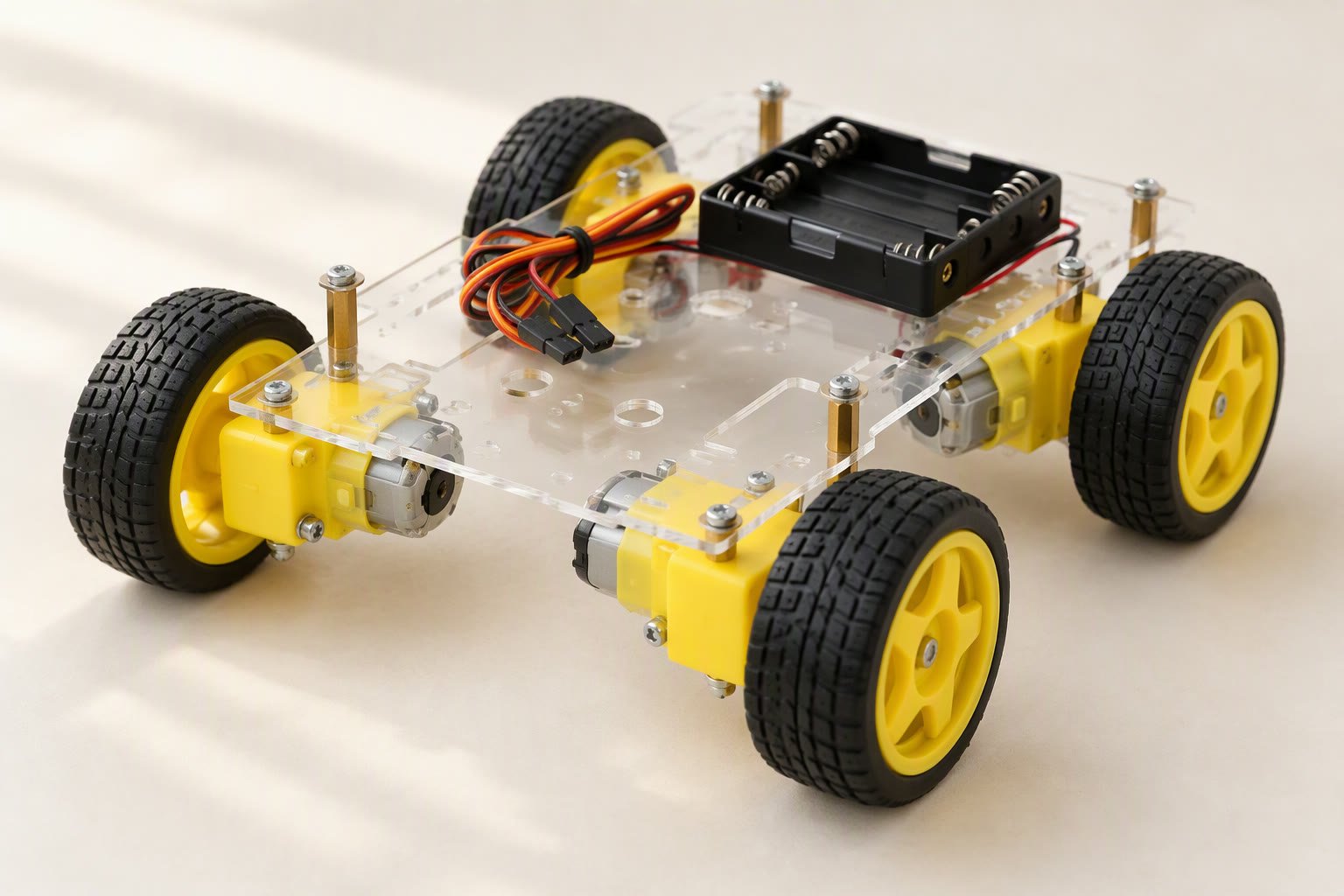
A chassis kit is only as good as its motor clamps. The common yellow TT gear motor mounts with two screws and a plastic bracket; it is cheap, noisy and has a small output shaft that wobbles under load. N20 gear motors are smaller and need a different bracket. Twelve-volt encoder motors with a 37 mm gearbox use a metal bracket and a 6 mm shaft, and they are the first upgrade that makes a robot feel solid.
Check three dimensions before ordering: the motor body diameter, the shaft diameter and the mounting hole spacing. A ₹400 chassis with the wrong clamps costs another ₹300 in brackets and a week of drilling. The parts sourcing guide lists sellers by category.
Robot chassis India price bands
| Kit | Typical price | What you get |
|---|---|---|
| 2WD acrylic with TT motors | ₹250–₹500 | Two plates, two motors, two wheels, battery holder, screws |
| 4WD acrylic with TT motors | ₹450–₹800 | Four motors and wheels, more current draw, no driver |
| Aluminium 4WD | ₹1,200–₹2,500 | Rigid frame, metal clamps, 12 V motors on better kits |
| Mecanum set | ₹2,500–₹5,000 | Four rollers, four motors, a controller that can mix four channels |
| Custom 3D-printed | ₹500–₹2,000 plus printing | Fits your exact battery, board and sensor layout |
Prices move with seller stock and batch. A kit that includes a motor driver is usually not cheaper — it includes a weak L298N-class board you may replace. Buy the frame and motors, then choose the TB6612FNG or L298N for your current.
A five-point check before you buy
- Wheel clearance: at least 10 mm under the lowest plate for indoor floors, more for outdoor use.
- Battery space: measure the pack, not the cells. A 3S 18650 holder is longer than people expect.
- Board mounting: standoffs at four corners, not double-sided tape on a flexing plate.
- Access: you will unplug USB and reach the power switch many times. Leave both reachable.
- Spares: buy two extra TT motors or one extra wheel. The cheapest part is the one that stops the demo.
Power layout matters as much as the frame. Keep the battery low and centred, run motor wires away from sensor wires, and read the power guide before choosing a pack. A well-built chassis with a bad power rail still behaves like a bad robot.
Common questions
Is an acrylic chassis strong enough for a robot?
For a light indoor robot with a small battery, yes. It flexes and cracks at screw holes under heavy packs or arm loads. Use thicker acrylic, washers and standoffs, or move to aluminium for anything that carries weight.
Should I buy a 2WD or 4WD kit?
2WD with a caster is simpler, cheaper and easier to steer. 4WD gives more traction and no caster, but draws more current and scrubs on turns. Choose 4WD for sumo or rough floors, 2WD for line following and learning.
What wheel size should a line follower use?
32–43 mm wheels keep the robot slow enough to see the line and give more push. A 65 mm wheel is faster but needs better sensors and tuning.
Can I use a chassis kit with NEMA 17 steppers?
Only if the frame and mounts are designed for them. Steppers are heavy and need a rigid plate and a driver board; most acrylic TT kits are not suitable.
Where can I buy robot chassis parts in India?
Robu.in, ThinkRobotics, Probots and Amazon sellers carry the common kits. Local electronics markets in Mumbai, Bengaluru and Delhi are cheaper for screws, standoffs and wheels if you can visit.
Related: line follower build, obstacle avoiding robot, 18650 battery pack.
Chassis and motors have to be chosen together; the motor selection guide turns wheel size and target speed into a torque figure.
Printed mounting plates pair well with a bought frame: see best 3D printer for robotics in India.
Gantry and rail-based builds need linear actuators sized for the load, not just the motor.
Check your chassis geometry in Gazebo before ordering a custom frame.
If you are printing brackets and sensor mounts instead of buying them, follow the 3D printed robot parts rules.
Drive motors and their drivers are part of the chassis decision; see NEMA 17 vs NEMA 23.
Chassis choice fixes your steering geometry, so read the Ackermann steering guide before ordering a kit.
Sources and further reading
- Pololu robot chassis range — dimensions, motor mounts and wheel options for comparison.
- A3 Robotics — industry context on mobile robot design and safety.
- Arduino documentation — motor control and power basics for the electronics side.
Last reviewed: October 2026. Prices are Indian retail ranges and change with stock. Not bench-tested by this site.