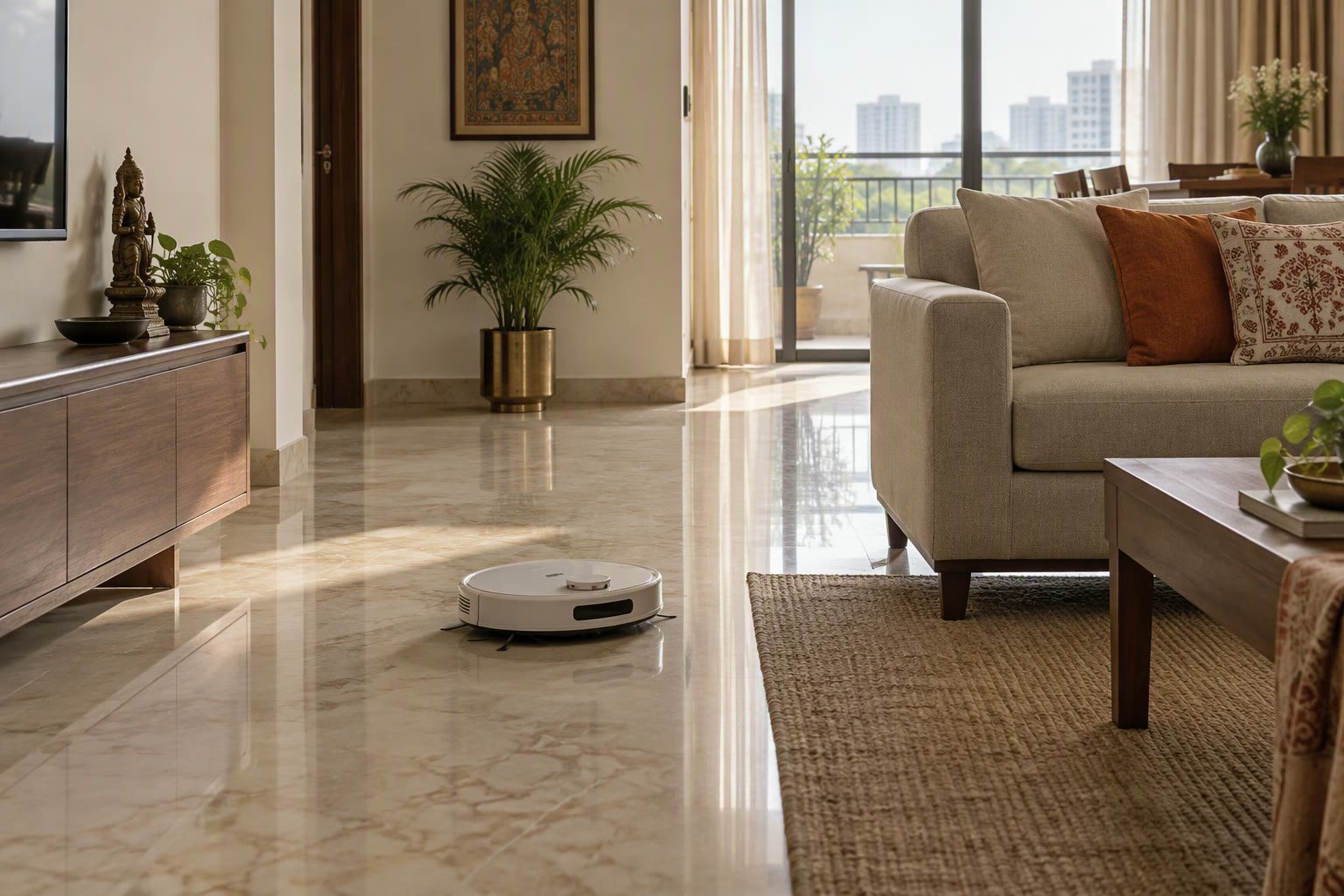
A robot vacuum is the most mature consumer robot you can buy in India, and also the one most often bought for the wrong reasons. It is excellent at daily maintenance on hard floors and low-pile carpets, and mediocre at deep cleaning, stairs and clutter. The difference between a ₹14,000 model and a ₹70,000 model is mostly navigation and self-maintenance, not raw suction. This guide explains what you are paying for at each price band and what to check before ordering.
What a robot vacuum does well, and what it does not
Set expectations first. A robot vacuum maintains a floor; it does not replace a deep clean. That is still valuable, because daily passes stop dust and hair accumulating in the first place.
| Good at | Poor at |
|---|---|
| Daily dust and hair on tile, marble and wood | Stairs and multi-level homes without barriers |
| Under beds and sofas where a manual vacuum struggles | Deep carpet pile and embedded sand |
| Keeping a pet’s shedding under control between deep cleans | Pet accidents, which it will spread |
| Small apartments where storage is tight | Rooms with cables, socks and clutter |
| Scheduled cleaning while you are out | Edges and corners, which need a manual pass |
If your home is mostly hard floor, has few loose cables, and someone is willing to empty the bin and untangle brushes weekly, a robot vacuum will earn its price. If the floor is cluttered or the home has three levels, a good stick vacuum will be the better purchase.
Navigation is the specification that matters
Suction is the number printed largest on the box. Navigation is the number that decides whether you come home to a cleaned floor or a robot stuck under a chair for two hours. There are three broad levels.
| Navigation type | How it behaves | Typical price band |
|---|---|---|
| Random or gyro-guided | Bounces around, may miss patches, cannot resume reliably | ₹10,000–₹18,000 |
| Camera or LiDAR mapping with app map | Plans routes, remembers rooms, supports no-go zones | ₹18,000–₹40,000 |
| Mapping plus self-empty base and obstacle avoidance | Weeks between bin empties, avoids cables and pet waste better | ₹40,000–₹90,000 |
Buy mapping before you buy suction. A mapped robot with average suction cleans more of the floor than a powerful random-bounce model. If the app cannot show you a map of the cleaned area, the robot is guessing.
Suction numbers are not comparable across brands
Suction is advertised in pascals, but the measurement conditions differ and the number says nothing about airflow at the brush, floor sealing or how the robot handles hair. A 4,000 Pa machine with a good brush and seal can outperform a 6,000 Pa machine with a leaky chassis.
What actually matters on an Indian floor:
- A rubber or hybrid brush that does not wrap hair around the axle.
- A side brush that reaches edges without flinging debris.
- A filter you can remove, wash and replace cheaply.
- Wheels that climb the thresholds in your home, typically 15–20 mm.
- Spare parts available in India two years after purchase.
Mopping: useful, but not a floor scrubber
Most mid-range robots include a mop attachment. Treat it as a damp wipe that lifts light dust, not as a replacement for mopping. It will not remove sticky stains, and it will drag dirt if the pad is not changed or washed.
Two features decide whether mopping is convenient or annoying: whether the water tank is easy to fill without flipping the robot, and whether the pad can be removed and machine-washed. A self-washing base solves the second problem at a significant price premium, and adds its own maintenance: dirty water tanks, filters and cleaning cycles.
Price bands in India
These are indicative retail bands, not quotations. Prices move sharply during festive sales, and the same model may be sold under different names by different retailers.
| Band | Indicative price | What you get | Who it suits |
|---|---|---|---|
| Entry | ₹10,000–₹18,000 | Random or basic gyro navigation, small bin, manual pad | One-room use, first experiment, hard floors only |
| Mid | ₹18,000–₹35,000 | LiDAR or camera mapping, app zones, mop tank | Most apartments; the value sweet spot |
| Upper mid | ₹35,000–₹55,000 | Better obstacle avoidance, stronger suction, larger bin | Homes with pets or more carpet |
| Premium | ₹55,000–₹90,000 | Self-empty base, self-wash mop, advanced avoidance | Large homes, low tolerance for maintenance |
| High end | Above ₹90,000 | Robotics arms, AI object handling, imported models | Early adopters; spares and service are the risk |
The best value for most Indian apartments is the mid band: mapping, a removable mop pad, and a brush that handles hair. Spending double rarely doubles the cleaning.
Running costs people forget
- Filters: ₹300–₹1,200 each, replaced every two to three months.
- Brushes and pads: ₹500–₹2,000 a year depending on pets.
- Battery: a replacement after roughly two to three years of daily use, ₹2,500–₹7,000.
- Self-empty bags: ₹300–₹800 each if the base uses disposable bags.
- Repairs: wheel modules and sensors are the usual failures; check that a service centre exists in your city.
Over five years, consumables can add ₹15,000–₹30,000. That is fine, but it changes the comparison with a ₹12,000 stick vacuum if the robot only cleans one room.
A checklist before you pay
- Measure the gap under your sofa and bed. If it is below about 8 cm, the robot will not enter.
- Count thresholds and mats. Anything above 15–20 mm will need a ramp or will block the robot.
- Check the map feature in the app screenshots, not just the marketing video.
- Confirm spare filters and brushes are listed for sale in India.
- Check the warranty terms for the battery, which is often excluded or covered for a shorter period.
- Read reviews that mention Indian conditions: tile, dust, hair and power cuts.
- Decide who empties the bin. If nobody will, buy a self-empty model or do not buy one.
Buying links and commission
Some links on this site may earn a commission if you buy through them. That does not change the price you pay, and it does not decide which products are recommended. Recommendations here are based on specifications and category behaviour, not on commission rates. See the affiliate disclosure for the full policy.
Should you build one instead?
A floor-cleaning robot is a genuinely hard build: navigation, obstacle detection, suction, battery management and a chassis that survives collisions. A student build is a good learning project but will not match a ₹20,000 commercial product for cleaning. If the goal is learning, start with a simpler rover and add a vacuum module later. The first-build guide is a better starting point than trying to clone a commercial vacuum.
If you do build, the power budget is the usual failure point. The motor selection guide covers current estimates, and the power guide explains rails and brownouts.
Consumer robot vacuums are the mass-market end of service robotics, which now includes hotel delivery machines.
Frequently asked questions
Is a robot vacuum worth it in India?
For a mostly hard-floor apartment with low clutter and someone willing to maintain it, yes. It saves daily sweeping time and reaches under furniture. For carpeted, cluttered or multi-level homes, a stick vacuum is usually the better first purchase.
LiDAR or camera navigation?
Both work. LiDAR is generally better in low light and more consistent on dark floors; camera systems can struggle in the dark but often handle obstacles better at the high end. Mapping quality and software updates matter more than the sensor type alone.
Do robot vacuums work on Indian marble and tile?
Yes, these are close to ideal surfaces. Watch for wet mopping on polished marble, which can leave streaks, and for dark floors that confuse some cliff sensors.
How long do they last?
With regular filter cleaning and brush maintenance, three to five years is a reasonable expectation. The battery is usually the first major replacement; motors and wheel modules follow.
Do they need Wi-Fi?
Only for app control, schedules and maps. Most robots can start from a physical button without Wi-Fi, but you lose zoning and scheduling. Check whether the app requires a cloud account, and whether it works on 2.4 GHz networks, which most do.
Background used for this page:
- Manufacturer specifications and publicly listed Indian retail prices for robot vacuum categories; prices change frequently and should be confirmed at purchase.
- Consumer reviews and spare-part listings used to check serviceability in India.
- Battery and motor guidance from the site’s robot battery guide.