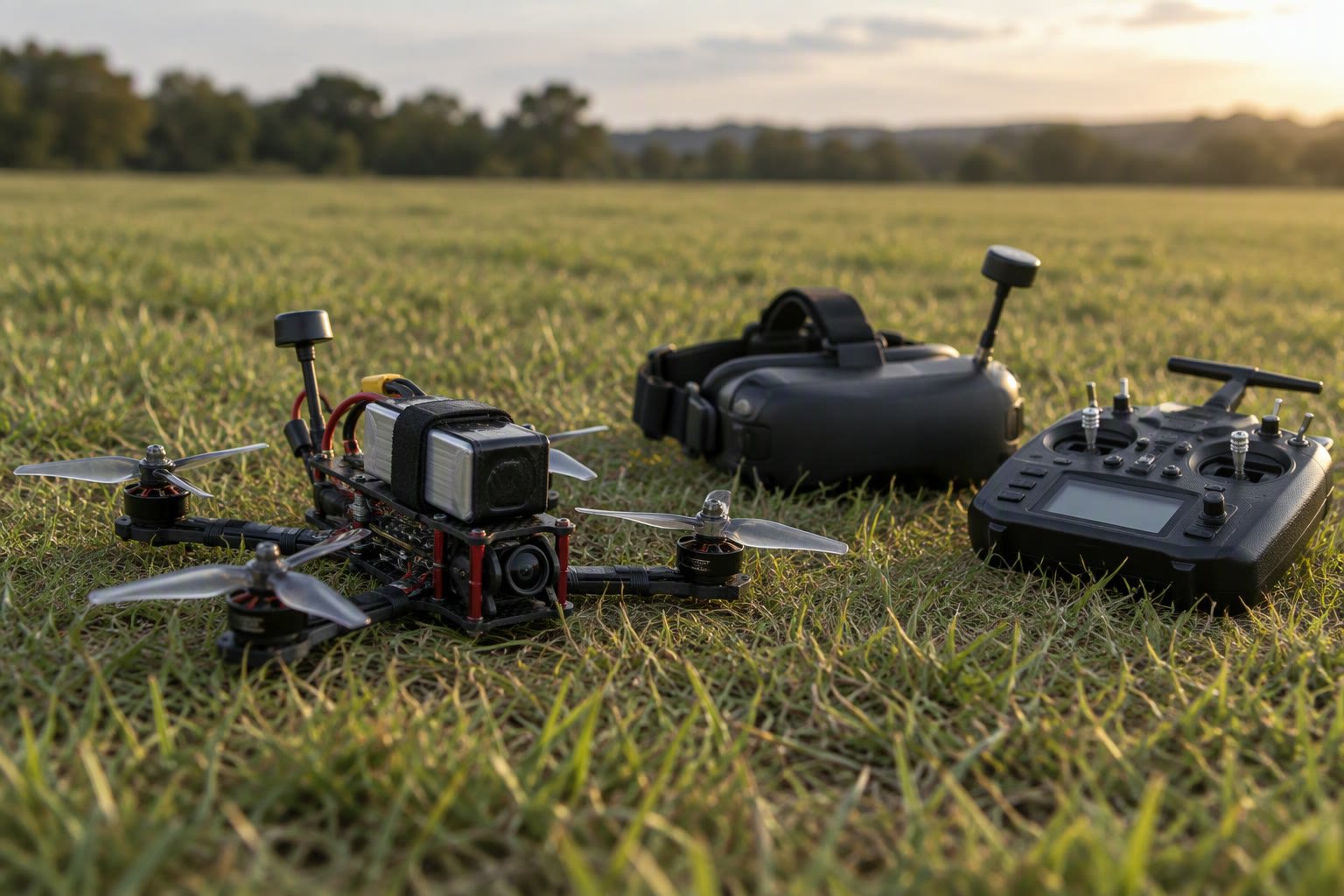
FPV flying is the cheapest way to feel like a pilot and the most expensive way to learn if you start with the wrong parts. The goggles matter less than the frame, and the radio matters more than the camera.
This guide covers what an FPV quad is made of, analogue versus digital video, how to choose between a ready-to-fly kit and a build, what it costs in India, and the rules you have to respect before you power up.
What FPV actually means
First person view means the pilot sees a live video feed from a camera on the aircraft, usually through goggles. That is the whole difference from a camera drone. A camera drone flies itself using GPS and the pilot composes shots on a screen. An FPV quad is flown manually, in rate mode, and the pilot’s hands are the stabiliser.
This has two consequences. Learning is harder, because there is no self-levelling to save a mistake. And the airframe can be cheap, because it does not need GPS, gimbal or obstacle sensing. A 5-inch FPV quad costs a fraction of a camera drone with similar flight performance.
The parts that make up a quad
| Part | What it does | Money well spent |
|---|---|---|
| Frame | Holds everything; takes the crash | Carbon fibre, replaceable arms |
| Motors | Thrust and control authority | Matched to propeller and battery |
| ESC or AIO board | Drives the motors | Headroom above motor current draw |
| Flight controller | Runs the control loop | Good gyro, enough UARTs |
| Camera | What you see | Low latency over resolution |
| VTX | Transmits video | Power suited to your flying site |
| Receiver | Takes your stick inputs | Reliable link protocol, failsafe |
| Goggles | Displays video | Comfort and receiver quality |
| Battery | Power | Correct cell count and C rating |
Analogue or digital video
Analogue video is inexpensive, has very low latency, and degrades gracefully: as signal weakens you see static, then you turn back. Digital video gives a clean image until the link fails, then it breaks up quickly. Latency is higher, and the goggles and air unit cost several times more.
For a first quad, analogue is still the better teacher, because static tells you that you are far away and losing link. Digital suits pilots who value the image and fly closer, or who want to record HD footage without a separate action camera.
Ready-to-fly or build your own
A ready-to-fly kit gets you flying in a day. It also hides how the parts fit together, which means every repair becomes a research project. Building from parts takes a weekend and a soldering iron, teaches you the system, and makes later repairs trivial.
For a student or a maker building skills, the build route wins even if it costs more time. For someone who only wants to fly and film, the kit is fine, provided you check that spare arms and motors are available in India before you buy.
Learn in a simulator first
FPV simulators use the same radio you will fly with, connected over USB. Twenty hours in a simulator costs nothing and saves several frames. Practise three things: hovering in place, figure eights at a fixed altitude, and recovering from a dive. Those three cover most of the first month of real flying.
When you move to real flight, start in an open ground with no people, no roads and no trees, and fly below the height of the tallest obstacle nearby. Altitude is not your friend while learning; space is.
Flight time estimate

Battery: 4S 1500 mAh, usable 80% = 1200 mAh
Average current draw in cruising flight: 18 A

Flight time = 1.2 Ah / 18 A = 0.0667 h = 4.0 minutes

At 6 A gentle hover: 1.2 / 6 = 0.2 h = 12 minutes

The gap between those two numbers is why FPV quads
feel like they fly for two minutes and camera drones
fly for thirty. Aggressive flying can triple the
current draw. Size the battery for the flying you
actually do, and check the C rating against the
maximum current the motors will pull.
The rules before the first flight
FPV is flown through goggles, which means you cannot see the aircraft with your own eyes. In practice that requires a second person acting as a visual observer, who watches the aircraft and warns you about people, obstacles and other aircraft. Flying alone through goggles in a public place is both unsafe and likely to breach the conditions under which hobby flying is permitted.
Beyond that, Indian drone rules categorise aircraft by weight and restrict where you may fly, with green, yellow and red zones administered through the Digital Sky platform. The category and the zone decide whether you need registration, a remote pilot certificate and permission. The drone pilot licence guide walks through that, and it is worth reading before you buy anything that weighs more than a nano drone.
What an FPV setup costs in India
| Item | Indicative price | Notes |
|---|---|---|
| Radio transmitter | ₹6,000–18,000 | Buy once, use for years |
| Analogue goggles | ₹8,000–18,000 | Receiver quality matters |
| Digital goggles and air unit | ₹35,000–70,000 | Higher cost, cleaner image |
| 5-inch frame | ₹2,500–6,000 | Spare arms are essential |
| Motors, set of four | ₹4,000–9,000 | Buy one spare |
| Flight controller and ESC stack | ₹5,000–12,000 | Or an AIO board |
| Camera and VTX | ₹3,000–10,000 | Analogue |
| Batteries, three packs | ₹4,500–9,000 | 4S, 1300–1500 mAh |
| Charger | ₹3,000–7,000 | Balance charging is mandatory |
| Complete analogue build | ₹35,000–55,000 | Excluding radio and goggles |
What does FPV stand for in drones?
First person view. The pilot sees a live video feed from a camera on the aircraft, usually through goggles, and flies manually rather than relying on GPS stabilisation.
Is FPV flying legal in India?
FPV flying is possible within Indian drone rules, but the aircraft category, the airspace zone and the purpose decide what registration, certification and permission you need. Because you cannot see the aircraft through goggles, fly with a visual observer. Check the DGCA rules before flying.
Analogue or digital FPV: which is better for a beginner?
Analogue is cheaper and degrades gradually into static, which teaches you to respect range. Digital gives a cleaner image but fails more abruptly and costs several times more. Most beginners learn faster on analogue.
How long does an FPV drone fly?
A 4S 1500 mAh pack gives about four minutes of aggressive flying or up to twelve minutes in a gentle hover. Aggressive throttle can triple current draw, so plan for short flights and carry several packs.
How much does an FPV drone cost in India?
Indicative ranges: a complete analogue 5-inch build ₹35,000–55,000 excluding radio and goggles, a radio transmitter ₹6,000–18,000, analogue goggles ₹8,000–18,000, and digital goggles with an air unit ₹35,000–70,000.
FPV quads run Betaflight or INAV; the flight controller guide explains what those firmware families do differently.
Sources and further reading
- DGCA India — drone rules, categories and airspace guidance.
- Betaflight — firmware and setup documentation for FPV quads.
- FAA — general small unmanned aircraft safety guidance.
- IEEE — research literature on multirotor control and video links.