If you want to fly a drone for money in India, the piece of paper you need is a Remote Pilot Certificate, and it comes from a DGCA-approved training organisation rather than from a YouTube playlist. The Drone Rules 2021 made registering and flying far simpler than the old regime, but they did not remove the certificate requirement for commercial work. This guide covers who needs one, what training costs, how long it takes, and where the jobs are.
Rules and fees change. Before paying anyone, confirm the current process on the DGCA Digital Sky portal and with the training organisation you shortlist. This page is a planning guide, not legal advice.
Drone categories in India
The Drone Rules 2021 sort drones by maximum all-up weight, and the category decides most of your obligations.
| Category | All-up weight | Registration (UIN) | Remote Pilot Certificate |
|---|---|---|---|
| Nano | Up to 250 g | Exempt | Not required for non-commercial flying |
| Micro | 250 g to 2 kg | Required | Required for commercial operations |
| Small | 2 kg to 25 kg | Required | Required |
| Medium | 25 kg to 150 kg | Required | Required |
| Large | Above 150 kg | Required | Required |
The practical line for most people is 250 g. Below it, a nano drone can be flown recreationally with far fewer formalities. The moment you charge a client for aerial work, or the drone carries a spray tank or a survey payload, you are in certificate territory.
Who actually needs a Remote Pilot Certificate
You need an RPC if you operate a drone above nano weight for commercial, agricultural, survey, inspection or cinematography work. You do not need one to fly a nano drone recreationally within the permitted zones, though you still have to respect no-fly areas and privacy.
Two separate things are often confused:
- UIN (Unique Identification Number) registers the drone itself. It is issued through the Digital Sky portal for anything above nano.
- RPC (Remote Pilot Certificate) certifies the person flying. It is issued after training and testing at a DGCA-approved Remote Pilot Training Organisation (RPTO).
Buying a registered drone does not make you a certified pilot, and holding a certificate does not register the aircraft. You need both for commercial work.
The steps, in order
- Check eligibility. The DGCA framework expects a minimum age of 18 and at least a Class 10 pass for RPC training. Confirm the current requirements with your chosen RPTO.
- Choose a DGCA-approved RPTO. The approval matters. A certificate from an unapproved institute will not be accepted. Ask for the approval reference and check it.
- Complete ground training. Rules, airspace, weather, emergency procedures, basic principles of flight and payload limits.
- Complete simulator and practical flying. Most institutes run four to five days of combined ground and flight training for a small-category certificate, though the schedule varies.
- Pass the theory and practical assessment. The RPTO conducts the examination under the DGCA framework.
- Receive the certificate. The RPC is issued digitally and is typically valid for ten years, subject to current rules.
- Register the drone and plan the flight. Obtain the UIN, check the airspace zone on Digital Sky, and take permissions where required.
What training costs in India
DGCA does not fix training fees; institutes set them. These are indicative market bands, and they move with location, drone category and whether equipment is included.
| Item | Indicative cost | Notes |
|---|---|---|
| RPC training, small category | ₹30,000–₹75,000 | Four to ten days depending on institute and batch |
| RPC training, micro category | ₹25,000–₹55,000 | Often bundled with small-category training |
| Drone hire for practice | Included or ₹3,000–₹8,000 per day | Ask whether flight time is on your own aircraft |
| Drone purchase, entry commercial | ₹60,000–₹2.5 lakh | Spray drones cost far more; see the agriculture guide |
| Insurance, third-party | ₹3,000–₹15,000 per year | Varies with drone value and cover |
| Registration and portal fees | Nominal | Confirm current Digital Sky charges |
Be sceptical of an unusually cheap course. Flight training needs an instructor, an airfield or approved site, and a drone that is actually airworthy. Those cost money, and a course that skips them is selling you a certificate-shaped piece of paper.
Where certified pilots work
Drone work in India has consolidated around a few applications that pay reliably, plus a long tail of seasonal and project work.
| Work | What it involves | Indicative pay |
|---|---|---|
| Agricultural spraying | Seasonal contracts, village to village, tank refills and battery swaps | ₹1,500–₹5,000 per day, or per acre |
| Survey and mapping | Grid flights, ground control points, processing into maps | ₹20,000–₹45,000 per month employed; project rates vary |
| Infrastructure inspection | Pylons, pipelines, solar plants, construction progress | ₹25,000–₹50,000 per month |
| Cinematography and events | Short shoots, high competition, portfolio-driven | ₹5,000–₹25,000 per shoot day |
| Drone service startups | Pilot plus processing plus client management | Own business; income depends on contracts |
Employment is often with survey firms, agri-input companies, solar EPC contractors and infrastructure consultancies rather than with “drone companies” alone. The fresher job guide covers how these roles sit alongside robotics and automation jobs, and the internship guide explains how to approach these firms before you graduate.
The agricultural route
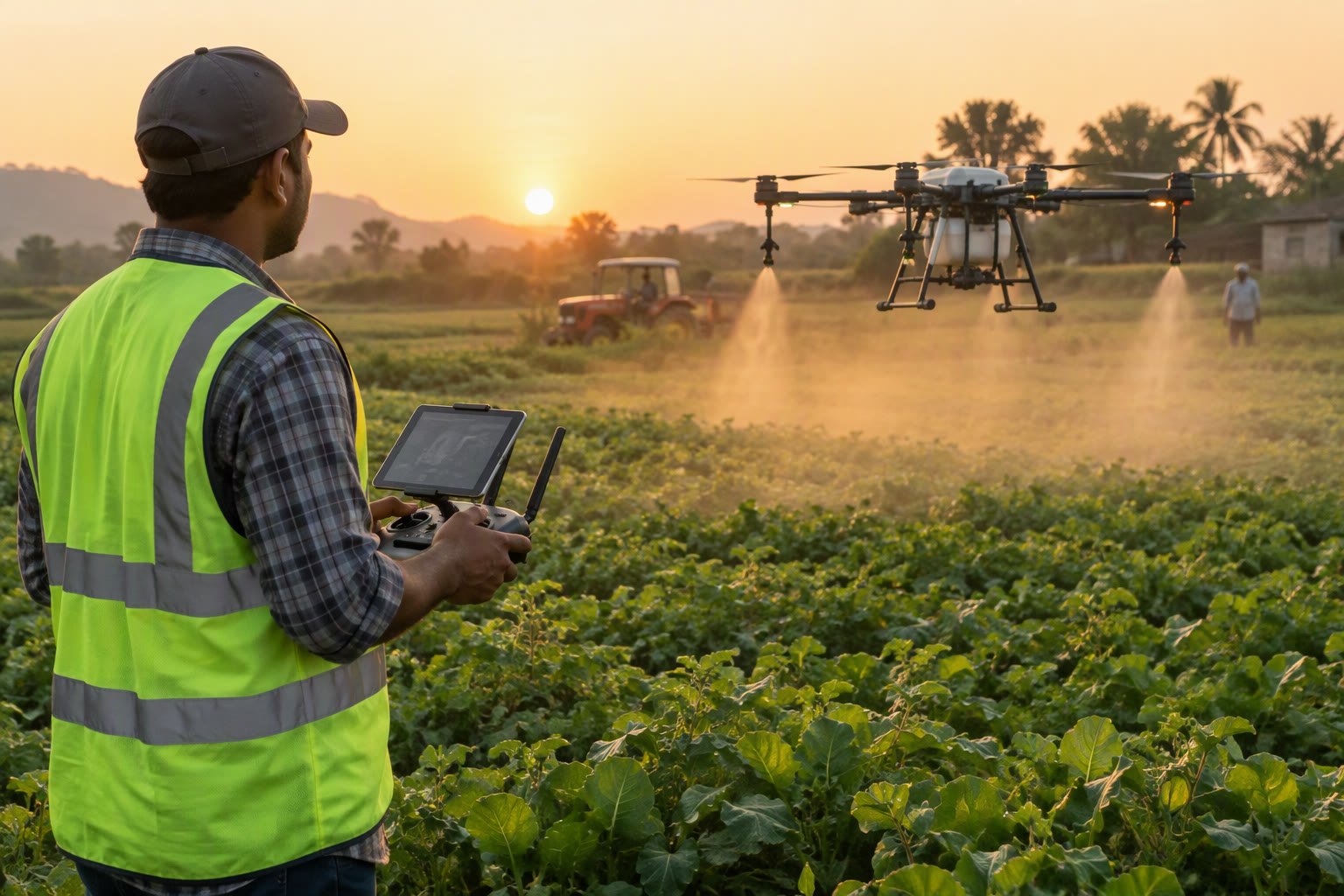
Spray drones are the largest volume of paid flying in rural India, helped by subsidy schemes and the Drone Didi initiative aimed at women’s self-help groups. The economics are covered in detail in the agricultural robots guide: a 10-litre spray drone typically sits in the ₹4.5–8 lakh range, and operators charge roughly ₹300–600 per acre depending on crop, terrain and distance.
This is real work, but it is also seasonal, physical and hard on equipment. Pilots who succeed usually combine flying with agronomy knowledge, local relationships and the ability to service the machine between fields.
Airspace and permissions
The Drone Rules 2021 introduced a zone system and a single portal. In practice, before any commercial flight you should:
- Check the location on the Digital Sky map for red, yellow and green zones, and for temporary restrictions.
- Keep the drone within visual line of sight unless you hold the specific approvals for beyond-line-of-sight work.
- Avoid airports, military areas, heritage sites and crowded spaces without explicit permission.
- Carry your RPC and the drone’s registration details during operations.
- Follow local police instructions during events and VIP movement.
Operating without a certificate or in a restricted zone carries penalties under the rules, and insurers will decline claims for illegal flights. The paperwork is the cheap part of the business.
Mistakes that waste money
- Training at an unapproved institute. Verify the DGCA approval before paying.
- Buying an expensive drone before finishing training. Learn on the institute’s aircraft, then buy for the work you have.
- Ignoring the airspace map. A single illegal flight can end a commercial operation.
- Underestimating batteries and travel. Agricultural work is limited by battery cycles and charging, not by flight speed.
- Assuming a certificate creates demand. The certificate is a licence to sell a service; the service still has to be sold.
If you plan to charge for flights, our guide to getting a drone pilot licence in India explains the DGCA paperwork before you quote your first acre.
For the hardware side, see how to build a drone in India.
Failsafes and tuning are aircraft concerns; the flight controller setup does not change what the rules require of you.
Before flying FPV, check the aircraft category and zone rules that apply to you.
Turning the licence into a business is covered in the drone survey business guide, which includes equipment and pricing.
What the job pays after certification is covered in the drone pilot career guide.
Frequently asked questions
Do I need a licence to fly a drone under 250 g?
For recreational flying of a nano drone, no remote pilot certificate is required. Commercial use, payloads and heavier aircraft bring registration and certification requirements. Check the current rules before flying for payment.
How long is a Remote Pilot Certificate valid?
Under the current framework it is typically valid for ten years, subject to renewal rules in force at the time. Confirm with your RPTO and on Digital Sky.
Can I get a drone pilot job without experience?
Yes, but usually through a survey, agri or inspection company that trains you on its workflow. Build a small portfolio of mapped sites or crop-spraying hours, because employers ask what you have flown, not just whether you are certified.
Is drone pilot training available in regional languages?
Many RPTOs run batches in Hindi, Marathi, Telugu and other languages alongside English. Ask before enrolling if language is a concern, and confirm that the assessment itself can be taken in a language you are comfortable with.
Do I need insurance?
Third-party insurance is strongly advisable and required in several operating contexts. Client contracts increasingly demand it. Budget for it as a running cost, not a one-time purchase.
Background used for this page:
- Drone Rules 2021, Ministry of Civil Aviation, Government of India.
- DGCA Digital Sky portal guidance on registration, remote pilot certification and airspace zones.
- Publicly advertised fee ranges from DGCA-approved remote pilot training organisations; fees are set by institutes and change frequently.