Construction is the least automated large industry in the world, and the reasons are physical: the factory moves to a new site every project, the product is different every time, and the weather does not negotiate.
That does not mean robots are absent from Indian construction. It means they arrive through specific niches — survey, layout, demolition, prefabrication and a small number of printing demonstrations — rather than as a general replacement for site labour.
Why sites resist automation
- The environment is unstructured. A robot that works in a fixed cell meets mud, dust, rain and a changing floor level.
- Every project is a prototype. Industrial robots amortise programming across thousands of identical parts. A building has one of everything.
- Labour is available and flexible. Indian construction has a deep labour pool that adapts to a changed drawing in an hour.
- Safety and liability sit with the contractor. New methods need approvals, insurance and a workforce trained to work beside a machine.
- Capital is project-financed. A contractor buys equipment against a project that may end in eighteen months.
Where robots already work in India
| Application | Maturity in India | What it replaces |
|---|---|---|
| Drone survey and progress capture | Mainstream and growing | Manual total-station survey, site visits |
| Layout marking robots | Early adoption on large projects | Manual setting out, string lines |
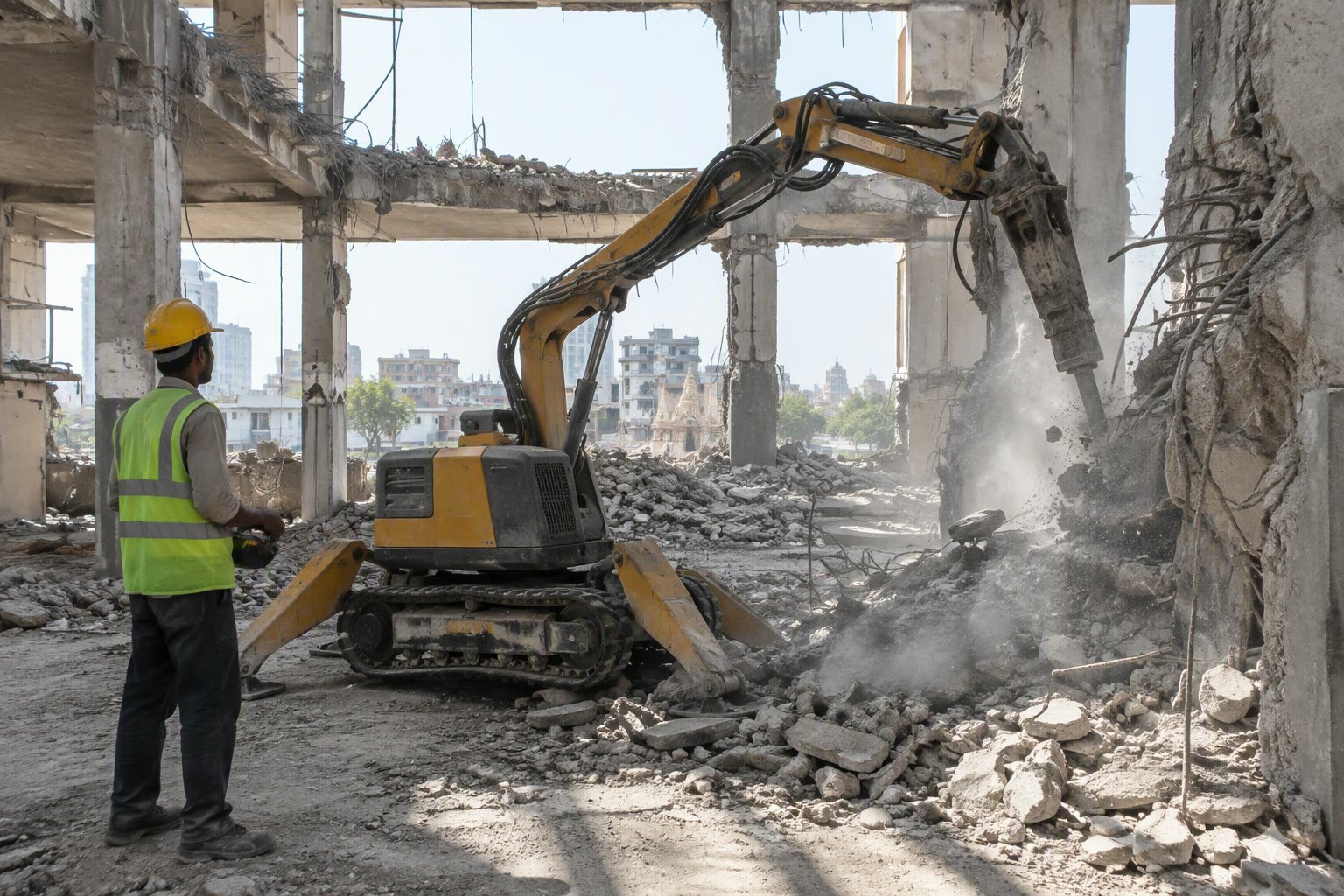
| Demolition robots | Established in urban redevelopment | Manual breaking, reducing exposure |
| Tunnel and shotcrete robots | Established in metro and hydro projects | Manual spraying in confined spaces |
| Prefabrication and precast automation | Established in organised factories | Site casting and manual handling |
| Facade and window cleaning robots | Niche, high-rise buildings | Rope access crews |
| 3D concrete printing | Demonstration and pilot projects | Not yet a replacement for conventional construction |
| Bricklaying robots | Very rare | Masonry crews |
Prefabrication is the automation that pays
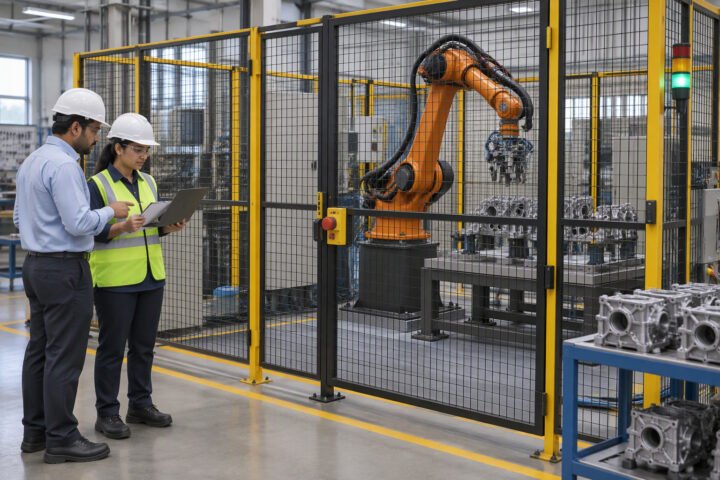
The most successful construction automation in India does not happen on site. It happens in factories making precast elements, steel structures, modular MEP assemblies and bathroom pods, where the work is repetitive and the environment can be controlled.
- Precast yards. Batching, mould handling, casting and curing lend themselves to gantry robots and conveyors, in the same way as any factory line.
- Steel fabrication. CNC cutting, robotic welding of standard joints and automated marking are established, supported by welding cells.
- Modular MEP. Pipe and duct spools fabricated off site, then assembled in a fixed sequence.
- Bathroom and kitchen pods. Repetitive fit-out in a factory, craned into place.
These are industrial automation projects wearing a construction hat. The equipment, integration and safety requirements follow the same logic as a gantry cell or a welding line, and the cost structure is covered in the robot cost guide.
The honest state of 3D concrete printing
India has seen several 3D-printed structures, including small buildings, military accommodation and demonstration walls. They are real and technically impressive. They are not yet a cheaper way to build a typical commercial project.
Three constraints keep printing in the pilot stage. The mix design and material supply chain are specialised. Reinforcement is difficult to integrate, and most printed walls still need conventional steel and services. And building codes and approval processes are still developing around the method. Anyone claiming that printing has replaced conventional construction in India is selling something.
The realistic use cases are small, repetitive, geometrically complex structures where conventional formwork is expensive: boundary walls, small shelters, decorative elements and prototypes.
Equipment and indicative costs
| Equipment | Indicative price | Notes |
|---|---|---|
| Survey drone with RTK | ₹4.5–12 lakh | Fastest payback of any site technology |
| Layout marking robot | ₹25–60 lakh | Justified on large repetitive floor plates |
| Demolition robot | ₹60 lakh–1.5 crore | Urban redevelopment, confined access |
| Shotcrete robot | ₹1–3 crore | Tunnel and slope stabilisation |
| Facade cleaning robot | ₹15–50 lakh | High-rise maintenance contracts |
| 3D concrete printer, small | ₹40 lakh–1.5 crore | Pilot scale, plus mix design and labour |
| Precast gantry handling system | ₹80 lakh–3 crore | Factory, not site |
The economics of a site robot
Layout robot business case (indicative)

Manual setting out
  surveyor crew of 3, 2 days per floor
  loaded cost INR 900/day per person
  per floor: 3 * 2 * 900        = INR 5,400

Layout robot
  one operator, 4 hours per floor
  loaded cost INR 1,200/day
  machine cost INR 40 lakh, 8 year life
  floors per year                     30
  annual machine charge
    40,00,000 / (8 * 30) = INR 16,667 per floor
  per floor: 16,667 + 600       = INR 17,267

The robot looks 3x more expensive per floor.
It becomes viable when:
  - the same crew is shared across sites
  - rework from setting-out errors is counted
  - the project schedule, not the day rate,
    is the constraint
  - utilisation exceeds roughly 60 floors a year

This is the pattern across construction
robotics: the arithmetic only works at
scale or where a delay is very expensive.
Safety and the rules
Industrial robot safety standards such as ISO 10218 assume a defined working envelope and a controlled area. A construction site rarely offers either. That means the safety case has to be built project by project: exclusion zones, trained banksmen, machine guards, and a competent person who signs off the arrangement.
For anything that lifts or holds a load, the lifting and plant regulations apply on top of the machine safety. The general requirements are covered in the robot safety standards guide, but on site, get a structural and safety review specific to the machine and the ground conditions.
What a contractor should do now
- Start with survey. Drone capture pays back in weeks and produces data every other technology needs. The drone survey guide covers the equipment and pricing.
- Move repetitive work into a factory. Precast, steel and MEP spools are proven automation targets.
- Buy robots for the tasks where access is the problem. Demolition, confined-space spraying and high-rise cleaning remove people from danger, and that is a business case on its own.
- Pilot one technology on one project. Do not restructure the company around a demonstration.
- Measure the baseline first. Without a labour and rework baseline, no automation claim can be verified.
The same discipline applies as in a factory: choose a constraint, measure it, and automate only that. The manufacturing automation overview explains the sequence that construction firms tend to rediscover the hard way.
Are robots used in construction in India?
Yes, but in specific niches: drone survey, layout marking, demolition, shotcrete in tunnels, prefabrication and facade cleaning. General site construction is still overwhelmingly manual.
Is 3D concrete printing viable in India?
It is technically demonstrated but not yet a cheaper mainstream method. Material supply, reinforcement and building approvals remain constraints. It suits small, repetitive or geometrically complex structures.
What is the most profitable construction robot to buy first?
A survey drone, in most cases. It has the lowest entry cost, the fastest payback and produces data that supports every later automation decision.
Why is construction harder to automate than manufacturing?
The site is unstructured, the product is unique each time, the weather interferes, and labour is flexible. Industrial robots depend on a fixed cell and repeated work.
Do construction robots need the same safety standards as factory robots?
ISO 10218 principles apply, but a site rarely provides a controlled envelope. Each project needs its own risk assessment, exclusion zones and competent-person sign-off, plus lifting regulations where loads are handled.
Sources and further reading
- International Federation of Robotics — construction robotics adoption data and case studies.
- ISO 10218-1 — safety requirements applied when industrial robots move onto site.
- A3 Association for Advancing Automation — automation application guidance.
- Bureau of Indian Standards — Indian standards relevant to construction materials and methods.