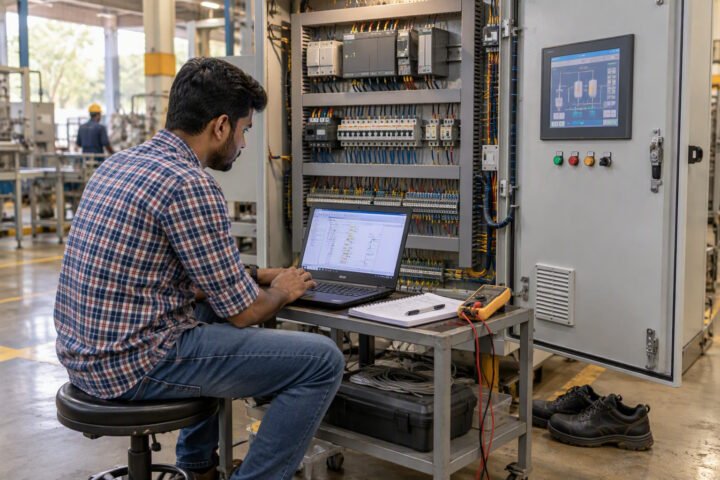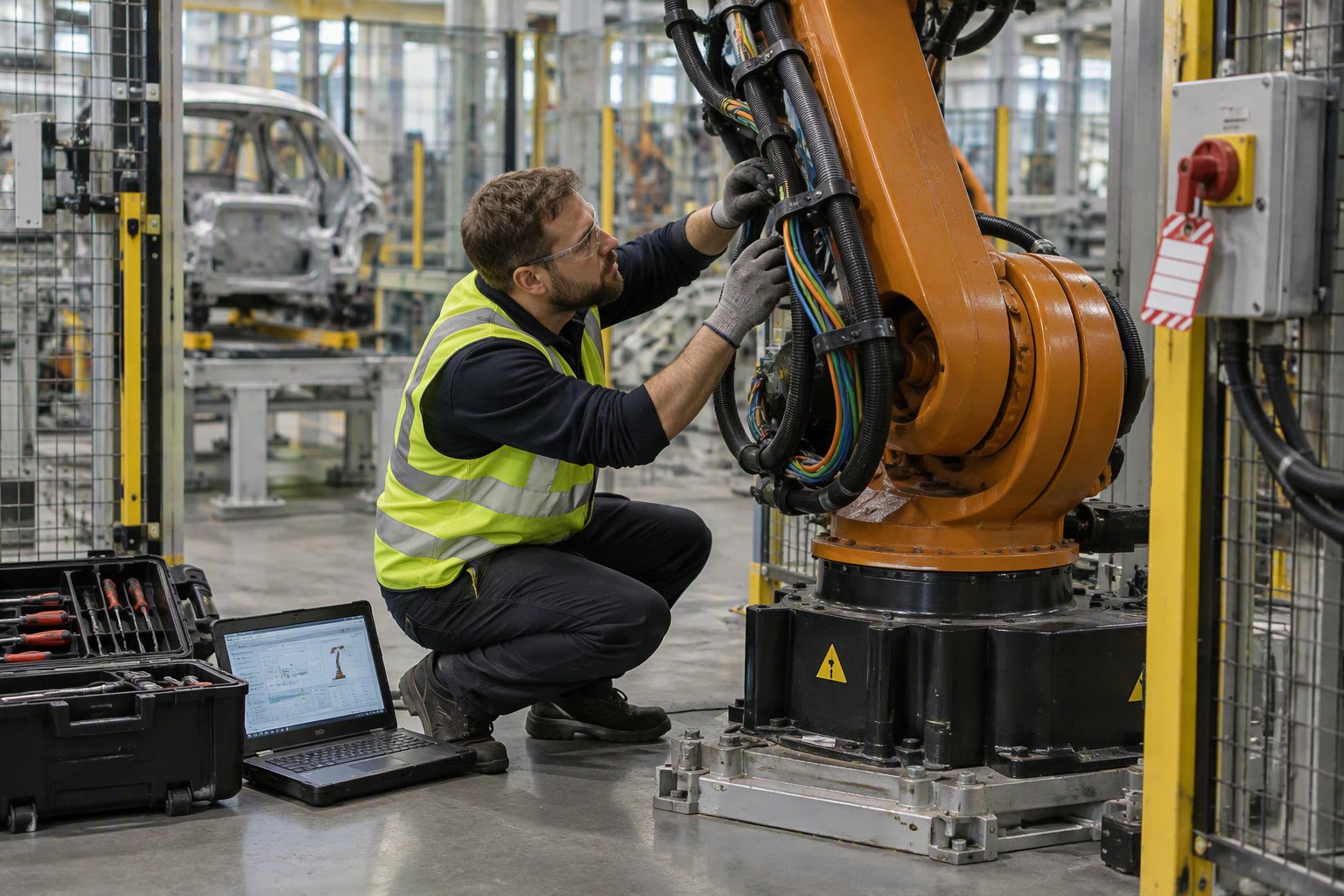
Robotics maintenance is a career in downtime, not in robots. The job is to find why a cell stopped at 2 a.m., restore it safely, and make sure the same stop does not happen next week.
It is one of the most reliable entry points into industrial automation in India, because every installed robot needs someone who can keep it running. This guide covers the role, the skills ladder, realistic salary bands and the twelve months that take you from technician to engineer.
The roles that carry the title
| Title | Focus | Typical entry |
|---|---|---|
| Maintenance technician | Breakdowns, lubrication, belts, sensors | ITI or diploma |
| Robot technician | Teaching points, backups, basic faults | Diploma plus OEM training |
| Maintenance engineer | Plans, spares, root cause, contractors | B.E. or diploma with experience |
| Reliability engineer | Failure data, PM optimisation, uptime | Engineering plus data skills |
| Commissioning engineer | Install, test, hand over new cells | Engineering, often travel-heavy |
Small plants often combine these into one person. Large plants split them, and the split is where career progression usually happens.
A realistic day
- Shift handover: what stopped, what was bypassed, what is still open.
- Attend the line: read alarms, check safety circuits, restore safely.
- Root cause: was it the sensor, the program, the part or the operator?
- Preventive work: lubrication, cable inspection, backup verification.
- Documentation: update the fault log and the spare parts list.
- Small improvement: fix the guard that keeps getting knocked, or the cable that keeps flexing.
The best maintenance engineers spend less time on breakdowns each month because they close the cause, not just the ticket. That shift from reactive to preventive is what promotion looks like.
The skills ladder
| Level | Skills | Evidence |
|---|---|---|
| Entry | Multimeter, wiring diagram, lockout-tagout, hand tools | ITI or diploma, site internship |
| Technician | Robot teaching, backups, drive faults, sensor replacement | OEM training certificate, 1–2 years |
| Engineer | PLC troubleshooting, root cause, PM planning, spares | B.E. or diploma plus 3–5 years |
| Senior | Reliability data, budget, contractor management, upgrades | Track record of uptime improvement |
Two skills separate good candidates at every level: reading a wiring diagram without guessing, and writing a fault note that the next shift can act on.
Add basic PLC skills early. Most robot cells fail in the handshake with the machine, not in the robot itself, and the person who can read both sides is the one who gets called.
Salary bands in India
Bands vary with city, industry and shift allowance. Treat these as planning ranges for 2026, not offers.
| Level | Monthly range | Notes |
|---|---|---|
| ITI technician | ₹18,000–30,000 | Shift allowance extra |
| Diploma technician | ₹22,000–38,000 | OEM training raises the ceiling |
| Maintenance engineer | ₹35,000–70,000 | Higher in automotive and FMCG |
| Senior or lead | ₹70,000–1,20,000 | Uptime ownership and team size |
Commissioning roles pay more but involve travel. Plant maintenance pays less per hour on paper but builds deeper system knowledge, which is the better base for a senior role.
How to enter without experience
- Apply to robot integrators and machine builders as a trainee; they need hands.
- Take an OEM robot programming course and keep the certificate.
- Learn one PLC platform well enough to upload, monitor and force an I/O.
- Get comfortable with lockout-tagout and safety circuits before touching a live cell.
- Document a real fault you fixed, even during an internship.
Integrators are the best entry because they expose you to many cells in a year. A plant role is deeper but narrower, and harder to get without prior site exposure.
Interview preparation
Interviews for maintenance roles are practical. Expect questions about a fault you diagnosed, how you isolate a safety circuit, and what you do before restoring power.
- Describe a fault from symptom to root cause to prevention.
- Explain the difference between a safety stop and a standard stop.
- Show how you verify a backup before a program change.
- Talk about a preventive task you improved, with a number.
- Ask about the spare parts process and the escalation path.
Safety answers carry weight. A candidate who reaches for lockout-tagout and verification before clearing a fault signals they will not hurt someone in month three.
The first twelve months
- Months 1–3: learn the line, the safety devices and the alarm list.
- Months 2–4: take ownership of one preventive routine and its records.
- Months 3–6: complete OEM robot training and practise backups.
- Months 4–8: learn the PLC handshake for one cell end to end.
- Months 6–10: run a small improvement with a measured result.
- Months 9–12: present a downtime analysis and a plan to reduce it.
The improvement in months six to ten is what gets you promoted. It does not need to be large; it needs to be measured and sustained.
For the adjacent engineering path, see the automation engineer career guide. For interview practice, the robotics interview questions and the embedded questions cover the technical ground.
The realistic outlook
Demand is steady rather than explosive. Every new cell needs maintenance, and every ageing cell needs someone who can keep it alive past its warranty. The engineers who move up are the ones who convert breakdowns into reliability data and use it to change the maintenance plan.
That is a skill you can start building in your first month, on any line, with a notebook and a fault log.
Do I need an engineering degree to work in robot maintenance?
No. ITI and diploma holders enter as technicians and can progress with OEM training and experience. A degree helps for engineer and lead roles, especially in larger plants.
Which certifications matter?
OEM robot programming and maintenance courses carry the most weight, followed by PLC training and functional safety awareness. Keep certificates and describe the practical work behind them.
Is maintenance a dead-end career?
No. It leads to reliability engineering, commissioning, maintenance management and automation project roles. The ceiling is higher for people who learn the PLC and data side.
How much travel does the job involve?
Plant maintenance is mostly fixed-site with shift work. Commissioning and field service roles travel heavily, often across states.
What should I learn first?
Electrical safety and lockout-tagout, then wiring diagrams, then one robot platform and one PLC. Safety knowledge is what makes an employer trust you on the floor.
Maintenance roles often lead into controls work, and the PLC programmer salary guide shows what the pay looks like after the move.
Sources and further reading
- NSDC — skill development programmes and qualification packs.
- Skill India — training schemes and certification pathways.
- International Federation of Robotics — installed base and automation trends.
- A3 Robotics — industry resources on robot integration and maintenance.