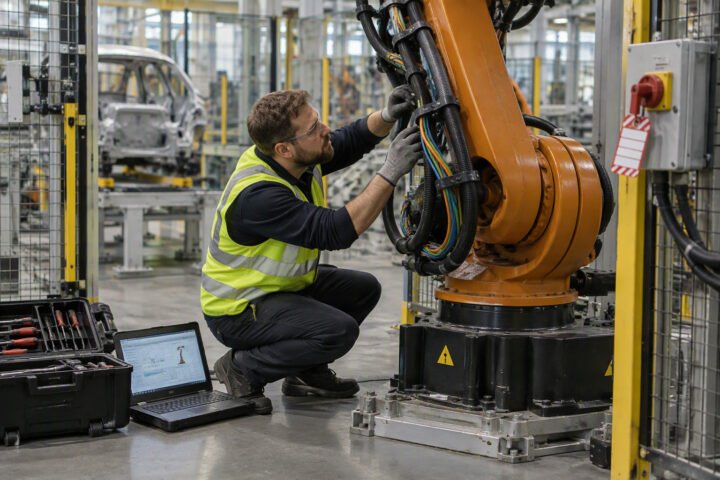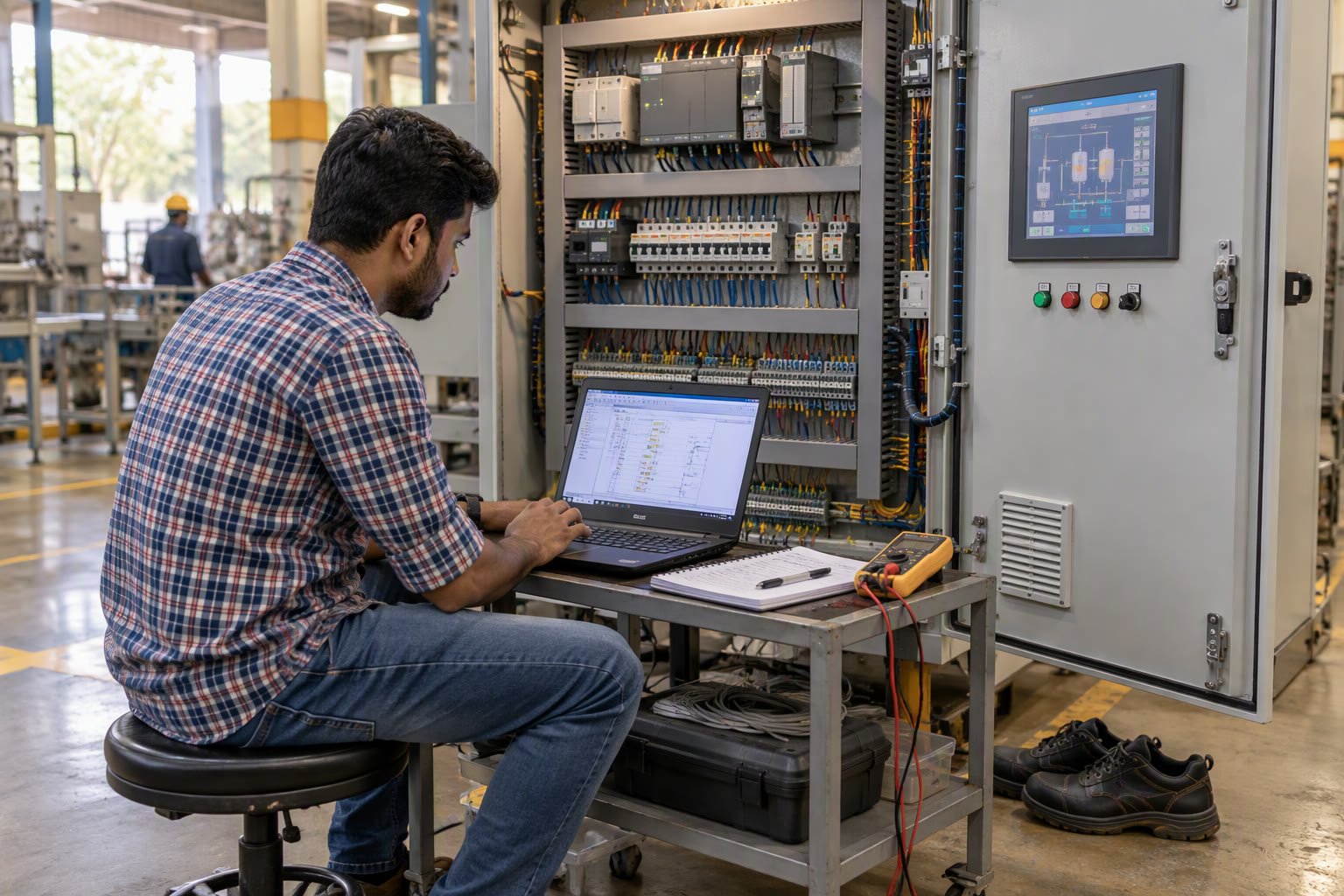
A PLC programmer in India earns well by engineering standards, but the range is wider than most job seekers expect. The difference between ₹5 lakh and ₹18 lakh is rarely the degree. It is the brand of platform, the amount of motion and safety work, and whether you can own a project instead of just writing logic.
This guide covers what the job involves in India, indicative salary bands by experience, what the CTC number hides, which skills move the figure fastest, and how to get the first role without experience.
What the job actually is in India
Four kinds of employer hire PLC programmers, and they offer different work at different pay.
- System integrators. Project work across many customers. Fast learning, heavy travel, modest base salary, generous allowances.
- Machine builders and OEMs. Standard machines built in series. Deep product knowledge, better base pay, some site commissioning.
- End users. Factories that own their automation. Stable hours, slower variety, strongest job security.
- Robot integrators and automation arms of large groups. PLC plus robot plus safety plus vision. The highest ceiling, because the scope is widest.
In all four, the day is a mix of reading electrical drawings, writing and debugging logic, forcing I/O during commissioning, arguing with a mechanical team about a sensor position, and documenting what you changed at 11 pm.
Indicative salary bands
| Role and experience | Indicative CTC | What the employer expects |
|---|---|---|
| Trainee or fresher, 0–1 year | ₹3.0–5.0 lakh | Read drawings, wire panels, modify existing logic under supervision |
| Junior programmer, 1–3 years | ₹4.5–8.0 lakh | Program a machine from a sequence, commission on site |
| PLC programmer, 3–5 years | ₹7.0–12.0 lakh | Own a machine’s controls, handle customer acceptance |
| Senior programmer, 5–8 years | ₹11–18 lakh | Architecture, safety design, mentor juniors, integration with robots and SCADA |
| Lead or project engineer, 8–12 years | ₹16–26 lakh | Own the project: scope, cost, schedule, customer |
| Controls manager, 12+ years | ₹24–40 lakh | Team, standards, multiple projects, commercial responsibility |
Two adjustments matter. Metro roles typically pay 10–25% more for the same work, but the living cost difference can exceed that. And commissioning-heavy roles often carry a lower base with daily allowance, which can add meaningfully to take-home without appearing in CTC.
What the CTC number hides
An offered package is not the money that reaches your bank account. Employer contributions come out of the headline figure before your salary is calculated.
CTC to monthly gross (illustrative)

Annual CTC                          INR 9,00,000
Basic assumed at 40% of CTC         INR 3,60,000
Employer PF, 12% of basic           INR   43,200
Gratuity provision, 4.81% of basic  INR   17,316
Group insurance and misc.           INR    2,000
                                   ------------
Annual gross salary                 INR 8,37,484
Monthly gross                       INR   69,790

Deductions from monthly gross
  Employee PF, 12% of basic         INR    3,600
  Professional tax, state-specific  INR      200
  Income tax, slab-dependent        INR   ~1,600
                                   ------------
Approximate monthly in-hand         INR   64,400

Assumptions that change the answer:
  - basic as a share of CTC
  - variable pay and joining bonus
  - tax regime and slab in force
  - state professional tax
Always ask for the monthly gross in writing.
The practical rule: a package with a low basic and a large variable component looks better in the offer letter than it feels in month one. Ask what percentage is fixed.
Which skills move the number fastest
| Skill | Why it pays | Indicative uplift |
|---|---|---|
| Motion control: servo axes, cams, electronic gearing | Fewer people can tune a multi-axis machine than can write ladder | 15–25% |
| Safety PLC and functional safety | Compliance work that cannot be improvised | 15–25% |
| Robot integration with PLC handshakes | Robot cells need one person who understands both sides | 15–30% |
| SCADA, historian and reporting | Every plant wants data, few programmers enjoy it | 10–20% |
| Second platform brand | Integrators bid across Siemens and Rockwell lines | 10–20% |
| Fieldbus depth: Profinet, EtherNet/IP, OPC UA | Diagnosing a network fault is a scarce skill | 10% |
| Project ownership and documentation | Moves you from programmer to engineer | Promotion, not a premium |
The strongest combination in the Indian market right now is PLC plus robot plus safety. A cell with a robot, a safety PLC and a machine tool handshake needs one engineer who can debug all three, and that engineer is rare. The industrial robot programming guide is the natural next step after PLC basics.
Certifications worth paying for
Vendor training has real value when it is the platform the integrators near you actually use. Siemens and Rockwell courses, and robot vendor training from ABB, FANUC, KUKA or Yaskawa, are recognised by hiring managers because they know what the course covered.
Generic online certificates carry much less weight. A hiring manager will ask you to explain how you would structure a sequence, handle an emergency stop, or recover from a jam. If you cannot answer, the certificate does not help.
Spend on vendor training after you can already program, not before. The course then consolidates knowledge you have, instead of giving you vocabulary without context.
Getting the first job without experience
- Start where the hiring is. Small system integrators hire continuously and train on the job. The pay is modest for two years and the experience is broad.
- Take the panel route if needed. Panel wiring and testing puts you next to programmers and is a legitimate entry point.
- Build three documented projects. A conveyor sequence with interlocks, a two-axis motion program, and a safety circuit with a gate interlock. Document the I/O list and the logic.
- Learn one platform deeply. TIA Portal or Studio 5000. Not both at once.
- Learn to read an electrical drawing fluently. This is the single most underestimated skill in interviews.
- Be willing to travel. Commissioning experience in the first three years accelerates everything.
The beginner-level path is in the PLC programming guide, and the wider skill sequence is in the robotics skills roadmap. If you are still choosing a direction, compare this role with the automation engineer and maintenance engineer paths.
Freelance and contract commissioning
Experienced programmers in India increasingly work on daily-rate commissioning contracts. Indicative day rates run from ₹3,000 for routine support to ₹8,000 or more for independent commissioning of a complex cell. Retrofits, breakdown support and holiday cover are common entry points.
The risks are real: payment delays, no benefits, and travel costs that eat the rate if you do not quote them. Two habits protect you. Take a written purchase order with a payment schedule before you travel, and keep one salaried or retainer client so that a single delayed invoice does not stop your cash flow.
Preparing for the interview
Technical interviews for PLC roles are practical. Expect to be asked how you would structure a machine sequence, how you would handle an emergency stop and a safety gate, how you would debounce a sensor, how you would diagnose a Profinet fault, and how you would prove a cycle time. Expect at least one question about a failure you caused and how you fixed it.
Salary negotiation is simpler when you have numbers. Know the band for your experience, know your current monthly gross rather than your CTC, and ask for the fixed component in writing. Compare offers on monthly gross plus guaranteed allowances, not on package headlines.
The same negotiation logic applies across engineering roles; the robotics engineer salary guide covers the wider market, and robotics jobs for freshers covers the entry market.
What is the salary of a PLC programmer in India?
Indicative ranges: ₹3–5 lakh for a fresher, ₹7–12 lakh at three to five years, ₹11–18 lakh at five to eight years, and ₹16–26 lakh for a lead or project engineer. Metro cities and large OEMs sit at the upper end.
Is a PLC programmer job better than a robotics engineer job?
They overlap. PLC work is more widely available and easier to enter; robot integration pays more at senior levels because fewer engineers can handle robot, safety and PLC together. Many engineers move from one to the other.
Do I need a B.Tech to become a PLC programmer?
No. Diploma holders are hired widely, especially by system integrators and panel builders. The constraint is usually practical skill and willingness to travel, not the degree.
Which PLC platform should I learn first?
Learn the platform used by integrators in your region. In India that is most often Siemens TIA Portal or Rockwell Studio 5000. Depth in one platform beats shallow knowledge of three.
How much do freelance PLC programmers charge in India?
Indicative day rates run from ₹3,000 for routine support to ₹8,000 or more for independent commissioning of a complex cell. Confirm travel, stay and payment terms in writing before you start.
Sources and further reading
- International Society of Automation — automation body of knowledge and certification framework.
- PLCopen — IEC 61131-3 programming standards and training material.
- Siemens Automation — TIA Portal platform documentation and training paths.
- Rockwell Automation India — Studio 5000 platform and certification information.
- A3 Association for Advancing Automation — automation career and skills resources.