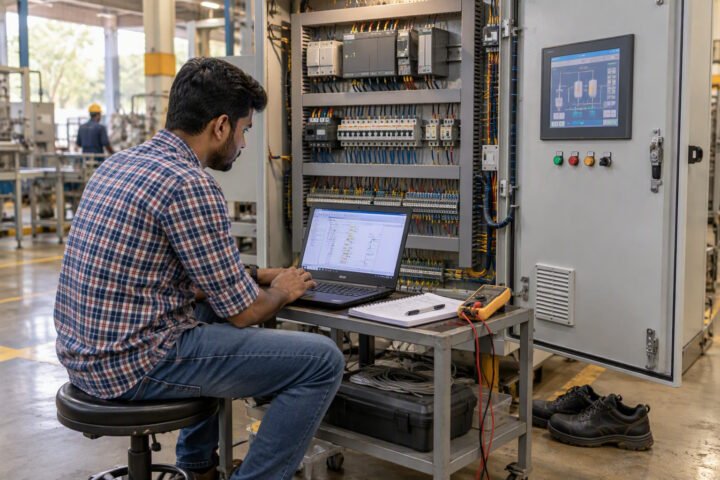
Automation engineering in India is less about inventing machines and more about making other people’s machines talk to each other on a deadline. The work is commissioning, documentation and troubleshooting, not research.
That is not a downgrade. It is a well-paid, in-demand trade with a clear skill ladder, and it is one of the few paths where a diploma holder can reach a senior technical role without a master’s degree. This guide explains what the job actually involves, what to learn in what order, what the market pays in 2026, and how to prove competence before you have experience.
What the job actually is
An automation engineer makes a machine or a line run automatically and prove that it ran correctly. In practice that means writing PLC logic, building HMI screens, configuring drives and fieldbus networks, integrating robots, wiring and testing safety circuits, and then standing on the shop floor at 11 pm because a sensor is giving a false trigger.
- PLC programming — ladder for most Indian installations, structured text for more complex logic.
- HMI and SCADA — screens that an operator can use with oily hands and no training.
- Drives and motion — VFD parameters, servo tuning, encoder wiring.
- Fieldbus — Profinet, EtherNet/IP, Modbus TCP, EtherCAT; usually one deeply and the rest by reading manuals.
- Robot integration — IO handshakes, safety signals, program selection from the PLC.
- Documentation — electrical drawings, IO lists, sequence descriptions, backup procedures.
The last item is what separates a reliable engineer from a talented one. A line that only one person can fix is a liability, and companies know it.
Where the jobs are
Four employer types, and they teach different things.
| Employer | What you do | What you learn fast | Trade-off |
|---|---|---|---|
| System integrator | Build and commission cells for many clients | Breadth, pressure, travel | Long site stints, variable work |
| OEM machine builder | Standard machines, repeated builds | Depth, design discipline, reuse | Narrower exposure |
| End-user factory | Maintain and improve existing lines | Reliability, troubleshooting, processes | Slower pace, internal politics |
| Panel builder | Wiring, testing, documentation | Electrical fundamentals, quality | Less programming early on |
For a first job, a system integrator gives the steepest learning curve. Two years there is equivalent to four in a single factory, provided you are actually allowed to touch the code and not just carry tools.

The skill ladder, in order
Most self-taught engineers skip step one and then wonder why commissioning is hard. Do these in sequence.
- Electrical fundamentals. Relay logic, contactors, overloads, fuses, earthing, 24 V control circuits. If you cannot read a panel drawing, nothing above this works.
- One PLC platform, deeply. Siemens TIA Portal or Rockwell Studio 5000 are the two that appear in most Indian job ads. Learn one properly; the second transfers.
- HMI basics. Tags, alarms, trends, user levels. An HMI that hides alarms is worse than no HMI.
- Drives. Parameter sets, motor nameplate entry, basic V/Hz and vector control, and what causes an overcurrent trip.
- Fieldbus. How to configure a device, read its diagnostics and find a dropped node.
- Robot IO integration. Handshake design, safety signals, and how the PLC starts a robot program.
- Safety. Category, performance level and why a safety relay is not a normal relay. The safety relay wiring guide is a practical start.
- Documentation and backups. Versioned programs, as-built drawings, a restore procedure someone else can follow.
If you are starting from zero, the PLC programming guide for beginners and the collection of ladder logic examples cover the first two rungs of that ladder.
Automation, robotics and controls: what is the difference
The titles overlap heavily in Indian job postings, which is why candidates get confused about what to prepare.
| Title | Core focus | Typical tools |
|---|---|---|
| Automation engineer | Machine sequencing, PLC, HMI, drives | TIA Portal, Studio 5000, VFDs |
| Controls engineer | Control system design, motion, safety | PLC, servo, safety PLC, CAD |
| Robotics engineer | Robot programming, simulation, sometimes perception | Robot pendants, RobotStudio, ROS |
| Mechatronics engineer | Mechanical plus electronics plus control | CAD, PLC, embedded |
In a small integrator, one person does all four. In a large OEM they are separate roles with separate interviews. Read the job description for tools, not for the title. The PLC versus robot controller comparison explains where the boundary usually sits in a cell.
What it pays in India
These are broad market bands for 2026, not offers. City, industry and company size move the number more than the title does. Manufacturing hubs such as Pune, Chennai, Ahmedabad and Bengaluru tend to pay at the upper end.
| Experience | Indicative CTC | What changes the number |
|---|---|---|
| Fresher, diploma or BE | ₹2.5 to ₹5 LPA | Internship, one platform depth, willingness to travel |
| 2 to 4 years | ₹5 to ₹9 LPA | Independent commissioning, robot experience |
| 5 to 8 years | ₹9 to ₹18 LPA | Owning a line, safety systems, customer-facing role |
| Lead or manager | ₹18 to ₹32 LPA and above | Team size, project value, sector |
Site allowances, travel reimbursement and overtime vary widely and can matter as much as base pay in the first three years. Ask about them explicitly. The robotics engineer salary guide compares adjacent roles, and robotics jobs for freshers covers where the entry-level openings actually are.
How to break in without experience
Employers hiring a fresher are not looking for expertise. They are looking for evidence that you will not be a safety risk on site and that you can learn a platform quickly. Three things provide that evidence.
- A working project with a PLC or a robot. Even a simulated one. A TIA Portal project that sequences a conveyor, a cylinder and a sensor, with an HMI screen and an alarm list, is a credible artefact.
- A wiring sample. A small panel with a contactor, overload, 24 V supply and terminal blocks, wired to a drawing you produced. Photograph it and include the drawing.
- A written explanation. Two pages on what the project does, what went wrong, how you debugged it and what you would change. This is the part candidates skip and the part interviewers remember.
The robotics portfolio guide covers how to present this without exaggerating, and the internship guide covers getting the first site exposure. If your interest is closer to firmware than panels, the embedded systems career guide is the parallel path.
Interview questions worth preparing
Automation interviews are practical. Expect a drawing, a fault and a whiteboard.
- “A motor trips on overcurrent at start. What are the first five things you check?” Talk about mechanical binding, parameter mismatch, phase loss, acceleration time and the drive’s fault code history.
- “How would you start a robot program from a PLC?” Describe the handshake: ready, enable, start, running, fault, with a heartbeat or timeout.
- “What is the difference between a safety relay and a normal relay?” One is designed and certified to fail safely and is monitored; the other is not.
- “A sensor gives false triggers once an hour. How do you find the cause?” Scope the signal, check supply and grounding, check for a nearby drive or welder, then look at mechanical mounting.
- “Walk me through your project.” This is the question that decides the interview. Have numbers: cycle time, IO count, what failed, what you fixed.
If you cannot answer the first four, say what you would check and how you would find out. Interviewers accept honest reasoning far more readily than confident nonsense, because on site the second one is dangerous.
The part nobody warns you about
Commissioning is travel, odd hours and pressure. A machine that was supposed to run on Monday runs on Friday, and the customer is standing behind you. You will spend weeks in towns with no good food and work night shifts during a shutdown.
People who thrive treat it as paid apprenticeship and keep a log of every fault they solve. After three years that log is worth more than any certificate, because it is a searchable memory of problems you have already fixed. People who burn out are usually the ones who never set a boundary on travel and never wrote anything down.
Ask about travel percentage, site allowance and comp-off policy in the interview. A role with 60 percent travel and no allowance is a different job from the same title with 20 percent.
Where it leads after five to ten years
Before moving into self-employment, review the independent automation consulting career guide. It separates advisory work from integration and specialist validation, and explains evidence, contracts and billable-day economics without promising a particular income.
- Lead automation engineer — owns a cell or line technically and mentors juniors.
- Project manager — owns schedule, budget and customer communication; less code, more meetings.
- Controls architect — sets standards across projects; the most technical long-term path.
- Independent consultant — commissions and audits for multiple clients; needs a reputation first.
- Product or application engineer at an OEM — closer to design, more stable hours.
Whichever path you choose, the transferable assets are the same: a documented body of solved problems, fluency in one platform, and a reputation for leaving a machine in a state someone else can maintain. The robotics skills roadmap maps the technical side year by year.
Can I become an automation engineer with a diploma instead of a degree?
Yes. Diploma holders are common in commissioning and maintenance roles. Depth in one PLC platform plus documented project work matters more than the degree for the first job.
Which PLC should I learn first, Siemens or Rockwell?
Learn whichever appears most in job ads in your city. Siemens TIA Portal dominates in many Indian manufacturing and automotive supplier plants; Rockwell is strong in some segments. The second platform transfers quickly.
Is automation engineering a good career in India in 2026?
Demand is steady because factories keep automating, and the skill is portable across industries. The trade-off is site travel and commissioning pressure in the early years.
Do I need to know robotics to be an automation engineer?
Not to start, but robot integration is increasingly part of the role. Learning the IO handshake and safety signals makes you significantly more employable.
How long does it take to become independent on site?
Typically 18 to 30 months of supervised commissioning. The marker is being trusted to modify a running line's program without someone checking every change.
A club is the cheapest place to build the skills on that ladder, and the club guide maps the twelve-month rhythm.
Commissioning cobot cells is a common early task for automation engineers, and the cost guide shows what the integration work involves.
Most automation engineers start with a site internship, and the internship guide maps the application timeline.
Maintenance is often the fastest door into automation, and our robotics maintenance engineer guide maps the route and the pay bands.
If you are comparing offers, the PLC salary guide for India breaks down the bands by experience and employer type.
Sources and further reading
- International Society of Automation — automation body of knowledge and certification paths.
- Siemens Industry Online Support — TIA Portal manuals and application examples.
- Rockwell Automation — Studio 5000 and control system documentation.
- International Electrotechnical Commission — IEC 61131 and industrial safety standards.