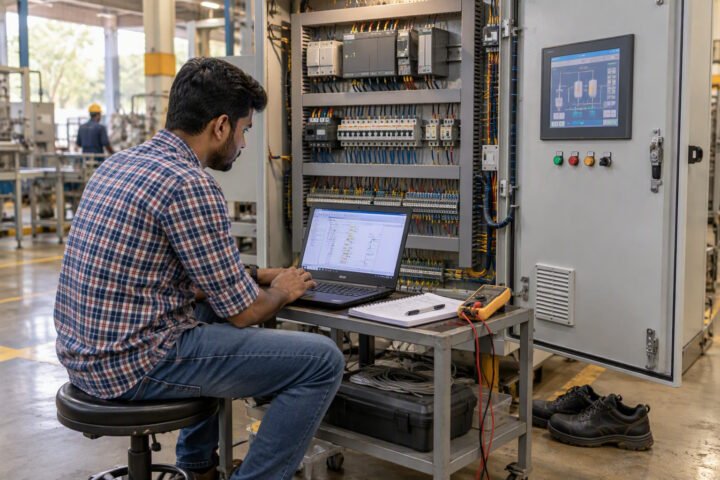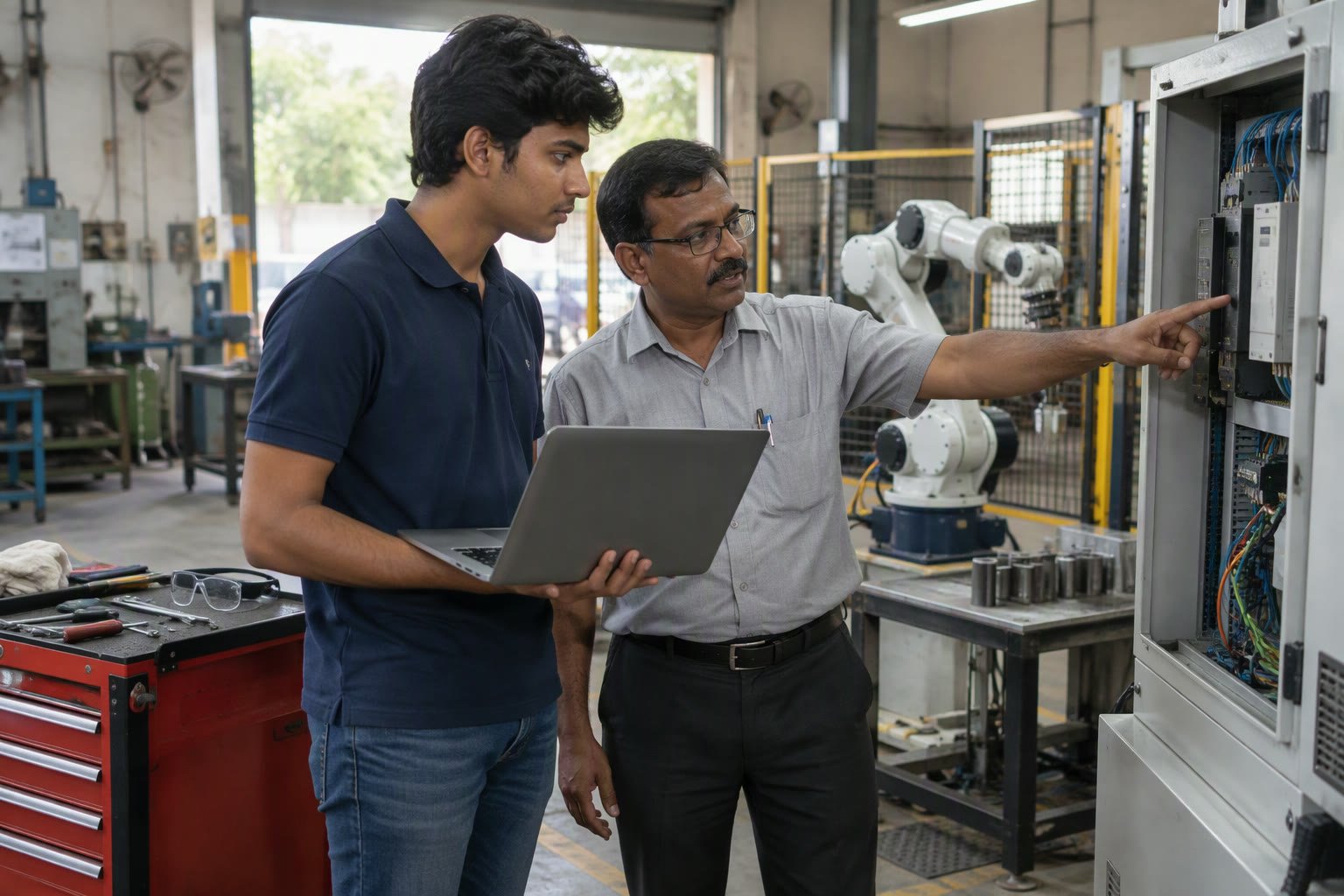
Most robotics internships in India are not advertised as robotics internships. They are automation trainee roles, maintenance internships, embedded firmware projects and machine-vision trials inside small companies that never post on a campus portal.
Finding one is a search problem with a process, not a lottery. This guide covers where the roles actually sit, what to prepare, how to approach companies that do not advertise, and how to turn three months into a job offer.
The four kinds of internship you will meet
| Type | Where it sits | What you learn | Stipend range |
|---|---|---|---|
| College-mandated | Local SME, often through a professor | Site discipline, basic integration | ₹0–8,000 per month |
| Startup | Drone, AMR, agri-tech, lab automation | Breadth, shipping under pressure | ₹8,000–25,000 |
| Industrial OEM or integrator | Robot cell builders, machine builders | Commissioning, PLC, safety | ₹10,000–25,000 |
| Research lab | IIT, IISc, CSIR, DRDO projects | Depth, publications, simulation | ₹5,000–20,000 or unpaid |
The stipend is the least useful way to compare these. A ₹8,000 internship where you commission a real cell teaches more than a ₹25,000 internship where you update spreadsheets. Ask what you will own in week one.
When the hiring actually happens
Robotics hiring in India follows the academic calendar and the project calendar. Campus placements run in the final year, but internships at SMEs are decided much later and with much less notice.
- November to January: summer internship applications for research labs and large OEMs.
- February to April: SME and startup hiring for May starts, often through direct contact.
- May to July: the internship itself; many companies decide on extensions in the last two weeks.
- August to October: final-year project partnerships, which often become internships.
If you start looking in May, you are competing for the leftovers. Start in February, and start with companies rather than portals.
The three assets that decide your application
Recruiters at small robotics companies do not read long resumes. They look for evidence that you have built something, broken it, and fixed it. Three assets do most of the work.
- A one-page resume with projects above coursework, and every claim tied to a number or a link.
- A portfolio page with three projects: problem, build, failure, fix, result. Photos and code links help.
- A two-minute demo video of the robot doing the thing, filmed on a phone is fine.
If you do not have three projects, build them. A line follower with a tuned PID, a camera stream with a detection overlay, and a small ROS 2 package that publishes sensor data are enough to start a conversation. The portfolio guide covers how to present them.
How to approach companies that do not advertise
Make a list of 30 companies within commuting distance that build machines, integrate robot cells, make drones, or automate a factory. Then contact the engineering manager, not the HR inbox.
Subject: Internship for 8 weeks - built a ROS 2 rover, can help with integration

Sir/Madam,

I am a third-year mechanical engineering student at [college].
I built a four-wheel rover that maps a room using ROS 2 and a lidar,
and documented the build here: [link].

I am looking for an 8-week internship from May. I can help with
wiring, sensor mounting, test documentation and basic Python scripts.
I am based in [city] and can travel to your site.

Could I send a one-page resume, or visit for 15 minutes?

Regards,
[Name] [Phone]
Short, specific, and asking for a small commitment. Send it to ten companies, follow up once after a week, and keep a tracker. A 10 percent reply rate is normal; that is three conversations from 30 emails.
What to learn before day one
You do not need to know everything. You need to be useful in the first week without supervision. Four skills cover most entry-level work.
- Reading a wiring diagram and using a multimeter safely.
- Basic Python or C for reading a sensor and logging data.
- Git, so your work does not live in a folder called final_final.
- One controller platform: Arduino, ESP32 or a PLC, depending on the company.
If the company builds robot cells, learn what a safety relay and a light curtain do before you arrive. If it builds drones, learn the basics of a flight controller and a LiPo pack. Ten hours of preparation makes you look like a different candidate.
The first week matters more than the interview
Most interns are judged in the first ten days. Arrive early, ask what “done” means for your first task, and write things down. The intern who documents a wiring change properly gets the next task; the one who only talks gets the filing.
- Ask for one clearly scoped task with a deliverable and a date.
- Keep a daily log of what you tried and what failed.
- Ask before touching a live panel or a powered robot.
- Photograph your work and label the photos while you remember.
- Show a working result at the end of week one, even if it is small.
Documentation is the cheapest way to stand out. A clear test report or a wiring note that the next person can follow is worth more than an extra feature that nobody can maintain.
Turning the internship into an offer
Companies hire interns they trust with real work. Earning that trust is a sequence, not a single heroic moment. Finish the assigned task, then ask for the next one, then offer to close a small gap you noticed.
In the last two weeks, ask for a short review: what went well, what to improve, and whether there is a full-time or extended role. Ask in person, and have a one-page summary of what you delivered ready to leave behind.
If the answer is no, ask for a reference and a written summary of your work. Both are useful when you apply elsewhere, and both are easier to get while you are still on site.
Red flags worth walking away from
- No named supervisor and no task list on day one.
- Work that is only data entry or cleaning, with no exposure to the machines.
- Unpaid work with a promise of a job that has no written terms.
- Asking you to work on live electrical panels without supervision.
- A company that cannot explain what it builds in two sentences.
An unpaid internship can be worth it at a research lab with real projects. It is rarely worth it at a company using interns as free labour. The difference is whether you leave with skills and evidence.
Where the jobs lead
An internship is a bridge, not a destination. The same three projects and the same documentation habit carry into your first job, and into the interview that follows. The fresher resume guide and the automation career guide cover the next step.
Start with one company this week. A list of 30 and ten emails beats another month of planning.
Do Indian companies pay robotics interns?
Many SMEs pay ₹8,000–25,000 per month, research labs vary widely, and some college-mandated internships are unpaid. Ask about the stipend in the first call, and weigh it against what you will actually work on.
Can I get a robotics internship without projects?
Rarely at a good company. Build two small projects first: a sensor logger and a robot that does one task reliably. Coursework alone does not prove you can build.
Is a remote robotics internship useful?
For software, simulation and data work, yes. For anything involving hardware, commissioning or safety, you need to be on site. Be honest about which one the role is.
Which companies in India hire robotics interns?
Robot integrators, machine builders, drone startups, AMR companies, agri-tech firms and research labs. Most are small and hire through direct contact rather than campus portals.
How long should an internship be?
Eight to twelve weeks is enough to finish a scoped task and earn a reference. Longer internships are worth it when you are given ownership of a subsystem.
For the application timing and the outreach email itself, read how to get a robotics internship in India.
Sources and further reading
- AICTE Internship Portal — government-listed internship opportunities.
- National Apprenticeship Training Scheme — apprenticeship and training positions.
- Internshala — internship listings across engineering roles.
- IEEE — student branches, competitions and technical communities.