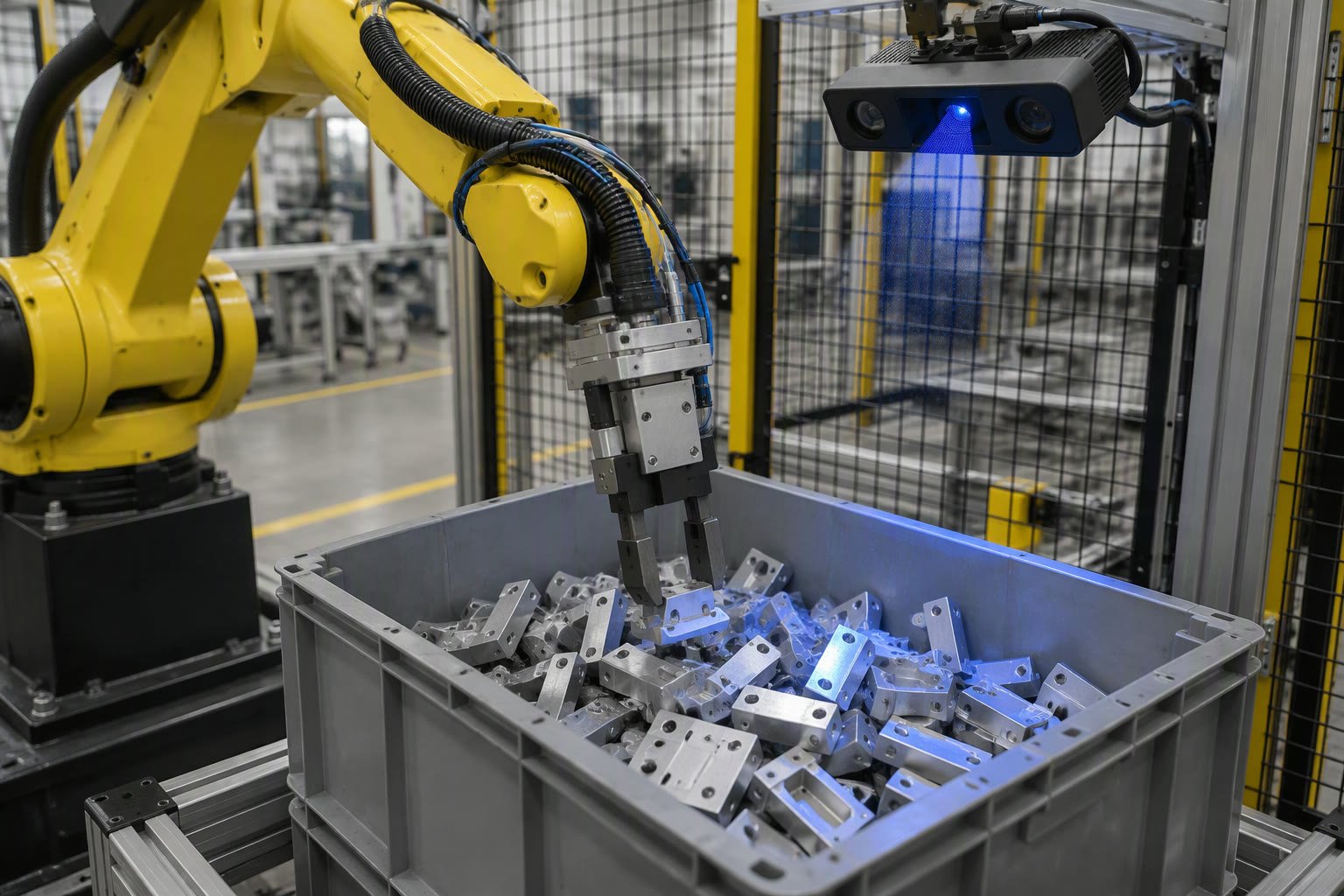
Bin picking has been “two years away” for a decade. It now works, but only inside a narrow set of conditions: known parts, controlled lighting, shallow bins and a tolerance for a pick rate well below what a conveyor-fed cell achieves.
This guide explains what a working bin-picking cell needs, the sensor and software choices, the cycle-time reality, costs in India, and the applications where the problem is still not solved.
Why bin picking is hard
A conveyor-fed robot knows where the part is. A bin-picking robot has to find a part in a pile, work out its pose in six degrees of freedom, decide whether a gripper can reach it without colliding, plan a path, and grasp it without disturbing the pile. Every one of those steps can fail.
The difficulty scales with part geometry. A cylinder in a bin has an infinite number of valid poses and can be picked from almost anywhere. A flat bracket with through-holes can only be grasped at specific points, and a smooth casting may have no accessible surface at all.
The four components
| Component | Typical choice | What matters |
|---|---|---|
| 3D sensor | Structured light or time-of-flight camera | Resolution on shiny or dark surfaces |
| Pose estimation software | Model-based matching or learned models | Accuracy for your part family |
| Gripper | Vacuum, magnetic, or two/three-finger | Reaching between parts without collision |
| Motion planning | Robot controller with collision checking | Handling failed picks and re-attempts |
Sensors: the honest limits
Structured-light cameras give high resolution but struggle with shiny metal and with parts that have deep holes. Time-of-flight cameras handle a wider range of surfaces but have lower resolution and more noise. Both suffer in ambient light that changes during the day.
Practical measures: enclose the bin area to control light, use a camera with a short working distance to maximise resolution, and test on the worst part in the family, not the easiest. A part with a black anodised finish and a mirror-polished face is the real test.
For a general grounding in 3D vision, the depth camera guide and the vision-guided robotics guide cover sensor selection and calibration.
Cycle time: the number nobody quotes
A conveyor cell can pick every 3 to 4 seconds. A bin cell typically manages 5 to 12 seconds per pick, and that is when everything works. The reasons are unavoidable.
- Scan time. Capturing and processing a 3D image takes 0.3 to 1.5 seconds.
- Re-planning. When the first target is unreachable, the system picks the next candidate, which adds time.
- Deep picks. As the bin empties, the robot has to reach further and move more slowly to avoid collisions.
- Failed picks. A vacuum cup that does not seal is a wasted cycle; expect 3 to 10 percent failures in real production.
- Bin exchange. Emptying and replacing a bin stops the cell unless a second bin is buffered.
Plan the business case on 6 to 8 seconds per pick and 90 to 95 percent pick success. If the required rate is higher, the answer is usually a different feeding method, not a better camera.
When bin picking works
- One part family with modest variation in size and finish.
- Parts that can be grasped from at least three orientations.
- Bins that are shallow relative to the part size, ideally depth below three times the part height.
- A rate requirement that a 6 to 8 second cycle satisfies.
- Downstream process that can tolerate an occasional missing part or a retry.
It usually fails when the bin is deep and narrow, the parts interlock, the finish is mirror-like, or the required rate is above 12 picks a minute. In those cases, a bowl feeder, a step feeder or a human unpacking station is cheaper and more reliable.
Gripper design decides success
The gripper must reach into the pile, grasp without disturbing neighbours, and release cleanly. That usually means a slim profile, a compliant finger or a small vacuum array, and a wrist that can rotate the tool to approach from the best angle.
Magnetic grippers work superbly on ferrous parts and fail completely on aluminium. Vacuum works on flat, non-porous surfaces and fails on castings with rough texture. Soft grippers handle irregular shapes but wear. The trade-offs are covered in the gripper design guide.
Budget for two or three gripper iterations. The first design is almost always wrong, and the cost of a revised gripper is small compared with the cost of a stalled project.
Costs in India
| Item | Indicative cost | Notes |
|---|---|---|
| 3D camera | ₹4–15 lakh | Resolution and surface handling drive price |
| Bin-picking software licence | ₹5–18 lakh | Often per robot, annual support extra |
| Six-axis robot, 10–20 kg | ₹18–40 lakh | Reach and payload for bin depth |
| Custom gripper | ₹2–10 lakh | Two to three iterations realistic |
| Complete cell with guarding | ₹55 lakh–1.6 crore | Including integration and commissioning |
How to de-risk the project
Insist on a paid feasibility study on real parts before the purchase order. It should produce a measured pick rate, a measured success rate, and a clear statement of the bin conditions the system needs.
If the integrator refuses a feasibility study, that is information. A bin-picking project without a trial is a gamble, and the technology is mature enough that a competent integrator can demonstrate it in a week.
Then run a pilot on one cell for three months before rolling out. The pilot will surface the bin-exchange procedure, the operator training and the maintenance routine, none of which appear in a simulation.
The alternative worth considering
If the parts are small and the volume is high, a vibratory bowl feeder with a vision check costs a fraction of a bin-picking cell and runs at 60 to 200 parts a minute. It needs a dedicated feeder per part family, which is its limitation, but for a stable product mix it is the better engineering answer.
Bin picking wins when the mix changes often, the volumes are moderate, and dedicating a feeder to each part is not viable. That is a real and growing segment, but it is narrower than the marketing suggests.
What is robotic bin picking?
Bin picking uses a 3D camera and pose-estimation software to locate parts in a pile, then commands a robot to grasp and remove them. It replaces manual unpacking where part orientation is unknown.
How fast is a bin-picking robot?
Typically 5–12 seconds per pick, or 5–12 picks a minute, with 90–95% success. Scanning, re-planning, deep picks and retries all add time. Conveyor-fed cells are considerably faster.
How much does a bin-picking cell cost in India?
Indicative ₹55 lakh–1.6 crore for a complete cell. Components include a 3D camera at ₹4–15 lakh, software licence ₹5–18 lakh, robot ₹18–40 lakh and a custom gripper ₹2–10 lakh plus integration.
When does bin picking not work?
Deep narrow bins, interlocking parts, mirror finishes, and required rates above about 12 picks a minute. In those cases a bowl feeder, step feeder or manual unpacking station is cheaper and more reliable.
How do I de-risk a bin-picking project?
Require a paid feasibility study on real parts that reports measured pick rate and success rate, then run a three-month pilot on one cell before rolling out. A supplier who refuses a trial is a warning sign.
Sources and further reading
- A3 Association for Advancing Automation — bin picking and vision resources.
- ISO 9283 — industrial robot performance criteria.
- OpenCV — open-source computer vision library used in many vision systems.
- MoveIt — open-source motion planning framework for robotic manipulation.