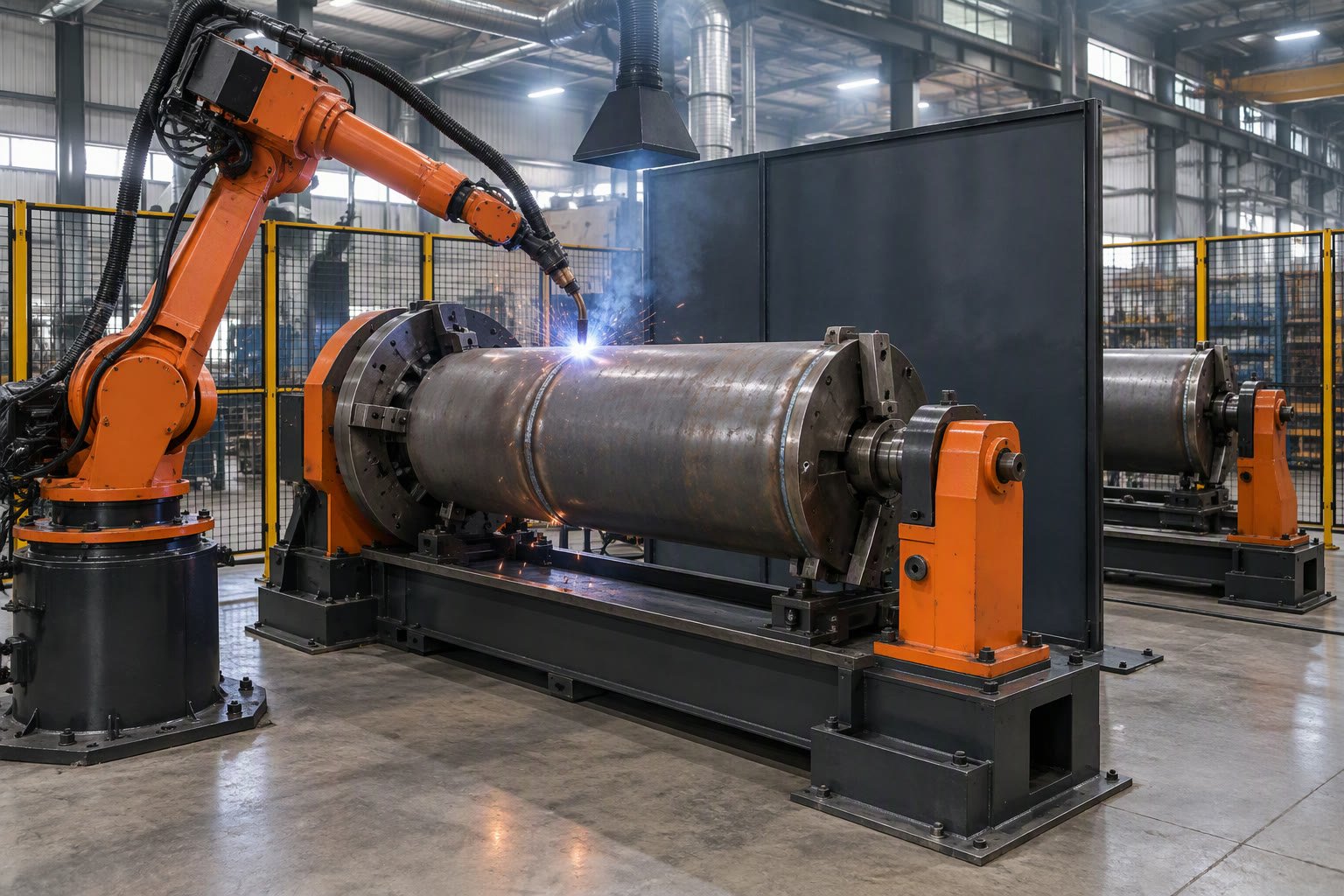
A robot welding positioner is what turns a fixed cell into a production machine. The robot can only weld what it can reach at the right angle, and almost no real fabrication job stays in one position.
This guide covers the positioner types used with welding robots, how to size one from torque rather than guesswork, how the positioner is coordinated with the robot, and what the hardware costs in India.
What a positioner actually does
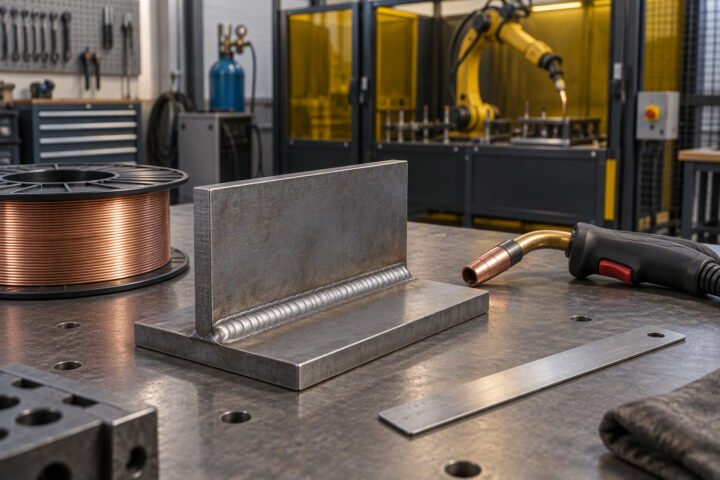
A positioner holds the workpiece and rotates or tilts it so the weld stays in the flat or horizontal position. Two things follow from that. First, welding in the flat position lets you run higher current and larger wire without the puddle running away, so the same joint is welded faster and with fewer defects. Second, the robot can stay inside a comfortable working envelope instead of stretching to reach awkward geometry.
That is why a modest six-axis robot with a good positioner often outperforms a bigger robot without one. The positioner is not an accessory. It is half the cell.
Positioner types and where each one fits
| Type | Motion | Typical part | Best fit |
|---|---|---|---|
| Turntable | Rotation about vertical axis | Round flanges, rings, discs | Circular welds and short shafts |
| Headstock and tailstock (H-frame) | Rotation about horizontal axis | Long cylinders, beams, frames | Any part that needs both ends supported |
| Drop-centre | Rotation about horizontal axis, low centre height | Wide, heavy fabrications | Deep sections where a high centre would put the weld out of reach |
| Trunnion | Tilt plus rotation | Complex weldments | Two-axis positioning for irregular parts |
| Skyhook / L-type | Overhead rotation | Large frames, tanks | Very large parts that would need deep foundations otherwise |
| Indexing table (two stations) | 180 degree index | Small to medium parts | Load one side while the robot welds the other |
Size from torque, not from payload alone
Positioners are sold by payload, but payload alone is a misleading number. A 500 kg positioner rated for a compact block will struggle with a 300 kg frame whose centre of gravity sits 800 mm from the axis. The load is not the mass; it is the mass times the distance.
Work out three figures before you talk to a supplier: the static holding torque, the tilting torque during acceleration, and the inertia the drive has to stop. Then check that the manufacturer’s rating is quoted at a comparable centre of gravity. A rating given at 100 mm offset and a real part at 700 mm offset are not the same machine.
Torque and inertia check (H-frame positioner)

Given:
  m  = 400 kg   (fixture + part)
  r  = 0.55 m   (centre of gravity offset from axis)
  t  = 1.5 s    (index time for 180 deg)

Static holding torque:
  T_hold = m * g * r = 400 * 9.81 * 0.55 = 2,158 Nm

Angular travel and acceleration (trapezoidal profile,
equal accel and decel, no dwell):
  theta = 180 deg = 3.1416 rad
  alpha = 4 * theta / t^2 = 4 * 3.1416 / 2.25 = 5.58 rad/s^2

Inertia of an offset mass about the axis:
  J = m * r^2 = 400 * 0.3025 = 121 kg m^2

Dynamic torque at the drive:
  T_acc = J * alpha = 121 * 5.58 = 675 Nm

Peak torque the drive must deliver at the gearbox output:
  T_peak ~= T_hold + T_acc = 2,833 Nm   (worst case, CG at 3 o'clock)

Add a service factor of 1.3 for weld spatter, off-centre
fixtures and braking shock: about 3,700 Nm.

A 500 kg-rated positioner with a 2,000 Nm output will not
do this job, even though the part weighs less than the rating.
Run the same check with the actual fixture mass and centre of gravity from the CAD model. Fixtures are often heavier than the part they hold, and a tall fixture moves the centre of gravity further out than anyone expects. If the numbers are close to the limit, ask for the manufacturer’s torque curve, not the headline rating.
Fixed speed, servo, or servo with robot coordination
There are three levels of positioner control, and the price gap between them is real. Choose deliberately.
- Fixed-speed rotation. Cheapest. Good for continuous circular welds where the robot only needs a steady surface speed. Starting and stopping is manual or by simple I/O.
- Servo positioner with its own drive. Indexes to set angles, holds position, and can run a programmed sequence. The robot and positioner communicate through handshake signals: the positioner reports “in position”, the robot starts its program.
- Coordinated external axis. The positioner is an axis of the robot controller, so the robot and the part move together as one kinematic chain. This is the only way to keep the torch angle constant while the part turns through a long weld.
Coordination costs more because the positioner must be a robot-controller axis, often with a matched servo package and a dedicated drive module. It also complicates programming, since the operator now creates paths in a combined frame. The payoff is access to welds that are simply impossible with a handshake-only setup, such as a continuous circumferential weld on a large diameter with a tight torch angle window.
If your parts can be welded in indexed positions rather than continuously, skip coordination. It is the most common overspend in small welding cells.
Two-station layouts pay back fastest
The largest hidden loss in a welding cell is the time the robot spends waiting while someone loads and unloads. A two-station positioner, or a turntable with a dividing wall, lets the operator load one side while the robot welds the other. Arc-on time can move from around 35 percent to 60 percent or better on the same robot.
The dividing wall is not optional. It must be a solid screen rated for the process, and it must be interlocked so that the robot cannot weld while the operator’s side is open. This is where cheap two-station designs fail safety audits. Plan the wall, the interlock and the light curtain together with the positioner, not after it arrives.
Cell layout and reach planning around a positioner is covered in the robot cell layout guide, and fixture design that supports rotation without distortion is covered in the welding fixture guide.
Safety points specific to positioners
- Crushing at the pinch point. The gap between a rotating frame and a fixed base closes fast. Guarding must cover the full rotation, not just the operator’s normal approach.
- Unexpected rotation on power-up. A servo positioner holding an unbalanced load can move when the drive is enabled. Use brakes rated for the holding torque, and check the brake before commissioning.
- Part ejection. A fixture that relies on gravity plus a clamp can release the part if the clamp loses air pressure. Use mechanically locking clamps on any axis that goes past horizontal.
- Access during indexing. The interlock must stop motion before a gate can be opened, and the gate must not be openable while the axis is moving.
The cell as a whole still has to meet the requirements in the robot safety standards guide, including the risk assessment and the validation of each safety function.
What a positioner costs in India
| Item | Indicative price | Notes |
|---|---|---|
| Turntable, 100–250 kg | ₹1.2–4 lakh | Manual or fixed-speed rotation |
| Turntable, 500 kg, servo | ₹4–9 lakh | Indexing with brake and encoder |
| H-frame, 1 tonne | ₹8–18 lakh | Headstock, tailstock, base |
| H-frame, 2 tonne servo | ₹15–32 lakh | Depends heavily on centre height |
| Drop-centre, 2–5 tonne | ₹12–28 lakh | Large fabricated structures |
| Coordinated external axis | +40–70% on positioner | Plus robot controller option and drive |
| Two-station indexing | +25–50% on positioner | Before the dividing wall |
| Dividing wall and interlock | ₹1.2–5 lakh | Process-dependent, do not skip |
| Positioner-to-robot integration | ₹1.5–6 lakh | Programming, handshake, testing |
What to put in the enquiry
- Part drawings with mass and centre of gravity for the heaviest and the most offset part.
- Fixture mass, since it often exceeds the part mass.
- Required index angles and cycle time per index.
- Whether continuous coordinated motion is needed or indexed positions are enough.
- Welding process and current range, because spatter protection and cable routing depend on it.
- Shop power supply and whether a transformer is available for the drive.
- Foundation details, especially for drop-centre and skyhook designs.
Ask each supplier for the torque rating at your actual centre of gravity, the brake holding torque, and the repeatability of the index. Those three numbers separate a positioner that will hold tolerance from one that will drift after a year of production.
What is a welding positioner used for?
It holds and rotates the workpiece so welds can be made in the flat or horizontal position, which allows higher current, faster travel and fewer defects. It also keeps the part inside the robot's comfortable working envelope.
How do I size a welding positioner?
Size from torque and inertia, not payload alone. Calculate holding torque as mass times gravity times centre-of-gravity offset, then add the accelerating torque from inertia and angular acceleration. A 400 kg part at 550 mm offset can need close to 3,700 Nm peak.
Does a positioner need to be coordinated with the robot?
Only if the torch angle must stay constant through a continuous weld. If parts can be welded in indexed positions, a servo positioner with a handshake to the robot is cheaper and easier to program.
What does a welding positioner cost in India?
Indicative ranges: a 100–250 kg turntable ₹1.2–4 lakh, a 500 kg servo turntable ₹4–9 lakh, a 1 tonne H-frame ₹8–18 lakh, a 2 tonne servo H-frame ₹15–32 lakh, and a drop-centre for large structures ₹12–28 lakh. Coordination adds 40–70%.
Why does my two-station cell fail safety audits?
Usually because the dividing wall is not rated for the process, the interlock does not stop rotation before the gate opens, or mechanically locking clamps are missing on axes that pass horizontal. Plan the wall, interlock and light curtain together with the positioner.
Sources and further reading
- ISO 10218-1 — safety requirements for industrial robots and robot systems.
- ISO 9283 — performance criteria and test methods for industrial robots.
- American Welding Society — welding position definitions and qualification guidance.
- A3 Association for Advancing Automation — robot cell and positioner integration resources.