A gantry robot is the right answer whenever the part is long, the travel is straight, or the arm cannot carry the tool. It is also the most predictable robot to build, which is why Indian machine builders often start here.
This guide covers gantry and cartesian structures, when they beat an articulated arm, how to size the axes, what a system costs in India, and the stiffness and accuracy issues that decide whether the machine performs as designed.
What counts as a gantry robot
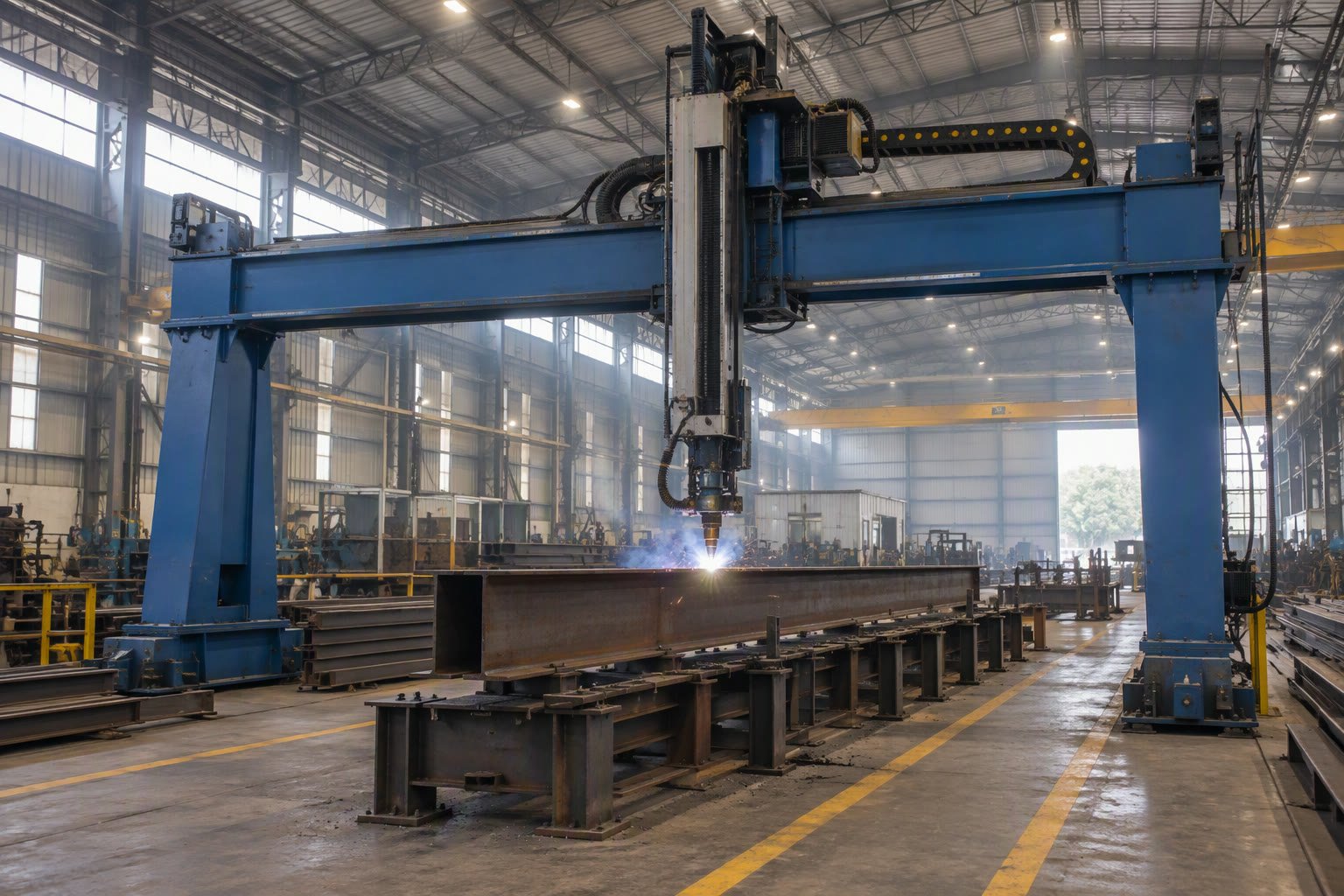
A gantry is a robot whose axes are linear and mounted on a rigid frame. The frame may be a bench-top two-axis table, a cantilevered arm, or a full portal spanning several metres with legs on both sides. The tool moves in X, Y and Z, with rotation added only where the task needs it.
| Structure | Typical span | Best fit |
|---|---|---|
| XY table | 0.3–1.5 m | Dispensing, assembly, light pick and place |
| Cantilever gantry | 1–3 m | Machine tending, palletising in a bay |
| Portal gantry, single beam | 3–8 m | Loading long parts, welding, cutting |
| Portal gantry, double beam | 6–20 m | Heavy welding, slab handling, storage |
| Telescopic mast | Vertical 2–6 m | Deep bin picking, die handling |
When a gantry beats an articulated arm
- Long travel in a straight line. Welding a 6 m beam with a six-axis arm needs a 7th-axis track and a large working envelope. A gantry covers it with two beams and a carriage.
- Heavy tool, light part. A welding torch with a wire feeder, or a spindle, is easier to carry on a rigid frame than on a wrist.
- Enclosed process. Gantries fit naturally over a tank, a press or a conveyor where an arm would collide with the structure.
- Simple, repetitive motion. If the path is mostly straight lines, cartesian kinematics are easier to program, easier to verify and cheaper to build.
- Multiple tools on one frame. Several carriages can share a beam, each doing a different job.
Conversely, a gantry is a poor choice when the work requires reaching into a complex volume, when the layout will change frequently, or when the machine must be moved. An articulated robot is more flexible per rupee in those cases, as set out in the industrial robot selection guide.
Stiffness decides accuracy, not the servo
Most gantry accuracy problems are structural, not electrical. When the carriage accelerates, the beam deflects; when the tool pushes on the part, the frame twists. A servo can hold position perfectly and the tool tip still moves several tenths of a millimetre.
Three design habits prevent this. Keep the tool close to the beam to reduce the bending moment. Use a box section or a truss rather than a flat plate for long spans. And mount the linear rail on a machined surface, not on a welded frame that has been painted and shimmed.
Deflection check for a simply supported beam

delta = (F x L^3) / (48 x E x I)

F = tool weight + cutting force (N)
L = span between supports (mm)
E = 210,000 N/mm2 for steel
I = second moment of area (mm4)

Example: F = 500 N, L = 4,000 mm, I = 8 x 10^6 mm4
delta = (500 x 64 x 10^9) / (48 x 210,000 x 8 x 10^6)
      = 3.2 x 10^13 / 8.06 x 10^13
      = 0.40 mm

At 0.40 mm static deflection, dynamic error under
acceleration will be larger. Stiffen the section or
shorten the span before choosing a better servo.
Run this calculation before the mechanical design is frozen. It takes ten minutes and prevents the most expensive kind of redesign, which happens after the frame is welded.
Drive choices
Three options, with clear trade-offs.
- Rack and pinion with a servo and gearbox. The standard for long travel. Fast, stiff and reasonably priced, but needs lubrication and protection from dust.
- Ballscrew. Precise and quiet for strokes up to about 3 m. Critical speed and whip limit longer screws, and the screw must be covered.
- Belt drive. Cheapest for light loads and long travel. Accurate enough for pick and place but not for machining or welding.
Servo sizing follows the same logic as any axis: moving mass, acceleration, friction and gravity. The servo drive selection guide covers the calculation, and gearbox choice matters more on a gantry than on an arm because backlash appears directly at the tool.
Costs in India
| System | Indicative cost | Notes |
|---|---|---|
| Two-axis XY table, 500 mm | ₹1.5–4 lakh | Belt or ballscrew, stepper or small servo |
| Three-axis cantilever gantry, 2 m | ₹6–15 lakh | Rack and pinion, servo, basic guarding |
| Portal gantry, 6 m span, 100 kg | ₹18–45 lakh | Structural frame, twin drives, safety |
| Welding gantry with torch and positioner | ₹35–90 lakh | Includes welding package and extraction |
| Controls and safety integration | 15–25% of hardware | Often underestimated |
Safety and standards
A gantry is a machine with stored energy and large moving masses. The relevant framework is the same as for any industrial robot: risk assessment, safeguarding, and a validated control system. The robot safety standards guide sets out the documents and the process.
Two gantry-specific points. First, the travel limits must be enforced mechanically as well as electrically, because a runaway carriage on a 6 m beam is a serious hazard. Second, maintenance access to the beam and rails must be designed in, with a safe platform and a lockout point, or the machine will be serviced from a ladder.
Build or buy
Indian machine builders frequently build gantries in-house because the structure is straightforward and the axes can be bought as modules. That works when the team has mechanical design capability and a machining partner. It fails when the frame is treated as a fabrication job and the deflection calculation is skipped.
Buying a complete system transfers that risk, at a price. A middle route works well: specify and buy the linear modules and servo package from a supplier who guarantees accuracy, and design the frame yourself with a structural check. You keep control of the layout and pay for engineering only where it matters.
Commissioning checklist
- Verify frame level and anchor torque before mounting rails.
- Check rail straightness and parallelism over the full stroke.
- Set soft limits inside the mechanical stops, then test each axis at low speed.
- Measure backlash at the tool, not at the motor.
- Run a squareness check between X and Y using a dial gauge and a machined block.
- Lubricate per the rail manufacturer’s schedule and record it.
- Test the safety circuit by interrupting each guard and confirming a controlled stop.
Record the measured values. When accuracy drifts six months later, the original numbers are what tell you whether the frame moved or the drive wore.
What is a gantry robot used for?
Gantry robots handle long travel, heavy tools and enclosed processes: welding long beams, machine tending, palletising in a bay, dispensing, cutting and storage handling. Their straight-line axes suit tasks where an articulated arm would need a track.
How much does a gantry robot cost in India?
Indicative ranges: two-axis XY table ₹1.5–4 lakh, three-axis cantilever gantry ₹6–15 lakh, 6 m portal gantry ₹18–45 lakh, welding gantry ₹35–90 lakh. Controls and safety integration add 15–25%.
Gantry robot or articulated robot: which should I choose?
Choose a gantry for long straight travel, heavy tools, or a process inside a frame or tank. Choose an articulated arm for reaching into complex volumes, changing layouts or moving the machine. Many welding cells combine both.
Why is my gantry not accurate despite good servos?
Frame deflection under acceleration and tool load is the usual cause. Check beam stiffness using the deflection formula, keep the tool close to the beam, and machine-mount the rails rather than shimming a welded frame.
What drives a gantry robot's cost up?
Span and payload drive structural cost; long spans need bigger sections and twin drives. Add precision rails, a welding package, safety fencing, extraction and controls integration, and the hardware price roughly doubles.
Precast yards use gantry handling, and the construction robotics guide covers the factory side of construction.
Sources and further reading
- A3 Association for Advancing Automation — robot types and integration resources.
- ISO 9283 — industrial robot performance criteria.
- ISO 10218-1 — safety requirements for industrial robots.
- HIWIN — linear guideway and ball screw technical data.