Most inspection projects fail for a reason that has nothing to do with the camera. The camera finds the defect; the line has no defined place to put the rejected pack, no sensor to confirm it left, and no rule for what happens when the reject lane fills. Three months later the operator switches the system to alarm-only and the inspection becomes decoration.
This guide is about the system around the camera: where the station sits, how the reject is proved, what the line rate allows, what has to be recorded, and what to specify before an integrator quotes. The camera itself is the part that gets the most attention and causes the least trouble.
What end-of-line inspection covers, and what it is not
End-of-line inspection is checks made on the finished unit or pack, after the value has been added and before it enters the warehouse. In a cartoning line that means the sealed carton; in a blister line it means the blister card or the carton around it; in a bottling line it means the filled, capped and labelled bottle.
It is not the same as in-process inspection. In-process checks catch a drift while the part can still be corrected. End-of-line checks decide whether the finished item ships. That difference decides the consequence of a miss, and therefore how much redundancy the system needs.
The four things an end-of-line station is usually asked to prove:
| Check | What it detects | Typical method |
|---|---|---|
| Presence and count | Missing leaflet, missing component, short pack | Presence sensors, weight check, vision count |
| Identity and code | Wrong product, wrong batch, unreadable or duplicated code | Barcode or 2D code reader, OCR and OCV |
| Appearance | Seal defects, label skew, print defects, contamination | Area or line-scan vision with controlled lighting |
| Completeness of the closure | Open flap, missing cap, incomplete seal | Vision, force or vacuum test, torque check |
A station that tries to do all four on day one usually does none of them well. Most plants get further by proving one check at a time, with the reject path already built for all of them.
Where the station sits decides the reject path
The position of the inspection point is a line-design decision, not a camera decision. It determines how much product has to be quarantined when something goes wrong and how the reject is removed without stopping the line.
Three positions come up again and again:
- Before cartoning. The check is on the unit, and a reject can be diverted to a small accumulation lane. Product is easy to re-inspect and easier to trace, but the pack is still open, so the reject has to be handled hygienically.
- After sealing, before coding. The pack is closed and stable, and the reject lane can be simple. Coding happens afterwards, so a rejected pack never receives a serial number, which keeps traceability clean.
- After coding, before palletising. This is where the code can be verified and the serialisation confirmed, but every reject now carries a number that has to be accounted for in the batch record.
If the product is serialised, the third position is the one that most often turns into a fight with the quality team, because a rejected serial number must be voided rather than silently dropped. Decide that workflow before the equipment is ordered.
The reject mechanism is where budgets fail
Every line has a camera budget. Very few have a reject-path budget, and that is the line item that decides whether the system works.
A working reject path has four parts, and all four have to be specified:
- A diverting device sized for the line rate and the pack mass. A pusher that works at 40 packs a minute may be a jam at 90.
- A confirmation sensor downstream of the divert, which proves the pack actually left. Without it, a failed divert becomes a silent escape that looks identical to a passing pack.
- An accumulation or lockable reject bin large enough for the worst realistic burst, with a level signal to the line.
- A rule for what the line does when the bin is full. Stop, alarm, or keep running and log – someone has to choose, and the choice belongs in the risk assessment, not in the PLC programmer’s head at commissioning.
The confirmation sensor is the part most often omitted. It costs very little and it is the difference between an inspection system and an inspection decoration.
Line rate sets the time budget, and the budget is smaller than it looks
At 60 packs a minute the line produces one pack every second. Subtract the time the pack is not in front of the camera – the gap between packs, the transfer, the index dwell – and the inspection has perhaps 300 to 600 milliseconds to trigger, expose, process, decide and signal.
That arithmetic is worth doing before the camera is chosen, because it rules out whole classes of system. A trigger that depends on a software poll over a network connection can eat the entire budget on its own; a hardware trigger from a photo-eye into the camera’s trigger input usually does not.
The check to insist on: at the quoted line rate, with the real conveyor speed and the real gap between packs, what is the measured time from the photo-eye edge to the reject output? Ask for it to be demonstrated with a scope or a PLC trace at SAT, not described in a datasheet.
Lighting, changeover and the two error rates
Inspection systems have two failure modes, and they pull in opposite directions:
- False reject. A good pack is rejected. Operators lose trust quickly, and a line that rejects 2% of good product will be switched off within a month.
- False accept. A bad pack passes. This is the one nobody notices until a customer does.
Both rates have to be measured on real product, not on a sample the integrator brought. Build a defect library before acceptance: at least a few dozen real examples of each defect class, plus good packs from every shift, including the ones made at the end of a run when the material is at its worst.
Lighting is the usual source of slow drift. A backlight gives a stable silhouette and is the easiest to keep stable; a dome light handles reflective packaging; coaxial light suits flat, printed surfaces. Whatever the choice, the housing has to be sealed to the washdown regime of the room and the light output monitored, because an LED that has dimmed 20% over a year silently changes the decision threshold.
Changeover is the other quiet killer. A station tuned for one carton size and one artwork will need a recipe per product: exposure, threshold, region of interest and code format. If the recipe is not a first-class part of the design, every product change becomes an engineer visit.
Traceability: what to record, and who asks for it
If the product is a medicine, a food product with a lot code, or anything exported under a customer audit, the inspection result is itself a record. The system has to answer, months later: which packs were inspected in this batch, which were rejected, and what the rejects were.
Three practical requirements follow:
- Every decision is timestamped and tied to the pack identity – batch, lot, and serial number where one exists.
- Rejects are accounted for, not just counted. The number inspected minus the number passed minus the number rejected must reconcile with the batch quantity, including packs removed manually.
- Records survive a change of equipment. An exported result file in a documented format outlives the vision software licence.
For pharmaceutical exports, computerised records fall under 21 CFR Part 11 where the US market applies, and under the equivalent expectations of other regulators: access control, audit trail, and no silent edits. Ask the integrator which of these the offered software actually implements, and ask to see the audit trail, not a brochure page about it.
Validation: proving the system is what it claims
An inspection station is a measuring instrument. Treat it like one.
- Gauge R&R on the measurement, or on the pass/fail decision if the output is binary, using real parts across the tolerance band.
- A documented defect library with at least 30 examples per defect class, each with the accept/reject decision recorded.
- A false-reject and false-accept rate measured at the real line rate, stated as numbers, not adjectives.
- A repeatability check – the same pack presented many times must get the same answer.
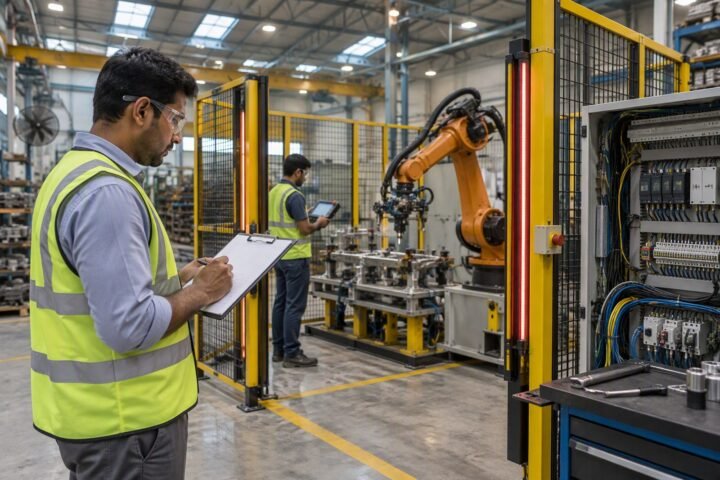
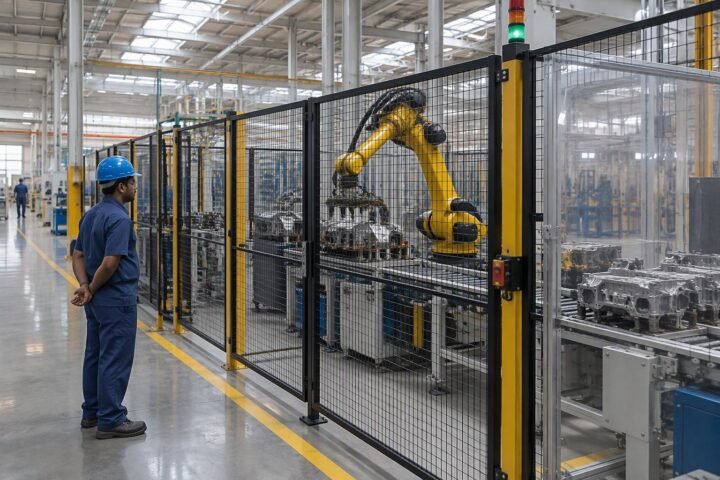
If the station includes a robot that picks rejected packs, it is a robot cell and the safety requirements apply to it as a cell: risk assessment to ISO 12100, safety-related control performance to ISO 13849-1, and the robot cell requirements of ISO 10218-1 and ISO 10218-2. A small SCARA behind a light curtain is still a machine that can crush a hand.
What it costs in India, as a planning range
These are indicative planning ranges for specification conversations, not quotations. Indian prices move with camera availability, import duty and the engineering hours a particular line needs.
| Element | Indicative range | What moves it |
|---|---|---|
| Smart camera, lens and light, per station | Rs 3-8 lakh | Resolution, code reading versus appearance, washdown housing |
| PC-based vision, first station | Rs 6-15 lakh | Multiple cameras, licence model, processing headroom |
| Reject mechanism with confirmation | Rs 1.5-6 lakh | Line rate, pack mass, accumulation length |
| PLC and line integration | Rs 3-10 lakh | Whether the line PLC has spare I/O and a documented protocol |
| Traceability and records layer | Rs 2-8 lakh | Regulated records, MES interface, audit trail requirements |
The pattern that surprises buyers is that the camera is rarely the largest line. Integration, records and the reject path together usually cost more than the optics, which is why a cheap camera on an under-specified line is the most expensive version of the project.
What to specify to an integrator
A specification that gets useful quotes contains, at minimum:
- The line rate, conveyor speed, pack gap and pack range, in numbers.
- The defect list for each class, with the smallest acceptable defect size.
- The reject path: where the pack goes, how it is confirmed, what happens when the bin is full.
- The records: what is stored, for how long, in what format, and who audits it.
- The changeover list: every product variant the line will run in the next two years.
- The acceptance tests: gauge R&R, defect library, false reject and false accept rates at line rate.
An integrator who answers those six points in writing is quoting the same project you asked for. One who replies with a camera datasheet is quoting a different one.
For the wider sequence this station sits inside, the industrial robotics index orders cost, commissioning, safety and maintenance guides. The end-of-line packaging automation guide covers the cartoning and palletising side, and machine vision defect detection covers the imaging method in more depth.
Frequently asked questions
What is end-of-line inspection?
End-of-line inspection is the set of checks on a finished pack after the value has been added and before it enters the warehouse: presence and count, identity and code, appearance, and closure completeness. It decides whether the item ships, which is why a missed defect costs more than an in-process miss.
How much does an automated inspection system cost in India?
Indicatively, a single smart-camera station runs Rs 3-8 lakh, a first PC-based station Rs 6-15 lakh, the reject mechanism Rs 1.5-6 lakh and line integration Rs 3-10 lakh. A typical station with two checks, a reject path and records lands in the Rs 15-40 lakh range, but these are planning ranges and not quotations.
Why do inspection systems get switched off?
Almost always because of false rejects. If the station rejects a visible share of good packs, operators stop trusting it within weeks and run it in alarm-only mode. The fix is a measured false-reject rate on real product at the real line rate, set as an acceptance condition before the system is signed off.
Do I need a robot for end-of-line inspection?
Not usually. Most stations use a fixed camera over the conveyor and a pusher, blast or diverter to remove the pack. A robot is needed when the rejected pack has to be lifted out of a confined space or sorted into several lanes, and a robot cell then brings the full safety requirements with it.
What has to be recorded for traceability?
Every accept or reject decision should be timestamped and tied to the batch and lot, and ideally to a serial number. The counts must reconcile: inspected, passed, rejected and manually removed. For pharmaceutical exports, regulated records also mean access control and an audit trail under 21 CFR Part 11 or the equivalent expectations of the destination market.
Sources and further reading
- GS1 – the General Specifications define the barcode and 2D code data structures used in serialisation.
- eCFR – Title 21, Part 11, on electronic records and signatures for FDA-regulated activity.
- ISO – ISO 10218-1 and 10218-2 for robot and robot cell safety, ISO 12100 for risk assessment, ISO 13849-1 for safety-related control performance.
- CDSCO – Indian regulator for drug and device requirements, including track-and-trace notifications for specified products.