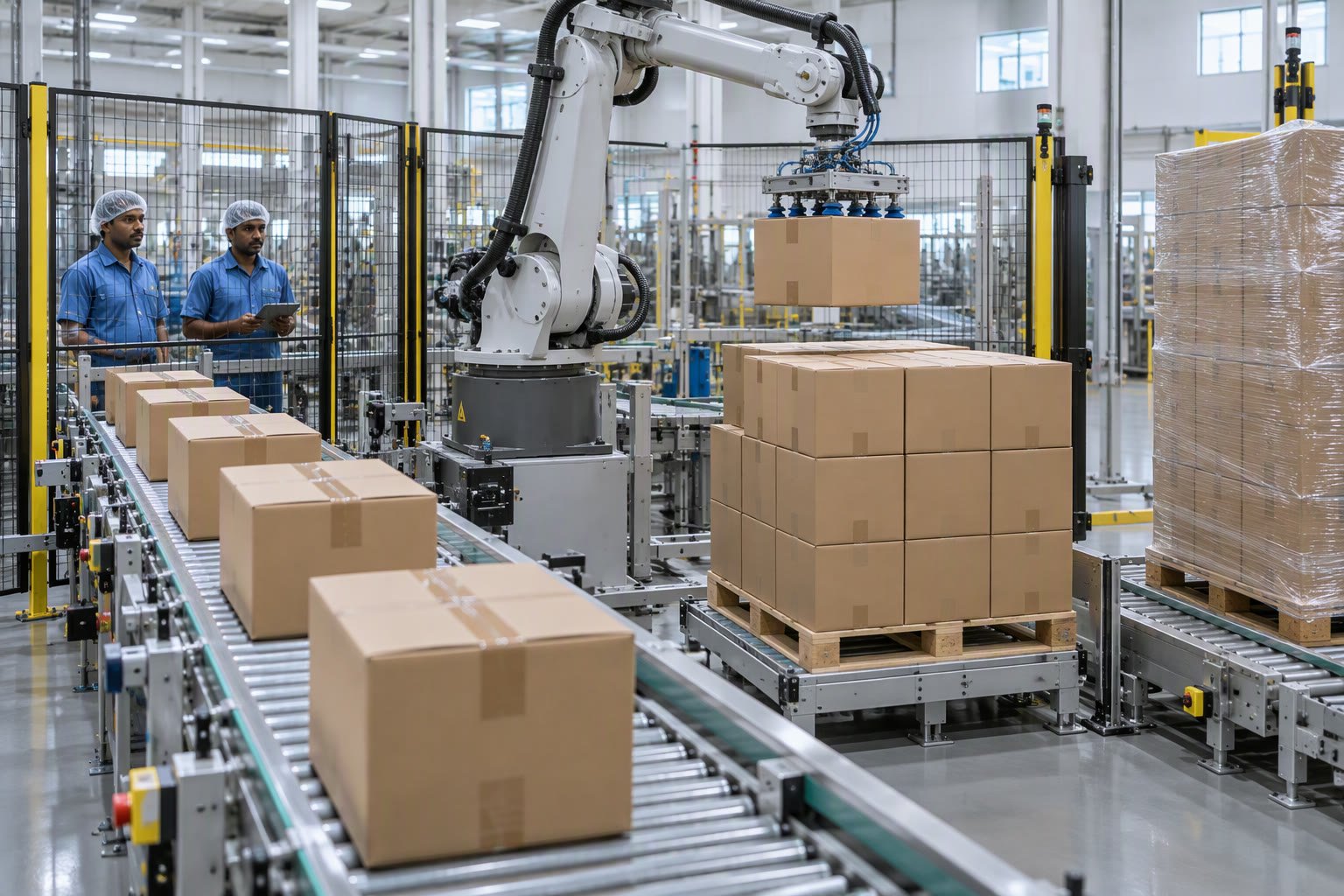
End-of-line is where factories put people on the most repetitive job in the plant: lifting cartons, stacking pallets and wrapping loads. It is also the easiest place to automate, because the work is regular and the parts are light.
This guide covers what sits at the end of a packaging line, which machines pay back at Indian volumes, the throughput arithmetic that decides between manual, semi-automatic and robotic, and what the equipment costs.
What end-of-line actually covers
End-of-line starts where the product is already in its primary pack and ends where a loaded pallet is ready for dispatch. Between those two points sit several separate machines, and each can be bought on its own.
- Case erecting. Forms and tapes the corrugated shipper.
- Case packing. Loads bottles, pouches, tubes or cartons into the shipper, top-load or drop-pack.
- Sealing. Tape, glue or stitch the case closed.
- Coding and labelling. Batch, date, MRP and barcode on the case.
- Checkweighing and metal detection. Rejects short or contaminated cases before they are palletized.
- Palletizing. Stacks cases into a stable pattern on the pallet.
- Stretch wrapping. Stabilises the load for transport.
- Pallet labelling and dispatch. SSCC label and handover to the warehouse.
Automating one of these usually exposes a weakness in the next one. That is why end-of-line projects are best planned as a line, then phased as a budget allows.
Where automation pays and where it does not
The decision is driven by three numbers: cartons per minute, number of SKUs, and how much the carton or pack shape varies. High rate with few SKUs favours dedicated machinery. Low rate with many SKUs favours manual work or a cobot with quick-change tooling.
| Cartons per minute | Practical choice | Why |
|---|---|---|
| Under 4 | Manual, with a lift assist | Robot utilisation too low to justify capital |
| 4–10 | Semi-automatic line, one operator at the pallet | Machines do the sealing and labelling, a person stacks |
| 10–20 | Robotic palletizer, single robot | Robot cycle of 5–7 seconds matches the line |
| 20–35 | Two robots or a layer palletizer | One robot cannot keep up at a stable pattern rate |
| Above 35 | High-level layer palletizer | Whole layer handling beats single-case cycles |
The throughput arithmetic
Most end-of-line projects are justified or killed by this calculation. Work backwards from the filling line, not forwards from the robot’s maximum speed.
Case A: small juice line
Filling rate                  3,600 bottles/hour
Bottles per carton                    24
Carton rate                  3600 / 24 = 150 cartons/hour
                             150 / 60 = 2.5 cartons/minute

A single-axis palletizer or a person handles this.
A robot would run at under 20% utilisation.

Case B: beverage line
Filling rate                 12,000 bottles/hour
Bottles per carton                    24
Carton rate                  12000 / 24 = 500 per hour
                             500 / 60 = 8.3 per minute

Robot cycle time incl. pattern               6.0 s
Theoretical capacity                 60 / 6 = 10 per minute
Required utilisation                 8.3 / 10 = 83%

83% is tight. Add 10% for stops, pattern
changes and conveyor starvation, and the
cell needs either a faster robot, a dual
pick, or a small buffer.

Buffer rule
  Accumulation of 2-3 minutes of line output
  between the case packer and the palletizer
  absorbs short stops without stopping the
  filler. That conveyor is usually cheaper
  than upgrading the robot.
Equipment options and Indian prices
| Equipment | Indicative price | Notes |
|---|---|---|
| Automatic case erector | ₹4–12 lakh | Rate decides the model |
| Case packer, drop or top-load | ₹8–25 lakh | Product and pack format specific |
| Carton sealer, tape or glue | ₹1.5–5 lakh | Random-size models cost more |
| Checkweigher | ₹3–10 lakh | Required for net-content compliance |
| Print and apply labeller | ₹3–8 lakh | Two-sided labelling costs more |
| Robotic palletizer, one robot | ₹45–90 lakh | Includes gripper, safety and programming |
| Layer palletizer | ₹60 lakh–1.5 crore | Higher rate, longer changeover |
| Turntable stretch wrapper | ₹3–8 lakh | Lowest cost per pallet |
| Rotary arm wrapper | ₹8–18 lakh | For unstable or heavy loads |
| Pallet conveyor and transfers | ₹1–3 lakh per unit | Layout dependent |
The robot palletizer figure matches the standalone estimates in the palletizing cost guide. Installation and programming across the whole line are covered separately in the integration cost guide.
Most projects fail at the carton, not the robot
Robots are reliable. Corrugated board is not. The most common commissioning problem in an Indian end-of-line cell is not the palletizing pattern, it is the case.
- Board weight. A case that is fine manually collapses under vacuum or slips in a gripper. Specify the board grade with the automation in mind.
- Humidity. Board softens in the monsoon. What works in January may crush in July. Test in the worst month.
- Glue and tape flaps. A flap that lifts by 3 mm jams a case packer. Check seal quality statistically, not by eye.
- Dimensional tolerance. Cheap cases vary by more than the machine’s clearance. Agree a tolerance with the carton supplier and inspect incoming board.
- Print and coating. Some coatings make tape and vacuum cups fail.
Run the trial on production cartons from your actual supplier, in the actual season, not on samples couriered from a machine builder’s showroom.
Grippers, patterns and changeover
A case palletizer usually uses a vacuum gripper for top-load cases or a clamp gripper for side-load. Vacuum is faster and simpler, but only works if the case top is flat, sealed and non-porous. Clamp grippers handle porous board and heavier cases but need clearance on two sides.
The pattern library matters as much as the gripper. Each product needs a stable pattern, which means the robot program needs recipes. If your team cannot add a new pattern without calling the integrator, every new SKU becomes a cost. Ask for pattern teaching training in the contract, and check the options in the gripper buying guide and end effector guide.
Labelling, coding and verification
An automated line that produces unlabelled or mislabelled cases is worse than a manual line, because the errors reach the customer faster. Two controls are standard: a print-and-apply labeller with verification after application, and a checkweigher that rejects before palletizing. Barcode verification is covered in the OCR and code reading guide.
Keep the reject lane inside the guarded area and make it visible. A reject that quietly recirculates back into the line is a recall waiting to happen.
Layout and safety
A palletizer needs three zones: infeed accumulation, the robot cell itself, and the pallet discharge. If the forklift driver has to enter the robot cell to collect a pallet, the safety design has already failed.
- Pallet dispenser or magazine. Operators should not walk into the cell to place an empty pallet.
- Discharge conveyor. Takes the full pallet out to a pick-up point outside the fence.
- Guarding. Fencing with an interlocked gate for maintenance, and a light curtain where operators load cartons. Costs are in the fencing cost guide.
- Layer height. Manual stacking at floor level and at 1.8 m are different jobs. The ergonomic gain is often the strongest part of the business case.
- Dust and draught. Vacuum grippers lose grip on dusty cases. Keep the cell clean and the cups maintained.
A phased plan that fits a budget
- Phase one: sealing and labelling. Lowest cost, fastest payback, removes the worst manual job at the end of the line.
- Phase two: checkweighing and reject. Protects the customer and the brand before volume grows.
- Phase three: palletizing. Justified once the carton rate crosses roughly 8–10 per minute, or when the pallet weight crosses safe manual handling limits.
- Phase four: stretch wrapping and pallet labelling. Cheap to add and finishes the line.
- Phase five: line integration. One controller, one recipe, one OEE number.
Buy each phase with the interfaces for the next one already agreed. The mistake is buying a palletizer that cannot talk to the wrapper you install two years later.
How much does a robotic palletizer cost in India?
A single-robot palletizer with gripper, safety and programming typically costs ₹45–90 lakh. A layer palletizer runs ₹60 lakh to ₹1.5 crore. A complete line from case packer to stretch wrapper usually lands between ₹70 lakh and ₹1.6 crore.
At what production rate does robotic palletizing make sense?
Roughly 8–10 cartons per minute and above. Below that, a robot runs at low utilisation and manual palletizing with a lift assist is usually cheaper.
Why do end-of-line automation projects fail at commissioning?
Usually because of the carton, not the robot. Board grade, humidity, flap sealing and dimensional tolerance all affect machine reliability. Trial with production cartons from your real supplier in the worst season.
Do I need a checkweigher if I already have a palletizer?
Yes, if net-content compliance matters. A checkweigher rejects short or overfilled cases before they are stacked, where the error is cheap to fix.
Can I automate palletizing without a robot?
Yes. Layer palletizers and single-axis stackers handle high rates with fewer SKUs, and semi-automatic lines with one operator at the pallet remain the right answer at low volumes.
Sources and further reading
- PMMI — packaging and processing machinery standards and industry guidance.
- FEFCO — corrugated packaging standards and board grades.
- ISO 10218-1 — safety requirements for industrial robots used in palletizing cells.
- A3 Association for Advancing Automation — palletizing and end-of-line application notes.