Most industrial robotics advice online is written for a market that is not India: prices in dollars, integrators who answer in a week, spare parts that arrive overnight. This site’s industrial guides are written for plants that buy in rupees, negotiate lead times in months and maintain equipment with an in-house team of three.
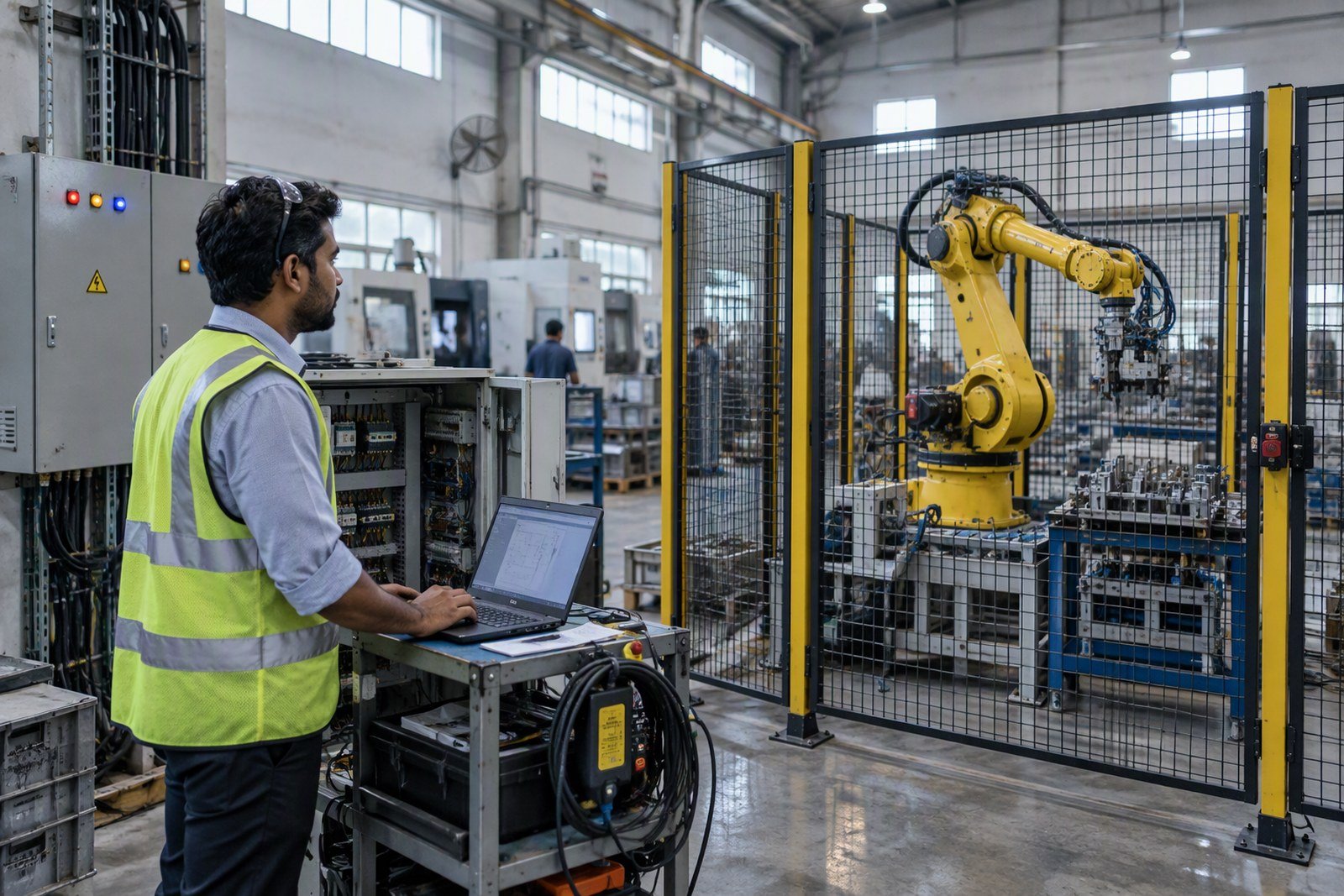
This page is the index for that cluster. It is organised by the stage of the decision rather than by robot type, because that is the order the work happens in: justify the spend, choose the process and machine, design and commission the cell, prove it is safe, then keep it running for a decade. Every link below is a full guide, not a teaser.
1. Justify the spend before you choose a robot
The first decision is not which robot. It is whether this cell pays back, how it will be financed, and what a robot actually costs once installation, tooling, spares and downtime are counted. These guides cover that arithmetic:
- How to choose an industrial robot — the specification sequence that starts with the part and the process, not the brand.
- Robot ROI calculation — payback with real cost lines, including the ones budgets usually omit.
- Robot lease vs buy — when renting a cell beats owning it.
- Industrial robot cost in India and cost per operating hour.
- Lead times and buying used — the two ways Indian plants compress a schedule.
- Automation subsidies for MSMEs.
2. Match the machine to the process
Robot type follows from the process, the cycle time and the part. These guides compare the options that come up most in Indian plants:
- Cobot vs industrial robot, cobot buying guide and collaborative robot prices.
- FANUC, KUKA, ABB and Yaskawa compared.
- SCARA, delta and gantry configurations.
- End effector types, gripper selection and vacuum gripper design.
- Payload calculation and cycle time calculation.
3. Applications, by process
Each of these covers the fixtures, cycle time and cost structure of one process in an Indian plant:
- Spot welding, laser welding, welding fixtures and positioners.
- Palletizing, palletizing cost and depalletizing.
- Machine tending, die casting and injection moulding.
- Deburring and grinding, screwdriving and assembly lines.
- Painting, end-of-line packaging and conveyor integration.
- End-of-line inspection, vision defect detection and code reading.
- Warehouse robotics, AS/RS, AGV vs AMR and 3D bin picking.
- Pharma, food and textile applications.
4. Design and commission the cell
- Cell layout design and the commissioning checklist.
- FAT and SAT checklists — what to sign before the machine leaves the integrator’s floor.
- Integration cost and how to choose an integrator.
- The integration checklist and retrofitting an existing cell.
5. Prove the cell is safe, and keep proving it
Safety is where Indian plants most often rely on paper that does not match the machine. The cluster below runs from the standards that apply, through the physical guarding, to the proof layer:
- Robot safety standards and what changed in ISO 10218:2025.
- Guarding and fencing, fencing cost and enclosure IP ratings.
- Light curtains, laser scanners and safety PLC vs safety relay.
- Safety validation — stopping-time measurement and the ISO 13855 distance calculation.
- The safety audit for a cell that has been running for years.
- Cobot risk assessment and ISO/TS 15066.
6. Keep it running
- Robot AMC — what a maintenance contract must cover.
- Maintenance cost and the maintenance checklist.
- Spare parts strategy — what to stock before you need it.
- Operator training and teach pendant programming.
- Energy consumption and OEE calculation.
7. Connect the cell to the plant
- OPC UA connectivity — getting robot data into the plant system.
- PLC and SCADA for a robot cell, PLC vs robot controller and industrial Ethernet: EtherCAT and PROFINET.
- IIoT machine monitoring and fleet management software.
- Digital twins and offline programming.
What these guides will not do
They will not quote a price and promise it holds next quarter, name a “best” robot brand, or claim a payback you can put in a board deck without checking against your own cycle time. Indian prices move with import duty, exchange rates and shipping, and a payback belongs to a specific cell, part and shift pattern.
What they do instead is give you the cost lines, the questions to ask a supplier, the standards that apply and the measurements that prove an installation is what it claims to be. Where a number depends on your plant, the guide says so.
Where to start if you have ten minutes
If a purchase decision is already open, read how to choose an industrial robot and the ROI calculation. If a cell is already running and something about it feels undocumented, start with the safety audit. If you have just won a project and need to brief an integrator, start with integrator selection and the commissioning checklist.
Frequently asked questions
What does an industrial robot cell cost in India?
It depends on the robot, the end effector, the guarding and the integration work, and those four lines are usually closer in size than buyers expect. The cost guide breaks the cell into those components and the integration cost guide covers the engineering and installation share.
Is a cobot cheaper than an industrial robot?
Not reliably. The robot itself can be cheaper, but a cobot cell still needs risk assessment, tooling and integration, and a collaborative application that needs a force-limited end effector can lose the price advantage. The comparison covers where each one wins.
How long does an industrial robot installation take in India?
Lead time for the robot and the integration work are separate clocks, and the integration usually takes longer than buyers plan for. The lead-time guide separates them; the commissioning checklist shows what has to happen before production starts.
What safety standards apply to a robot cell in India?
The design basis is ISO 10218-1 and ISO 10218-2 for the robot and the cell, ISO 12100 for risk assessment, ISO 13849-1 for the safety control system and ISO 13855 for protective device positioning. The standards overview explains how they fit together and the 2025 revision explains what changed.
Do I need a maintenance contract?
Robots fail in predictable ways, and the parts that fail first are usually the ones with a long lead time. A contract that covers response time, spares and safety testing is cheaper than unplanned downtime; the AMC guide sets out what to demand and what to refuse.