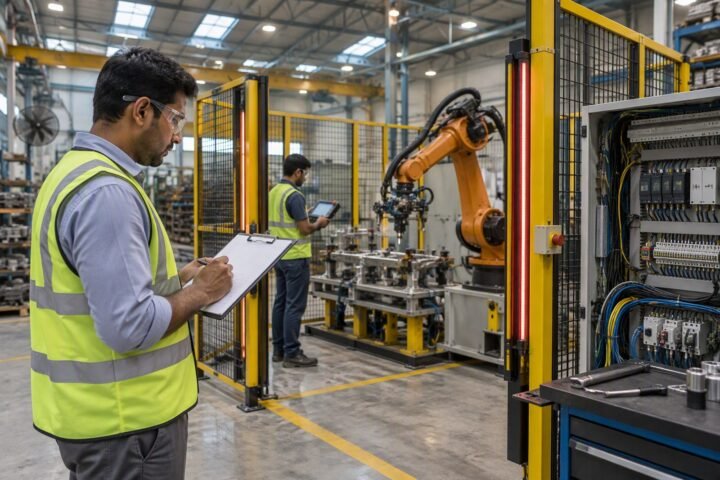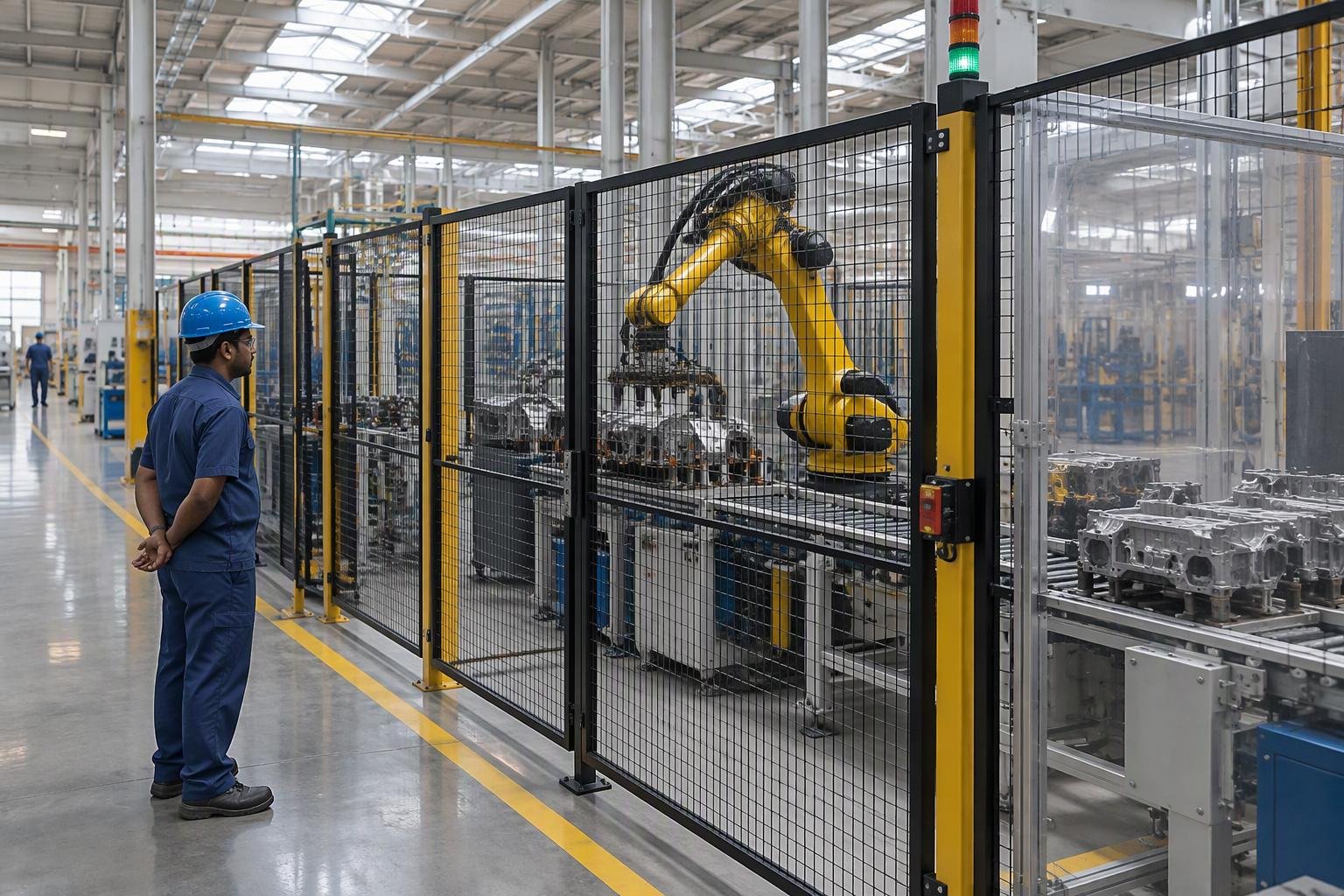
A fence does not stop a robot hitting someone. It keeps people out of the reach envelope, and works only if the gate, interlock and reset prevent the cell running with a person inside. It is the last decision, not the first.
The fence is the last line, not the first
ISO 12100 sets the order: eliminate the hazard by design, then safeguard, then warn. In a robot cell the first move is layout — fixture outside the reach envelope, panel where nobody steps in to press it, take-away conveyor where nobody reaches through. A cell that needs a person inside every hour will have its interlocks defeated before long. Those decisions are covered in robot cell layout design, and they decide how much steel you need.
What the standards actually split
Tender documents write “ISO 10218” as if it were one book. It is two documents plus supporting standards, each answering a different question.
- ISO 10218-1:2025 — the robot as a product: stopping functions, protective stop, enabling device. Revised and published February 2025.
- ISO 10218-2:2025 — the system and cell: integration, layout, safeguards, operating modes, commissioning. Published February 2025; this is your integrator’s document.
- ISO 12100:2010 — risk assessment: limits, hazards, estimation, measures, residual risk. It does not set fence distances.
- ISO 13849-1:2023 — the safety-related control system, assigned a performance level a to e.
- ISO 13857:2019 — reach distances through openings and over guards; decides mesh and height.
- ISO 13855 — positioning of safeguards against approach speed, the basis of curtain and scanner distances. A 2024 edition exists.
- ISO 14119:2024 — interlocks and defeat prevention; replaced the 2013 edition on older cell drawings.
- ISO/TS 15066:2016 — collaborative applications. A Technical Specification; the 2025 editions now cover collaboration too.
BIS transposes many ISO standards as dual-numbered IS/ISO documents. Whether the 2025 editions have been adopted, and under which number, is a question for the BIS standards portal. Our overview of robot safety standards in India follows how these documents reach a factory floor.
Measuring the safety distance instead of guessing it
Every curtain and scanner distance has the same structure: how far a person travels before detection, plus how far the robot travels while stopping, plus an allowance for reaching past the detection plane.
Written out, S = K × T + C. S is the distance to the hazard; K the assumed approach speed; T the time from detection to standstill, including device response, relay response and measured stopping time; C the intrusion distance, set by detection capability and mounting height.
A worked example, with every number an assumption:
- Horizontal field, walking approach: K = 1,600 mm/s.
- Curtain 15 ms plus relay 15 ms: td = 0.030 s.
- Stopping time measured on this robot, payload and program, at 100% override: ts = 0.400 s.
- T = 0.430 s, with C = 850 mm assumed for the field height.
- S = 1,600 × 0.430 + 850 = 688 + 850 = 1,538 mm.
Now assume worn brakes and the same test gives 0.480 s. S becomes 1,600 × 0.510 + 850 = 1,666 mm. The field is 128 mm too close, and nothing looks different. That is why you measure: stopping time moves with payload, tooling, override, pose and brake condition. Test the worst case — heaviest payload, highest speed, closest pose — and record instrument, date and person.
A fence has no approach speed, so ISO 13857 reach tables apply instead. The document-by-document split is in robot safety standards in India.
Guard types and when each is wrong
Four arrangements cover almost every cell; the hazard decides which.
| Arrangement | What it does | Right when | Wrong when |
|---|---|---|---|
| Fence with interlocked gate | Barrier plus stop on entry | High payload, high speed, thrown parts | Operator must stand inside every cycle |
| Vertical light curtain | Detects entry, stops motion | Access point where nothing is ejected | Sole barrier where the robot throws parts |
| Safety laser scanner | Presence detection in a set field | Changing entries, mobile platforms | Blind spots, dusty or reflective floors |
| Fixed barrier, no interlock | Keeps people out, no stop function | No routine access, tools needed | Panel opened with a spanner while running |
A light curtain detects; it has no mass and stops nothing. A part leaving at 2 m/s crosses a 900 mm opening in under half a second, so the curtain sees it only once it is outside. A 5 kg part at that speed carries about 10 J — energy a fence absorbs and a curtain cannot. Where parts are ejected, polycarbonate at the load station does more than heavier mesh everywhere.
Scanners suit entries that change, shared aisles and irregular openings. They are less forgiving than they look: the plane must see a foot but clear swarf, and the floor must be flat. Where a floor pools water, the scanner nuisance-trips until someone shrinks the field to keep production running — and then it protects nothing.
Interlocks, muting and the reset that gets wired backwards
Hardware failures are rare next to wiring mistakes, and the wiring is done at commissioning, under time pressure, by someone who did not design the circuit.
- Gate defeated with a magnet. A magnetic switch closes for a magnet held near it, or a spare actuator in the tool cabinet. ISO 14119:2024 asks for coded actuators and mounting that resists a bypass.
- Single-channel wiring on a two-channel device. Both contacts go into one input. The gate works, so nobody questions it, but a welded contact is invisible and the PL on the drawing is not the PL installed.
- Reset inside the cell. The button sits by the fixture. Anyone inside can press it, and the person outside cannot see behind the fixture.
- Timer muting. Legitimate for a pallet crossing a curtain, until the mute is timed rather than tied to the material’s position, the lamp is missing, or the gap lets a person follow the pallet through.
What “the machine restarted with a person inside” looks like: the gate swings shut, the tongue enters the switch, the relay sees both channels and closes. A line leader presses reset, seeing the gate but not the two metres behind the fixture. The stack light goes green, the robot runs its home routine, and the fitter clearing a jam is between the arm and the fence.
What decides the price, and what a quote must say
Guarding prices move with height, mesh aperture, frame section, gate type, interlock class, guard locking, scanner resolution, cable routes and how much validation is included. Two cells of the same footprint can differ widely, because one needs guard locking and a safety PLC while the other needs a gate switch and a relay.
Indicative per-metre ranges, the costs that never appear in the fence quote, and a procurement template that makes two quotations comparable are in our robot safety fencing cost guide. Use that page for the money and this one for what the installed system has to satisfy.
The one public price you can check without a quotation is the standard itself: ISO lists the 2025 edition of Part 2 at CHF 227. Everything else arrives as a quote, and installed cost is dominated by fabrication, cable routes, labour, civil work and production lost during the shutdown.
Validation and paperwork
Validation is not commissioning. It shows each safety function reaches its designed performance level, and leaves a record someone can check.
- Risk assessment. Scope and limits, tasks including cleaning and jam clearing, hazards, measures, residual risk. Signed, dated, with revision history.
- Safety function list. Gate, curtain, e-stop, enabling device, safe speed — each with its PL target, circuit and result.
- Stop-time record. Robot serial number, payload, tool, program, override, pose, instrument, measured time, date, who measured.
- Functional tests. Gate opened mid-cycle, curtain broken, e-stop pressed: the robot stops within the measured time and does not restart until reset. Witnessed.
- As-built package. Drawings, component list with part numbers, interlock schematic, PLC archive, guard drawing, cell declaration.
- Change control. Any change to program, payload, gripper, speed or guarding triggers a new stop-time measurement and re-validation.
An auditor will ask for four things first: risk assessment, validation report, last stop-time record and evidence of the last functional test. Dated and signed, those four carry the conversation.
Retrofitting an old cell
A robot installed in 2014 was placed on the market under the 2011 editions of ISO 10218 and guarded to the risk assessment of that time. You cannot re-certify the arm to the 2025 Part 1, but the cell can be reassessed.
The 2011 text may still be right for an unmodified installation, because conformity is judged against the state of the art when the machinery was placed on the market. A new gripper, conveyor, speed, product or guard makes it a modified system, and the current editions become the benchmark. Older cells often have no written risk assessment at all.
A retrofit usually runs in this order:
- Survey and as-built drawings, because the drawings no longer match the cell.
- Stop-time measurement at current payload and speed, on every robot.
- Risk assessment of the cell as it stands, including maintenance.
- A gap list: single-channel interlocks, reset position, missing locking, conveyor gaps, scanner fields that no longer fit.
- Hardware and wiring changes, validation, training.
The shutdown, not the hardware, is usually the expensive part: lost output plus finding out why the original relay was chosen. If the gap list reaches the controller and the fence, compare a newer arm — the framework in how to choose an industrial robot in India applies to retrofits, and ongoing costs are in industrial robot maintenance cost in India.
Five questions to ask an integrator before signing
- “Will you give me the stop-time record for my robot, at my payload, signed and dated?” Yes means they measure. “We use the manufacturer’s figure” means every distance is an assumption.
- “Which performance level did you design each safety function to, and can you show the calculation?” The answer should name the function, the PL and the basis: architecture, component data, diagnostic coverage.
- “Where is the reset, and can someone inside the cell reach it?” It should be outside the safeguarded space, with the whole hazard zone in view.
- “If I hold a magnet against the gate switch, what happens?” Coded actuators should make it difficult, and the circuit should detect a discrepancy. Not “nobody would do that here”.
- “Who signs the risk assessment, and what is the change-control process after handover?” A named competent person signs, and the process is in the O&M manual.
Ask for the answers in the quotation, not the meeting. The robot integration checklist lists the documents to request.
The level one safety function needs, and what to check in a supplier’s calculation, is in the ISO 13849 performance level guide.
Frequently asked questions
Is fencing legally required for a robot cell in India?
The Occupational Safety, Health and Working Conditions Code, 2020, in force since November 2025, requires dangerous machinery to be securely fenced. No law names ISO 10218, but compliance is shown through a risk assessment and guarding built to the ISO standards.
Can a light curtain replace a fence?
Only at an access point, and only when the hazard is reach rather than ejection. A curtain detects and stops; it does not contain. If the robot throws parts, it needs a physical barrier.
What is the minimum safety distance for a robot cell?
There is no single number. It depends on approach speed, detection and stopping times, detection capability and mounting height. Two identical robots with different payloads or brakes give different distances, so each device is calculated separately.
Does a cobot need guarding?
Not automatically, but not never. A collaborative robot is only collaborative in a specific application, with a specific tool, payload and speed. Power and force limiting must be justified in the risk assessment against the 2025 ISO 10218 editions and ISO/TS 15066.
How often must safety functions be tested?
At commissioning, after any change, then at an interval set by the risk assessment and maintenance plan. Stop-time measurement is repeated after brake work, a tool change or a speed increase. Daily checks catch failures between formal tests.
What drives the cost of a guarding upgrade?
Metres of fence, number of gates, the performance level of each function, guard locking, scanners or curtains, and how much engineering and validation is included. Shutdown time is usually the largest line.
Fencing is one decision inside the wider safety case; check the 2025 ISO 10218 revision before you fix the layout.
Where the audit ends, validation begins: how to prove the cell stops in time, using measured stopping time and the ISO 13855 distance calculation.
Sources and further reading
- ISO 10218-1:2025 — Industrial robots
- ISO 10218-2:2025 — Industrial robot applications and robot cells
- ISO 12100:2010 — Risk assessment and risk reduction
- ISO 13857:2019 — Safety distances for upper and lower limbs
- ISO 14119:2024 — Interlocking devices associated with guards
- ISO 13855:2024 — Positioning of safeguards
- ISO/TS 15066:2016 — Collaborative robots
- HSE RR1214 — Review of key machinery safety standards
- HSE — PUWER 1998
- OSHA — Robotics
- OSHA 1910.212 — Machine guarding
- BIS — Indian standards portal