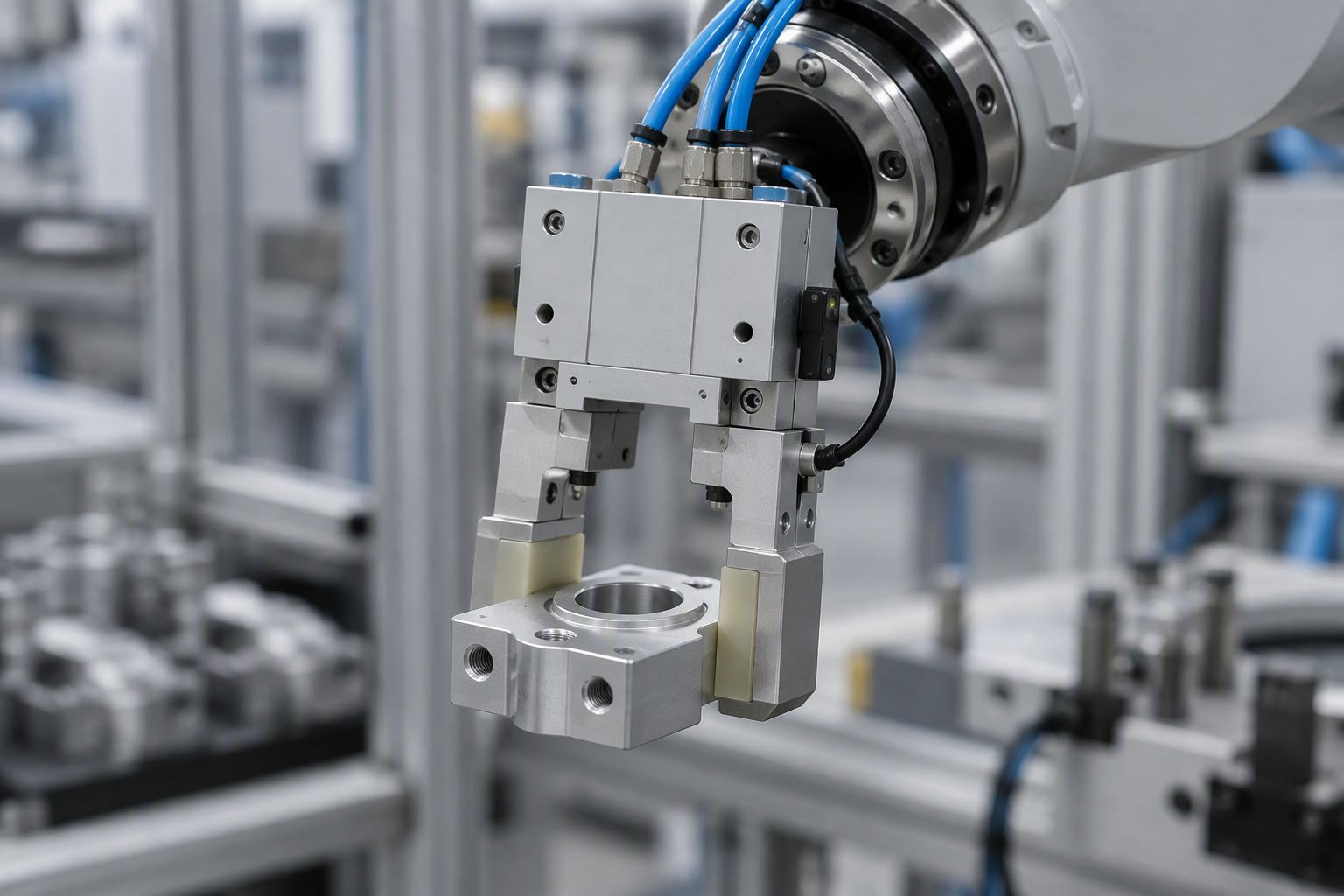
The gripper is the cheapest part of a robot cell and the one that decides whether it runs. A ₹40,000 gripper can stop a ₹40 lakh cell for a week.
This guide covers the gripper types, how to calculate grip force instead of guessing, the vacuum traps, pneumatic versus electric, and what grippers actually cost in India.
Start from the part, not the catalogue
Before looking at a single model, answer five questions about the part: mass, centre of gravity, surface finish, how much it can deform, and how it arrives. Those five answers eliminate most of the catalogue and stop you buying a gripper that marks every part it touches.
| Gripper type | Grip principle | Best for | Watch out for |
|---|---|---|---|
| Two-finger parallel | Jaws close linearly | Boxes, blocks, most machined parts | Part rotation between jaws |
| Angular | Jaws pivot | Round and irregular parts | Grip force changes with opening |
| Three-finger centric | Jaws close to centre | Cylinders, shafts, gears | Higher cost, more moving parts |
| Vacuum | Suction cup | Flat, smooth, light parts | Leaks on porous or curved surfaces |
| Magnetic | Permanent or electro | Steel sheets and billets | Residual magnetism, stacked sheets |
| Soft or compliant | Fingers that conform | Fragile, irregular, food handling | Short life, lower force |
| Needle or pin | Inserts into a feature | Parts with a bore or hole | Wear, alignment sensitivity |
Calculate grip force, do not guess it
The jaw force must hold the part against gravity and against the acceleration of the robot. For a horizontal grip on a vertical face, the simple version is:
F_grip = m * (g + a) / mu * S

m  = part mass (kg)
g  = 9.81 m/s^2
a  = peak acceleration of the robot (m/s^2)
mu = friction coefficient between jaw and part
S  = safety factor, 2 for a clean dry part

Example: 2 kg part, 8 m/s^2 acceleration, mu = 0.4, S = 2
F_grip = 2 * (9.81 + 8) / 0.4 * 2 = 178 N
Then divide by the number of jaws that actually carry load. Two jaws share the force, so each needs about half of the total, assuming a symmetric part. A part with an offset centre of gravity loads one jaw more and also creates a moment that can rotate it out of the grip.
- Use peak acceleration from the motion profile, not the average.
- Use the friction of the real contact, not the polished-steel figure.
- Add the moment from an off-centre centre of gravity.
- Increase the safety factor for oily, wet or vibrating parts.
- Check that the jaws do not crush a hollow or thin-walled part.
Jaw design matters as much as jaw force
Two grippers with the same force behave differently because of contact area, hardness and compliance. Hard serrated jaws grip well and mark the part. Soft pads grip less but protect the finish. A compliant pad also tolerates small misalignment, which reduces the accuracy the robot and vision must deliver.
| Jaw choice | Grip | Marks part | Use when |
|---|---|---|---|
| Hard steel, serrated | High | Yes | Castings, rough parts, no cosmetic requirement |
| Hard steel, smooth | Medium | Light | Machined surfaces |
| Urethane pad | Medium | No | Finished parts, electronics housings |
| Rubber or silicone | Lower | No | Fragile or slippery parts, food |
| Custom contour | High | Controlled | High volume, one part family |
Custom jaws are often the difference between a cell that runs and one that re-grips. They cost money once and pay back in cycle time and scrap.
Vacuum grippers: cheap until they leak
A suction cup is the simplest end effector and the one with the most hidden failure modes. Holding force depends on the pressure difference and the sealed area, so a leak costs force directly.
F = dP * A * n * S

dP = pressure difference (bar), typically 0.4 to 0.6 with an ejector
A  = cup area (cm^2)
n  = number of cups
S  = safety factor, 2 or more for dynamic moves

A 40 mm cup has about 12.6 cm^2 of area.
At 0.5 bar that is roughly 63 N per cup, before safety factor.- Porous parts such as cardboard, foam and castings leak through the material, not around the cup.
- Curved surfaces need a bellows cup or a smaller cup that sits on a flatter patch.
- Textured or dusty surfaces break the seal; clean the cup and consider a larger one.
- Venturi ejectors are cheap and fast; a vacuum pump gives more flow for leaky parts.
- Add a vacuum switch, otherwise the robot moves with nothing in its grip.
Pneumatic versus electric
| Criterion | Pneumatic | Electric |
|---|---|---|
| Upfront cost | Lower | Higher |
| Force for size | High | Moderate |
| Position control | Usually open or two-position | Programmable position and force |
| Feedback | Needs sensors | Built in on good models |
| Air supply | Compressor, filter, regulator | None |
| Cycle time | Fast | Fast on good models |
| Noise | Exhaust noise | Quiet |
| Best for | Simple open/close at volume | Variable parts, force control, clean rooms |
In India, compressed air is often already available, which is why pneumatic grippers dominate. Add the cost of the compressor, dryer and filter if the cell is the first air user, and the comparison changes.
Sensors that stop silent failures
- Open and closed confirmation: the robot must not move until the gripper reports the commanded state.
- Part present: a proximity sensor or vacuum switch confirms the part is held, not just that the jaws closed.
- Pressure switch: detects a leak or a dropped part mid-move on vacuum systems.
- Force feedback: on electric grippers, detects a jam or a wrong part size.
Without a part-present signal, a dropped part is discovered by the operator or the customer. That signal costs a few thousand rupees and prevents the most common robot-cell failure: running an empty cycle and placing nothing.
The gripper eats robot payload
Every kilogram of gripper is a kilogram the robot cannot use for the part. It also moves the centre of gravity forward, which reduces usable payload further and increases the moment on the wrist. A heavy gripper on a robot chosen for its rated payload is one of the most common sizing mistakes.
Calculate the combined tool and part mass, the centre of gravity offset and the moment, then compare against the robot’s payload diagram rather than its headline figure. A robot rated 10 kg may allow far less at 300 mm from the flange.
What grippers cost in India
Planning ranges only; quotes vary with brand, stroke, force and sensors. Import duty and lead time often matter more than the list price.
| Item | Planning range |
|---|---|
| Small pneumatic parallel gripper | ₹8,000–₹25,000 |
| Large pneumatic parallel gripper | ₹25,000–₹70,000 |
| Electric parallel gripper | ₹60,000–₹2,50,000 |
| Vacuum ejector, cups and switch | ₹6,000–₹40,000 |
| Magnetic gripper | ₹20,000–₹80,000 |
| Custom jaws, pair | ₹8,000–₹40,000 |
| Tool changer, robot side plus tool side | ₹1,50,000–₹5,00,000 |
| Air preparation and valves | ₹15,000–₹60,000 |
Integration details people forget
- Cable and tube routing that survives wrist rotation; a dress pack that snags is a weekly stop.
- Gripper weight and offset entered into the robot’s tool data, not just the mechanical mounting.
- Cycle time of the gripper itself, including valve exhaust and sensor delay.
- Safe access to change jaws without entering the guarded area.
- Spare jaws and cup sets on site before production starts.
- Cleaning routine for vacuum cups and magnetic faces.
One part family or five: plan the changeover
A gripper tuned for one part is cheap and fast. A cell that runs five variants needs a decision early: adjustable jaws, interchangeable jaws, or a tool changer. Each step up costs more and changes the layout, so decide before the robot is ordered rather than after.
| Approach | Changeover time | Cost | Use when |
|---|---|---|---|
| Fixed jaws | Minutes with tools | Lowest | One part, high volume |
| Adjustable jaws | 2–10 minutes | Low | A few similar sizes |
| Quick-change jaws | Under a minute | Medium | Daily variants |
| Tool changer | Seconds, automatic | High | Different processes, lights-out running |
A tool changer needs a parking station inside the cell, extra safety assessment for the added mass and a robot with enough payload for the heaviest tool. It is the right answer for a flexible cell and the wrong answer for a single-part job.
Mistakes that stop a cell
| Mistake | Consequence |
|---|---|
| Grip force guessed, not calculated | Parts slip during acceleration |
| No part-present sensor | Empty cycles and misplaced parts |
| Gripper mass ignored in payload | Robot overloads and stops |
| Hard jaws on a finished surface | Scrap and rework |
| Vacuum on a porous part | Part drops mid-move |
| Jaws designed for one part variant | Changeover takes an hour |
| No spare cups or jaws | Days of downtime for a ₹2,000 part |
Related: gripper design basics, end effector types, payload calculation, cobot buying guide, robot cell layout.
How do I calculate gripper force?
Use the part mass, gravity, peak robot acceleration, the friction between jaw and part and a safety factor of at least two. Divide by the number of load-bearing jaws, then add margin for an offset centre of gravity.
Pneumatic or electric gripper?
Pneumatic is cheaper and strong for size where compressed air is available. Electric gives programmable position and force, built-in feedback and no air supply, at a higher price.
Why does my vacuum gripper drop parts?
Usually a leak through a porous part, a curved or dirty surface, too few cups, or no vacuum switch to detect the loss. Check sealed area and add a switch before changing the robot.
Does gripper weight matter if the part is light?
Yes. Gripper mass counts against payload and moves the centre of gravity forward, which reduces usable payload. Enter the real tool mass and offset in the robot's tool data.
How much does a robot gripper cost in India?
Small pneumatic grippers plan from about ₹8,000, electric grippers from about ₹60,000, and tool changers from about ₹1.5 lakh. Custom jaws and sensors are additional.
Before comparing prices, check the holding force calculation so the cups you buy are actually big enough.
Before buying a gripper, decide whether it needs force sensing to confirm the part is held.
The end effector is a real line in the budget, so choose it with the cobot cell cost guide open.
The end effector decides whether the take-out damages the part, and the moulding robot guide budgets for tooling alongside the robot.
Bending uses vacuum and magnetic grippers in ways that differ from pick-and-place, as the press brake robot bending guide explains.
If one gripper cannot cover every part, the robot tool changer guide explains how to switch between several.
In bin picking the gripper has to reach into a jumble, which rules out many standard finger designs.
Grippers for hot castings need mechanical hold and heat clearance; the die casting cell guide explains why vacuum fails here.
In assembly the gripper does the fine positioning, so its repeatability can matter more than the robot’s.
A palletizer gripper has to handle cartons, not parts, and the end-of-line packaging guide explains the pattern and changeover implications.