A robot that is not maintained does not fail slowly. It fails on the day you have a full order book, and the cost of that day is usually larger than the entire year of maintenance.
This guide covers what industrial robot maintenance actually costs in India, what a preventive visit should include, how to choose between an OEM contract and a third-party one, and how to budget for the two big-ticket failures nobody plans for.
The number to plan around
For a healthy installation, annual maintenance and spares typically land between 3% and 8% of the robot’s purchase value. A robot in a foundry, a grinding cell or a paint booth sits at the top of that band. A robot in a clean assembly cell sits at the bottom.
That percentage covers the routine work. It does not cover a gearbox replacement at year seven, a controller board failure, or the production lost while the robot is down. Those are the events that make maintenance budgets look wrong in hindsight.
| Cost bucket | What it covers | Indicative annual cost |
|---|---|---|
| Preventive maintenance | Scheduled visits, inspection, lubrication, calibration checks | ₹40,000–1.5 lakh per robot |
| Consumables | Batteries, filters, grease, seals, torch parts, gripper jaws | ₹25,000–2 lakh |
| Spares and repairs | Motors, amplifiers, cables, gearboxes, teach pendant | ₹50,000–4 lakh average, lumpy |
| Contract or in-house team | AMC fee, or the loaded cost of a maintenance technician | ₹1–6 lakh |
| Downtime | Lost contribution while the cell is stopped | Often the largest line |
What a preventive visit should include
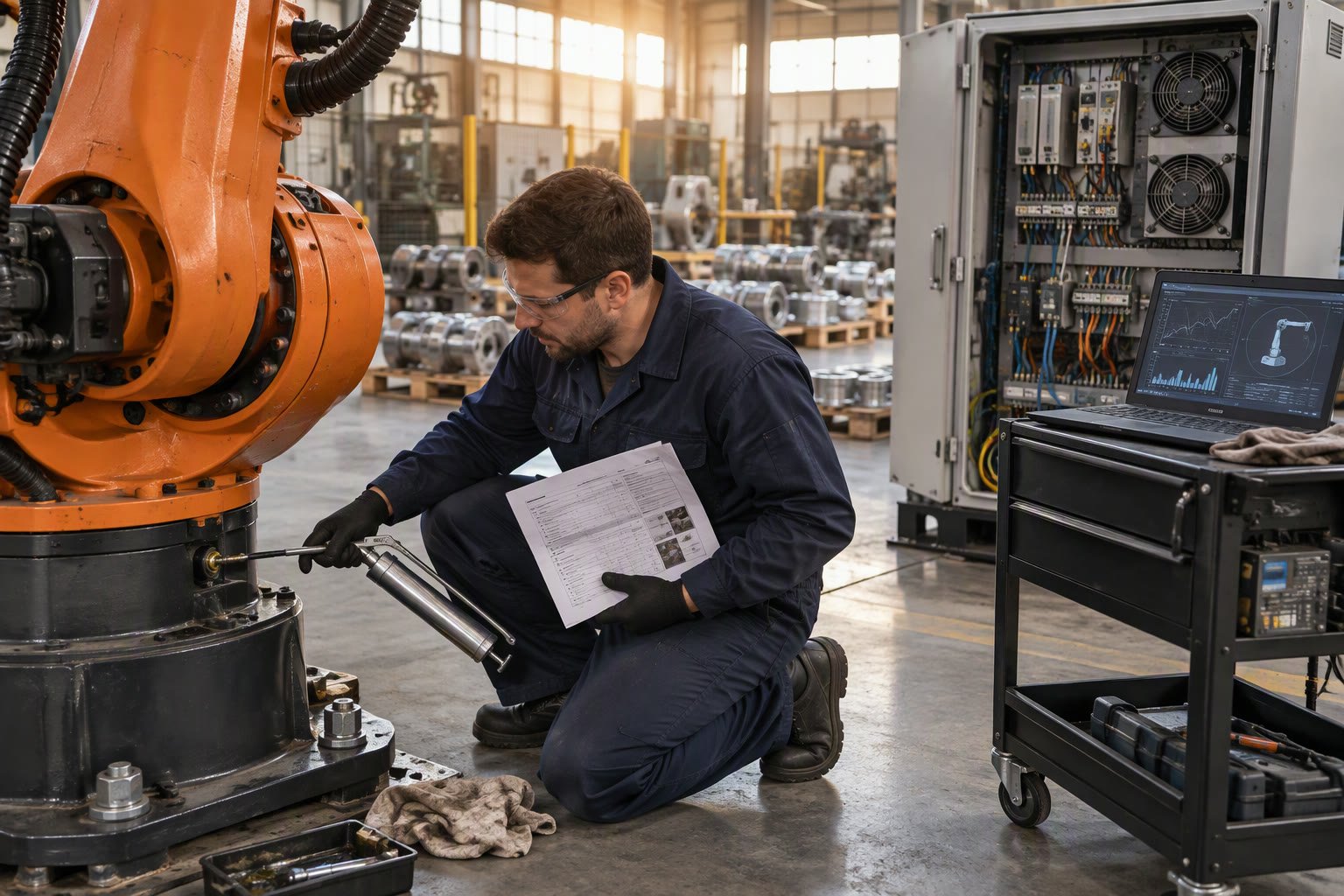
A maintenance contract that consists of someone wiping the robot and listening to it is not a maintenance contract. The visit should produce a written report with measurements, not a tick sheet.
- Mechanical. Backlash check on each axis, belt and gear condition, abnormal noise, brake holding test, foundation bolt torque.
- Electrical. Cable and dress pack inspection for abrasion, connector condition, earth continuity, controller filter cleaning.
- Battery. Encoder backup battery voltage, with replacement before it fails rather than after.
- Calibration. Master position verification, and a check that the tool centre point still matches the program.
- Lubrication. Grease quantity and type per the manufacturer schedule, with the old grease inspected for metal particles.
- Safety. Interlock function test, light curtain and scanner test with a test piece, emergency stop on every station.
- Process equipment. Torch, spindle, gripper, dispenser, and the fixture clamps that the robot depends on.
The full schedule is in the robot maintenance checklist. Use it to audit your own contractor: if the report does not mention backlash, battery voltage and safety interlocks, the visit was incomplete.
Spares: the short list that saves a week
Robot lead times in India are usually short for common models and long for everything else. The spares you keep on the shelf should be chosen by one question: what failure stops the cell and takes more than two days to replace?
- One teach pendant cable, because it is the most abused cable in the cell.
- One encoder battery per robot, plus the procedure to change it with power on.
- One servo amplifier or drive module for the most common axis rating.
- Gripper jaws, vacuum cups, proximity sensors and clamp seals — cheap items that stop production.
- For welding, a spare torch and liner set. For grinding, a spare spindle or tool holder.
- Cooling fan filters and controller air filters, which are consumables in dusty plants.
Do not stock a spare motor or gearbox for every axis. Stock the one that fails most often in your duty cycle, and know the lead time for the rest in writing.
OEM contract, third party or in-house
| Option | Best for | Watch out for |
|---|---|---|
| OEM annual contract | New robots under warranty, critical lines, complex processes | Highest cost; response time must be written into the contract |
| Third-party service | Older robots, standard applications, multi-brand fleets | Check technician certification and spare part provenance |
| In-house team | Five or more robots, or a plant with strong maintenance culture | Training and diagnostic tools are an upfront cost |
| Hybrid | Most Indian plants | Define who does what, so nobody assumes the other party did it |
For a single robot, an OEM or authorised contract is usually worth the premium because diagnostics and spares are direct. For a mixed fleet of older machines, a good third-party service with access to refurbished parts can cost half as much, provided the technician can show you a calibration certificate and a traceable part source.
Downtime is the real cost
Cost of one day of unplanned downtime
(indicative, single robot machining cell)

Shifts per day                              2
Planned time per shift                    450 min
Ideal cycle                                  42 s
Uptime assumed                              85%
Good parts per day
  2 * 450 * 60 * 0.85 / 42 = 1,093 parts

Contribution per part                   INR 150
Contribution lost per day          INR 1.64 lakh

Add:
  idle operator cost                     ₹2,000
  restart and first-part scrap           ₹5,000
  expediting and overtime               ₹10,000

One day down is roughly INR 1.8 lakh.

A ₹60,000 preventive visit that avoids two
such days a year has already paid for itself
three times over.

This is why maintenance is a production
decision, not a purchase decision.
The two failures that break a budget
Most maintenance spending is predictable. Two items are not, and both appear in the second half of a robot’s life.
Gearbox and reducer wear. Backlash grows slowly, then shows up as path error on a welding seam or a burr left on a part. A reducer replacement is a five to six figure part plus downtime, and it is often the point where plants start comparing repair with a retrofit or replacement. Monitor backlash every preventive visit so that the decision is planned, not forced.
Encoder battery and mastering loss. A dead battery can lose the master position. Recovery needs the mastering procedure and, on some models, a fixture. It is a cheap part that causes an expensive day. Replace on condition, not on failure, and keep the procedure printed in the cell.
A budget model for a single cell
Annual maintenance budget, one robot cell
Cell value assumed INR 1.34 crore, robot 45 lakh

Preventive maintenance, 4 visits       INR 1,20,000
Consumables and process spares          INR   90,000
Critical spares amortised over 5 years  INR   60,000
AMC fee, process equipment included     INR 1,80,000
Training refresh, one technician        INR   25,000
                                      -------------
Planned annual spend                   INR 4,75,000
As share of cell value                        3.5%
As share of robot value                      10.6%

Contingency for unplanned repair        INR 1,50,000
Total budget                           INR 6,25,000

If the cell runs two shifts and the
contribution per day is INR 1.8 lakh,
this budget equals about 3.5 days of
downtime. That is the trade being made.
The energy side of running the cell is covered in the energy consumption guide, and the full running cost per hour is in the robot cost per hour guide.
Contract clauses that decide the outcome
- Response time, in hours, with a penalty. Not “prompt response”.
- Coverage list. Which parts are included, which are charged, and at what discount.
- Remote support. Can the contractor log in and diagnose before travelling?
- Preventive visits, in writing. Number per year and what each visit includes.
- Programming changes. Included or hourly, and at what rate.
- Calibration and mastering. Included, or a separate charge.
- Escalation. Who you call when the first response fails.
If the cell operates in dust, heat or moisture, check that the equipment is rated for it before you blame the contractor. The IP rating guide explains what the rating actually protects against, and the integration cost guide shows where maintenance sits in the original project budget.
How much does industrial robot maintenance cost in India?
Plan for 3–8% of the robot value per year in preventive maintenance, consumables and spares. A single robot typically needs ₹1.5–5 lakh a year including a service contract, with foundry, grinding and paint applications at the upper end.
Is an OEM maintenance contract worth it?
For a new robot under warranty, usually yes, because diagnostics and spare parts are direct. For older or mixed fleets, a competent third-party service can cost much less, provided the technicians are certified and parts are traceable.
What spares should I keep for a robot cell?
At minimum a teach pendant cable, encoder batteries, one servo drive module, gripper jaws and sensors, and the process consumables such as torch parts or spindle tooling. Choose items whose failure would stop the cell for more than two days.
How often should a robot be serviced?
Most manufacturers specify a preventive interval based on operating hours, commonly every 3,500–4,000 hours or annually. Dusty, hot or high-duty applications need shorter intervals, and the schedule should follow the duty, not the calendar alone.
When should I replace a robot instead of repairing it?
When the repair cost approaches a significant share of a new or retrofitted machine, when spares lead times become long, or when the controller no longer supports the software you need. Compare the options before the failure, not during it.
Sources and further reading
- ISO 10218-1 — safety requirements that maintenance procedures must respect.
- ISO 9283 — robot performance criteria used when verifying accuracy after repair.
- A3 Association for Advancing Automation — robot maintenance and reliability guidance.
- International Federation of Robotics — installed base and robot life-cycle context.