There is no single national “robot subsidy” in India. There are several separate routes that can each reduce what a small manufacturer pays for automation, and most of them are found at the state level.
This guide explains the routes that exist, the documents they ask for, the rule that cancels most claims, and how to work out whether an incentive actually changes your payback. Scheme rates change with every Union and state budget, so treat every number here as a starting point and confirm the current scheme text before you order equipment.
The three routes that reduce cash outlay
Support for automation arrives in one of three forms, and they behave very differently. A capital subsidy or grant reduces the price of the machine. A credit guarantee or concessional loan reduces the difficulty of borrowing. A tax or duty treatment reduces the effective cost over time. Most MSMEs need the first or second, and only some qualify for the third.
| Route | What it does | Typical source | When it helps |
|---|---|---|---|
| Capital subsidy or grant-in-aid | Reimburses part of the equipment cost | State industrial policy, sector schemes | You are buying new, approved equipment and can wait for reimbursement |
| Interest subvention | Lowers the rate on a term loan | State policy, sector schemes | You are borrowing, not paying cash |
| Credit guarantee | Removes the collateral requirement | CGTMSE | You have a viable order book but no property to pledge |
| Concessional term loan | Longer tenure or lower rate | SIDBI and scheduled banks | The project is bankable but cash-flow heavy |
| Duty and tax treatment | Changes landed cost or depreciation | Customs tariff, income tax | You are importing, or you need faster depreciation |
Central schemes worth checking
Start with registration, because almost every scheme checks it. Udyam registration is the current MSME registration and is free. A unit without it is invisible to most incentive windows.
- Udyam registration. Online, free, and the base document for most MSME benefits. Keep the certificate and the enterprise category (micro, small, medium) updated as turnover grows.
- CGTMSE. A credit guarantee trust that lets banks lend to micro and small enterprises with limited or no collateral. It does not reduce the interest rate, but it can turn a rejected loan into an approved one.
- SIDBI. Development finance for MSMEs, including machinery loans and energy-efficiency products. Useful when the robot is part of a larger modernisation plan.
- Technology Upgradation Fund Scheme (TUF). Textile-sector specific, but it is one of the longest-running machinery upgradation schemes in the country. Relevant if you are in textile or garment processing.
- Production Linked Incentive (PLI) schemes. Sector-specific and turnover-linked, not a machine grant. They matter to auto-component, electronics, pharma, textile and specialty steel manufacturers investing at scale.
- State industrial policies. Usually the most accessible source for a small unit. See the next section.
What state industrial policies usually offer
Every state publishes an industrial and investment policy, revised every few years, with a package for micro, small and medium units. The names change but the menu is fairly consistent. Read the current policy for your state, and read the notification that implements it, because the policy document alone is not the rulebook.
| Incentive | What it usually covers | Where to verify |
|---|---|---|
| Capital subsidy | A percentage of plant and machinery, capped at a limit | State Directorate of Industries |
| Interest subvention | A rate reduction on term loans for a fixed period | State policy notification, lending bank |
| SGST reimbursement | Refund of state GST for a defined period | State commercial taxes department |
| Power tariff concession | Reduced tariff or duty exemption | State electricity board |
| Quality certification support | Part reimbursement of testing and certification | State MSME department |
| Stamp duty and registration | Waiver or refund on industrial land | State registration department |
The practical step is a visit or call to your District Industries Centre (DIC). They hold the current notification, the application form and the eligibility checklist, and they know which categories are being rejected this year.
Import duty and the real landed cost
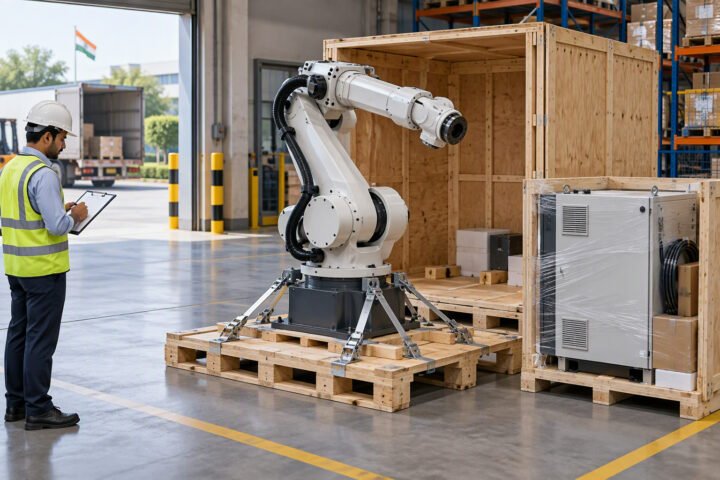
Industrial robots are imported under HS code 8479 50 00. The duty depends on the rate in force at the time of import, and the rate can change in any Union Budget. Do not plan a project on a rate you read in an old article, including this one. Ask your customs broker for a written landed-cost estimate against the actual invoice.
Landed cost check for an imported robot
(illustrative rates only - confirm current rates with your CHA)

Ex-works price, Germany              EUR 42,000
Freight and insurance to port         EUR 2,400
Assessable value                     EUR 44,400
Exchange rate                         INR 92 / EUR
Assessable value                     INR 40.85 lakh

Basic customs duty, illustrative 7.5%  INR 3.06 lakh
Social welfare surcharge, 10% of BCD    INR 0.31 lakh
                                      ------------
Duty-paid value                      INR 44.22 lakh
IGST, illustrative 18%                 INR 7.96 lakh
                                      ------------
Total cash at customs                INR 52.18 lakh

IGST is usually available as input credit.
Non-creditable cost is therefore about
INR 44.22 lakh, not the EUR 42,000 you
negotiated.

Two things follow:
1. Always compare quotes landed, not ex-works.
2. A 5% duty change moves the project by
   more than a month of negotiation on
   the robot price.
Domestic purchase avoids duty but not GST, which is also creditable for most manufacturers. The comparison that matters is landed cost after credits, plus the cost of spare parts and support.
The rule that cancels most claims
Incentive schemes generally require prior approval. The application, the eligibility certificate or the sanction letter must exist before the purchase order is placed. A unit that buys the robot first and applies afterwards usually finds the scheme closed to it, and no amount of correspondence fixes that.
This single rule is worth more than any percentage. If you are evaluating a robot today, the first call is not to the robot supplier. It is to the DIC, to ask what approval you need and how long it takes.
Documents you will be asked for
- Udyam registration certificate and enterprise memorandum.
- GST registration and returns for the last financial year.
- Audited financial statements, usually two or three years.
- Project report with technical justification and cost breakdown.
- At least three competitive quotations for the machinery.
- Land or building documents, or a registered lease.
- Term loan sanction letter, where the project is financed.
- Machinery invoice, payment proof and installation certificate, at the claim stage.
- Electricity connection and pollution clearance, where applicable.
The project report is where most applications are won or lost. It has to show why the robot is needed, what it replaces, how the capacity will be used, and how the unit will service the loan. Generic copy-paste reports get generic rejections.
Why applications get rejected
- Purchase before approval. The most common and the least fixable.
- Machine not on the eligible list. Some schemes fund production machinery but not testing, office or utility equipment.
- Used machinery. Most capital subsidies are for new equipment only. This matters if you are considering a used robot.
- Incomplete cost breakup. A single lump-sum invoice is hard to verify against an approved list.
- Unit category mismatch. A unit that has crossed into “medium” may no longer qualify for a micro or small scheme.
- Duplicate claim. The same machine claimed under two schemes.
- Delay beyond the claim window. Many schemes require the claim within a fixed number of months of installation.
Does the incentive change the payback?
Sometimes less than you expect. A capital subsidy is usually paid after installation, against proof of payment, often several months later. Until it arrives you have financed the full amount. Model the cash flow, not just the net price.
Payback with and without a capital subsidy
(indicative)

Project cost                         INR 60.0 lakh
Capital subsidy, 15% capped at 8.0   INR  8.0 lakh
Net project cost                     INR 52.0 lakh

Annual net benefit from the robot     INR 15.0 lakh
Simple payback, no subsidy           60 / 15 = 4.0 years
Simple payback, net of subsidy       52 / 15 = 3.5 years

But the subsidy arrives in month 14,
not at purchase. Peak funding need is
still INR 60 lakh for over a year.

Decision rule: treat the subsidy as an
upside, never as the reason the project
works. If the payback fails without it,
the project is fragile.
The underlying arithmetic is in the robot ROI guide, and the equipment price ranges are in the industrial robot cost guide. If the capital outlay is the real constraint, compare buying outright with renting the robot or starting with a cobot.
How to start, in order
- Complete or refresh Udyam registration.
- Call the District Industries Centre and ask for the current policy, the eligibility checklist and the approval sequence.
- Ask your bank whether the project can be structured under CGTMSE, and what documents the guarantee needs.
- Get three quotations with a clear cost breakup, not lump sums.
- Write the project report around capacity, labour, quality and payback.
- Apply for approval before releasing the purchase order.
- Keep every invoice, payment advice and installation certificate in one file from day one.
- File the claim inside the window, and follow up in writing.
Is there a government subsidy for buying industrial robots in India?
There is no single national robot subsidy. Support comes through state industrial policies, CGTMSE-backed loans, SIDBI lending and sector schemes such as TUF for textiles and PLI for specific industries. Eligibility and rates vary by state, unit size and sector.
Can I claim a subsidy after buying the robot?
Usually not. Most incentive schemes require prior approval or registration before the purchase order is placed. Confirm the sequence with your District Industries Centre before you commit to the supplier.
What is the import duty on industrial robots in India?
Industrial robots are classified under HS 8479 50 00, and the applicable duty changes with Union Budget decisions. Ask a customs broker for a written landed-cost estimate rather than relying on a published rate.
Does CGTMSE give a subsidy?
No. CGTMSE provides a credit guarantee that lets banks lend to micro and small enterprises with limited collateral. It improves access to finance, not the price of the machine.
Should I base my automation decision on the subsidy?
No. Model the payback without any incentive. If the project only works with a subsidy that may arrive a year later, the cash-flow risk is probably too high.
Sources and further reading
- Udyam Registration — official MSME registration portal.
- Ministry of Micro, Small and Medium Enterprises — central schemes and policy notifications.
- CGTMSE — credit guarantee scheme details and eligibility.
- SIDBI — MSME lending and machinery finance products.
- Central Board of Indirect Taxes and Customs — current customs tariff and notifications.