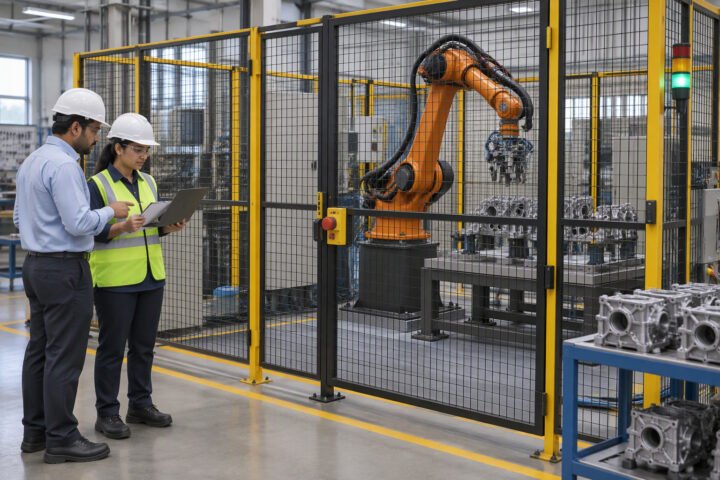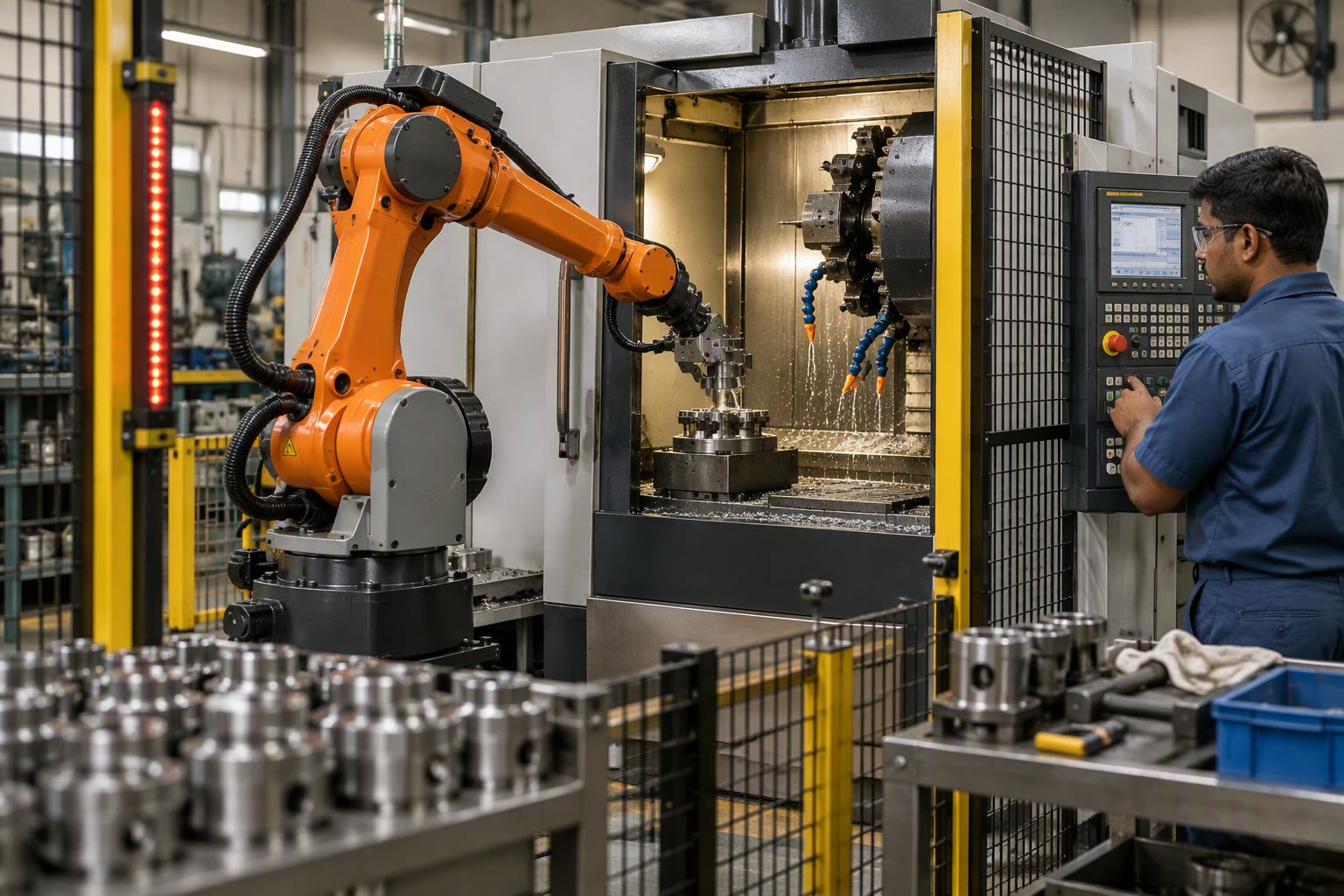
The robot is rarely the expensive part. A six-axis arm that looks affordable on a quotation sheet becomes a different number once you add the controller, the gripper, the safety fencing, the integration and the year of engineering that makes it actually produce parts. This guide breaks down where the money goes in an Indian installation, with planning ranges you can take to a vendor conversation. Industrial robot cost India quotations show is mostly the controller, gripper, safety and integration around the arm.
All figures below are indicative planning ranges for 2026, before GST. Actual quotes move with payload, reach, brand, duty structure, integration scope and how much of the plant has to be reworked. Treat them as a budget envelope, not a price list.
What you are actually buying
A working robot cell has six cost centres. Vendors quote them differently, which is why two offers for the “same” arm can differ by a factor of two.
| Item | What it covers | Share of project cost |
|---|---|---|
| Robot arm | Mechanics, motors, gearboxes, brakes, encoders | 25–40% |
| Controller and teach pendant | Motion control, I/O, safety logic, programming interface | Often bundled with the arm |
| End effector | Gripper, vacuum cup, welding torch, dispenser, tool changer | 5–20% |
| Safety system | Fencing, light curtains, laser scanners, interlocks, safe stop wiring | 8–20% |
| Integration and programming | Cell design, fixture, PLC, conveyors, vision, commissioning, training | 25–50% |
| Installation and services | Foundation, power, compressed air, transport, duty, insurance | 5–12% |
The pattern to remember: the arm is the smallest predictable line item. Integration is the largest variable, and it is where a cheap robot can quietly become an expensive project.
Price bands by payload class
Payload and reach drive the arm price more than any other specification. These bands cover the arm with controller, before end effector and integration.
| Class | Typical payload | Arm and controller | Common use |
|---|---|---|---|
| Small SCARA or delta | 1–6 kg | ₹3–8 lakh | Pick and place, assembly, small part handling |
| Entry six-axis | 3–10 kg | ₹4–12 lakh | Machine tending, packing, palletising small cartons |
| Mid six-axis | 10–30 kg | ₹10–25 lakh | Welding, grinding, medium assembly, palletising |
| Heavy six-axis | 50–200 kg | ₹20–60 lakh | Foundry, heavy machine tending, palletising bags |
| Cobot (collaborative) | 3–16 kg | ₹8–35 lakh | Assembly beside people, machine tending, inspection |
Chinese and Indian-assembled arms sit at the lower end of each band; Japanese, German and Korean brands sit at the upper end. The gap buys repeatability data, spare-part availability, service depth and resale value. For a first cell in a job shop, a mid-band arm with a strong local service contract is usually the better commercial decision than the cheapest quote.
Why two quotes for the same arm differ
When quotes diverge sharply, compare these seven lines before comparing totals: Differences between quotes explain much of the industrial robot cost India buyers see on paper.
- Scope of integration. One vendor supplies a robot and a training session; another designs fixtures, rewires the machine, adds a safety PLC and proves cycle time.
- Safety compliance. A cell that must meet the risk-assessment requirements of ISO 10218 and the Factories Act carries real engineering cost. Fencing and scanners are not optional extras.
- Vision or sensing. A camera, lighting and part-location software can add more than the arm itself.
- Cycle-time guarantee. Vendors who guarantee throughput price the risk in. Vendors who do not are cheaper for a reason.
- Spares and warranty. Two years of on-site support is a different product from a one-year parts warranty.
- Import duty and logistics. Landed cost depends on classification, freight and currency at the time of order.
- Training. Programming training for two engineers versus a handover document changes the total by lakhs over the life of the cell.
Cobot or industrial arm
Cobots cost more per kilogram of payload, run slower and have smaller reach. They earn their premium when the cell has to share space with people, when changeovers are frequent, or when the part has to be loaded by hand. If the process can be fenced and the part is presented by a conveyor, a conventional industrial arm will usually deliver more cycles per rupee.
| Question | Cobot | Industrial arm |
|---|---|---|
| People inside the cell? | Yes, with a risk assessment | No, fenced |
| Changeovers per shift | Frequent, reprogrammed by operators | Infrequent, programmed by engineers |
| Speed priority | Secondary | Primary |
| Payload above 20 kg | Rare and expensive | Normal |
| Floor space | Small footprint, no fence | Cell plus fence and access |
Buy, lease or rent by the hour
Three commercial models are common in India:
- Outright purchase. Lowest total cost over a long life, highest capital outlay. Best when utilisation is high and the process is stable.
- Lease or equipment finance. Spreads cost over three to five years, preserves working capital. Compare the effective interest rate, not the monthly number.
- Rental or robot-as-a-service. Useful for seasonal peaks, trial projects and companies that want to prove a process before committing. The hourly rate looks high against purchase price but includes service and often programming support.
A worked payback example against industrial robot cost in India
A small machining shop runs two shifts of machine tending. One operator loads and unloads two CNC machines, earning a loaded cost of about ₹35,000 a month including statutory costs. The cell needs one arm, a double gripper, a small conveyor and fencing.
project cost        = arm ₹9 L + gripper ₹1.2 L + safety ₹1.5 L
                      + integration ₹4 L + installation ₹0.6 L
                    ≈ ₹16.3 lakh

monthly saving      = one operator ₹0.35 L + attrition and training ₹0.05 L
                    ≈ ₹0.40 lakh

payback             = 16.3 / 0.40 ≈ 41 months

with 2 operators    ≈ 20 months
This is why single-operator cells are hard to justify and multi-machine cells are easier. The robot’s cost is fixed; the labour it replaces scales with the number of machines one person was tending.
Running costs people forget
These running costs belong in any industrial robot cost India comparison, not just the purchase price.
- Spares. Budget 3–6% of arm value per year for belts, batteries, grease and occasional motor or reducer service.
- Power. A small arm draws roughly 1–3 kW in production; the compressor for vacuum grippers often draws more than the robot.
- Programming time. New part variants need reprogramming. If you change parts weekly, budget engineer hours every month.
- Training turnover. Every trained operator who leaves takes knowledge with them. Document programs and keep a second person trained.
- Insurance and downtime. A stalled cell can stop an entire line. Keep critical spares on site.
Funding and subsidies
MSMEs can usually access equipment finance through scheduled banks and NBFCs, and several states offer capital subsidy or interest subvention for automation under their industrial policies. Schemes change, caps differ by state and category, and eligibility is rarely automatic. Check the current state industrial policy and speak to a chartered accountant before assuming a subsidy in your payback calculation.
Questions to ask before signing
- What cycle time is guaranteed, and what happens if the cell misses it?
- Is the safety system designed to ISO 10218 and documented with a risk assessment?
- Which spare parts are stocked in India, and what is the lead time for a motor or reducer?
- Who writes the PLC and vision code, and do I get the source?
- What is the acceptance test, and where does it run?
- How many days of on-site support are included after commissioning?
- What is the training plan, and how many people does it cover?
- What happens to the price if the rupee moves before delivery?
- Can the cell be expanded to a second machine or a second variant?
- What is the resale or trade-in position in five years?
Common mistakes
- Buying on payload alone. Reach, repeatability, wrist torque and mounting matter just as much.
- Forgetting the part presentation. If a human still has to orient the part, the robot has not removed the bottleneck.
- Skipping the risk assessment. Safety is a legal requirement, not a finishing touch.
- Underestimating commissioning. Cells that run in a vendor’s lab often need weeks of tuning on the real line.
- No internal owner. A cell without a trained internal champion becomes a very expensive statue after the integrator leaves.
Frequently asked questions
How much does an industrial robot cost in India?
A small six-axis arm with controller is roughly ₹4–12 lakh, a mid-size 10–30 kg arm ₹10–25 lakh, and a heavy 50–200 kg arm ₹20–60 lakh. A complete working cell typically costs 1.8 to 2.5 times the arm price once grippers, safety and integration are included.
What is the cheapest way to start with industrial automation?
Start with a single repetitive machine-tending or pick-and-place task, buy a mid-band arm with local service, and keep the first cell simple. Prove payback before adding vision, conveyors or a second robot.
Do I need safety fencing for a robot cell in India?
Yes, unless a documented risk assessment shows the application is safe without it. ISO 10218 and the Factories Act set the framework; collaborative robots reduce but do not remove the need for assessment.
How long does installation take?
A simple cell can be commissioned in two to four weeks after the equipment arrives. Cells with vision, conveyors, PLC integration and custom fixtures commonly take two to four months including acceptance testing.
Can I lease an industrial robot instead of buying?
Yes. Equipment finance and robot-as-a-service models exist in India. Compare the effective interest rate and what service is included, not just the monthly payment.
What maintenance does a robot need?
Grease and battery replacement on a schedule, belt and cable inspection, backup of controller programs, and an annual check of brakes and safety devices. Budget 3–6% of arm value per year.
Related: robotics in manufacturing, robot safety standards in India, warehouse robotics, gripper design basics, robotics engineering careers.
See also: cobot welding costs and payback for a worked small-business example.
Our breakdown of industrial robot costs shows why the arm is rarely the largest line in a SCARA cell.
Programming usually hides inside integration budgets, and our industrial robot cost breakdown shows how to separate the two.
If a full six-axis cell is out of budget, the cobot buying guide for India breaks down what a collaborative arm actually costs.
Budget for controls engineering too; PLC programming is a separate skill from robot teaching.
For cells built around a CNC machine rather than a welding torch, see machine tending robots in India: costs and payback.
Purchase price is not total cost: robot maintenance and spares decide what the cell really costs per year.
For high-volume carton handling, compare a palletizing cell in palletizing robot costs in India.
Humanoids are a different class of purchase; see what humanoid robots cost in India.
The choice between a cobot and an industrial arm changes the whole cell budget: cobot vs industrial robot compared.
Before approving a robot purchase, run the numbers with this robot ROI method.
Budget for the PLC, HMI and safety controller, not just the robot: see PLC vs robot controller.
Price and performance are separate questions: see what accuracy and repeatability really mean, and plan the install with a robot integration checklist.
A used arm is the other half of the cost picture; see the used industrial robot buying guide.
Brand choice changes the price and the service story; see the robot brand comparison.
Do not size the robot on the brochure payload; the tool and part decide.
Two robots at the same price can differ by seconds per cycle, so compare cycle time as well as payload and reach.
Floor space and layout drive the civil work, so plan it with the robot cell layout guide.
If the capex is hard to justify, compare it with the robot rental and lease options in India.
Mobile robots have their own cost structure, and the AMR and AGV comparison breaks down the five-year view.
Cobot cells have a different cost mix, broken down in the cobot price guide alongside industrial robot pricing.
The dress pack is a real line in the cell budget, and the parts breakdown shows typical Indian prices.
For moulding shops the take-out robot is usually the first and cheapest step, which our injection moulding robot cost guide explains.
Deburring adds a spindle, a compliance device or force sensor and extraction to the robot price; the deburring cell costs are set out separately.
An explosion-proof painting robot costs two to three times a comparable general-purpose machine, so budget separately.
Before comparing a new robot with a used one, cost the retrofit of the used machine, because that is the honest comparison.
The robot is only part of the bill; the rest of the project is explained in this guide to robot cell integration cost.
If the capital outlay is the obstacle, start with the guide to automation subsidies for MSMEs before you settle on a budget.
Convert the purchase price into an hourly figure with the robot cost per hour guide.
Budget the upkeep as well as the purchase; the maintenance cost guide shows the annual figure to plan for.
Sources and further reading
- International Federation of Robotics — global installation statistics and robot density data.
- ISO 10218-1 — safety requirements for industrial robots.
- ISO/TS 15066 — collaborative robot safety guidance.
- Ministry of MSME — scheme and credit information for small manufacturers.
- DGFT — import policy and duty classification for machinery.