Service robots in Indian hotels and restaurants are no longer a novelty, but the business case is narrower than the brochures suggest. A robot that carries a tray from the kitchen to a table can work well. A robot expected to replace waiters, navigate a crowded banquet hall and handle guests will disappoint. The difference is in the building, the workflow and the expectations.
This guide covers the categories of service robots available in India, realistic 2026 costs, the unit economics of a deployment, and the site conditions that decide whether a robot is useful or a photo opportunity.
The four categories
| Type | What it does | Where it fits |
|---|---|---|
| Delivery robot | Carries trays, linen or parcels between fixed points | Restaurants, hotels, hospitals, large offices |
| Cleaning robot | Scrubs or sweeps floors on a route | Malls, airports, hotels, warehouses |
| Reception or guidance robot | Displays information, escorts visitors, handles check-in | Hotels, hospitals, showrooms |
| Kitchen automation | Cooking, dispensing or dish handling | Quick-service restaurants, cloud kitchens |
Delivery and cleaning robots are the categories with a measurable return, because they move things or cover floor area on a schedule. Reception robots are harder to justify on labour savings; they are usually bought for experience, marketing or after-hours service.
What they cost in India
Indicative 2026 ranges, before GST and installation. Prices vary widely with payload, navigation stack, brand and after-sales support.
| Category | Purchase range | Monthly rental | Notes |
|---|---|---|---|
| Entry delivery robot | ₹1.5–3.5 lakh | ₹15,000–30,000 | Fixed route or marker navigation |
| SLAM delivery robot | ₹3–7 lakh | ₹25,000–55,000 | Lidar navigation, lift integration |
| Cleaning robot, small | ₹2–5 lakh | ₹20,000–45,000 | Scrubbing or sweeping, one floor |
| Cleaning robot, large | ₹6–15 lakh | ₹50,000–1,20,000 | Ride-on class, larger tanks |
| Reception robot | ₹3–10 lakh | ₹30,000–80,000 | Screen, speech, escort behaviour |
Rental is often the better first step. It moves the technology risk to the vendor and lets you measure whether guests and staff actually use the robot before committing capital.
The unit economics of a delivery robot
A restaurant delivery robot typically replaces part of a runner’s task, not the runner. If it carries 20–40 trays a day over a short route, the saving is a fraction of one salary. The case improves when the route is long, the floor is flat, and the alternative is a dedicated runner who spends most of the shift walking.
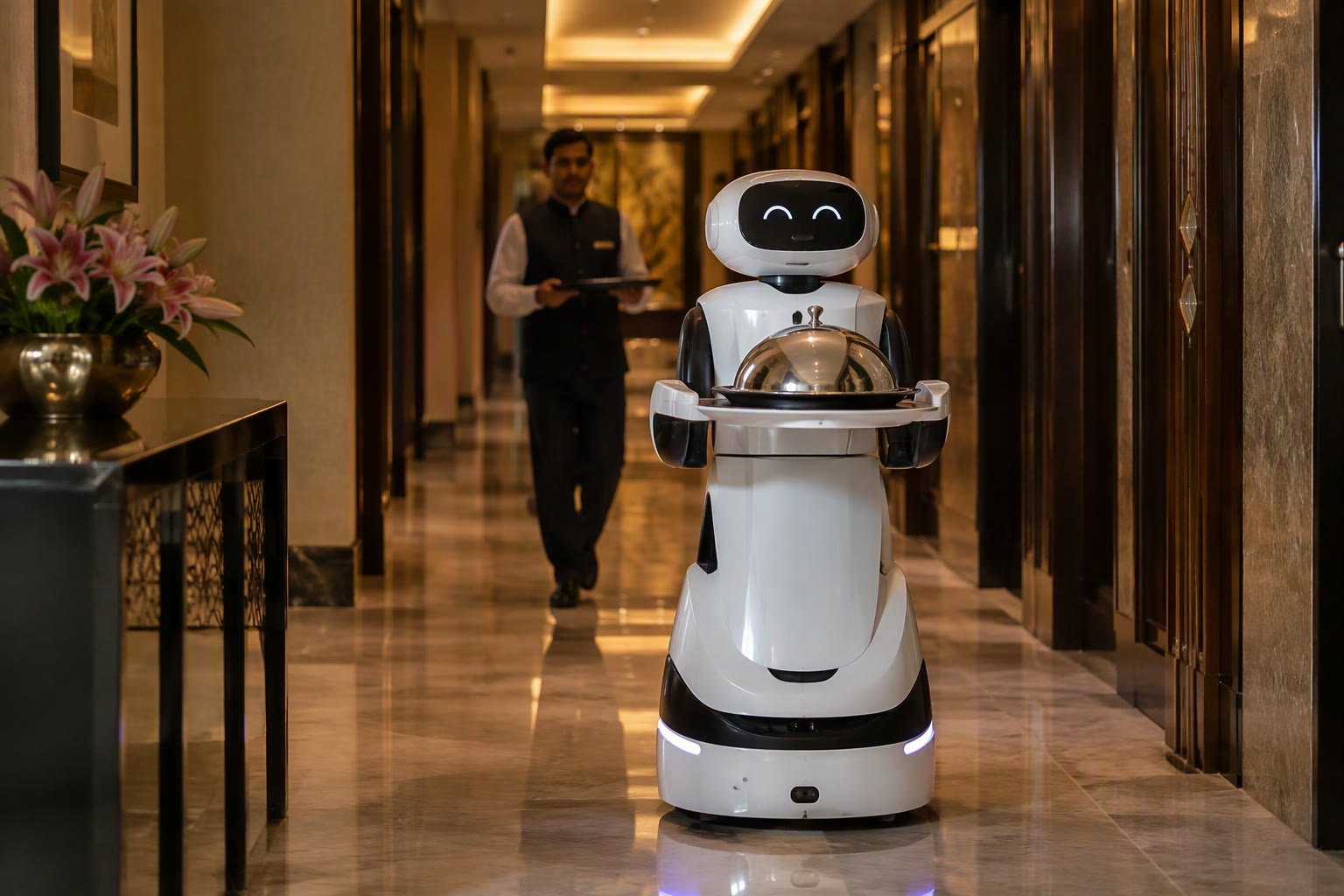
In a hotel, a delivery robot moving linen, water or room-service trays can cover several floors if lift integration works. That is where the payback appears: night shifts, repetitive trips and a building with reliable connectivity.
Site conditions that decide success
- Floor quality. Tiles, thresholds, ramps and loose mats break navigation and spill drinks.
- Lift integration. Multi-floor service needs a robot that can call and ride a lift, which is a software and building-management project.
- Wi-Fi coverage. Dead spots cause pauses and lost maps. Survey the route before buying.
- Human traffic. Crowded banquet halls and children are hard for any service robot; plan routes away from peak congestion.
- Charging location. The dock needs power, clearance and a route that does not block fire exits.
- Staff workflow. If the robot adds a step for the kitchen team, they will stop using it.
What guests actually notice
Guests notice whether the robot arrives with the right order, whether it blocks the aisle, and whether a staff member has to rescue it. They do not notice the navigation stack. A deployment that needs constant staff intervention damages the experience more than no robot at all.
Pilot for at least a month, on real shifts, with a named staff owner. Measure trips completed, interventions per day and guest complaints. Those three numbers decide whether to scale.
Vendor questions that matter
- Who services the robot in my city, and in how many hours?
- What is the spare-part lead time for wheels, lidar and battery?
- Does the price include mapping, staff training and software updates?
- What happens when the internet or Wi-Fi goes down?
- Can I export trip data, and who owns it?
- What is the expected battery life in cycles, and what does a replacement cost?
Related: AGV vs AMR, SLAM for beginners, warehouse robotics in India, solar panel cleaning robots, robot charging and docking.
How much does a service robot cost in India?
Indicative 2026 ranges are ₹1.5–3.5 lakh for an entry delivery robot, ₹3–7 lakh for a SLAM-navigated model, and ₹2–15 lakh for cleaning robots, before GST. Monthly rentals start around ₹15,000.
Do service robots replace waiters?
Rarely. They replace part of the running task, especially long repetitive trips. Staff still take orders, serve at the table and handle exceptions, so the labour saving is partial.
Can a delivery robot use a lift?
Some models can, but it requires integration with the lift controller and building management. Treat it as a separate project and test it before committing.
What is the biggest cause of failure?
Poor site conditions and unrealistic expectations: thresholds, Wi-Fi dead spots, crowded routes and staff workflows that the robot disrupts. Piloting on real shifts exposes these early.
Should I buy or rent?
Rent for a first deployment. Rental moves technology risk to the vendor and lets you measure actual usage before spending capital.
Runtime and charging depend on the battery pack and its BMS.
Narrow corridors are a costmap tuning problem as much as a sensor problem.
A delivery robot in a hotel corridor turns tightly, and Ackermann geometry sets the minimum radius.
Sources and further reading
- International Federation of Robotics — service robot categories and installation data.
- ISO 10218-1 — safety requirements relevant to mobile and service robots.
- Nav2 documentation — navigation, localisation and costmaps used by many delivery robots.
- Bureau of Indian Standards — Indian standards relevant to electrical safety and machinery.