A robot controller that works on a bench can fail in a Gujarat monsoon or a Pune machine shop within a month. Dust, coolant mist and humidity attack the parts of an enclosure nobody photographs: glands, seals and vents.
This guide explains what an IP rating actually promises, where enclosures leak in practice, how to manage heat and condensation, and what to specify when you have a panel fabricated in India.
What the IP number means
IP stands for ingress protection, and the two digits describe solids and liquids separately. The first digit is dust and foreign objects, the second is water. A higher number is not automatically better for every situation, because sealing traps heat and moisture inside.
| Rating | Solids | Water | Typical use |
|---|---|---|---|
| IP54 | Dust protected | Splashing water | Clean workshop panel |
| IP65 | Dust tight | Water jets | Machine shop, coolant nearby |
| IP66 | Dust tight | Powerful jets | Washdown areas |
| IP67 | Dust tight | Temporary immersion | Outdoor, exposed robots |
| IP69K | Dust tight | High pressure, high temperature | Food and pharma washdown |
Note the gap between IP54 and IP65 in dust: protected means dust can enter but not in a quantity that interferes, while dust tight means no dust ingress at all. For a workshop with grinding dust, that difference decides the life of the electronics.
Where enclosures actually leak
A certified enclosure with an uncertified installation is an unsealed box. Most failures come from the accessories, not the sheet metal.
- Cable glands: an unused hole with a plastic plug is not a seal.
- Door gaskets pinched by a hinge that was not adjusted.
- Vents and filters that were added for cooling and never maintained.
- Connectors on the enclosure wall that are rated lower than the box.
- Cable entries at the bottom with a drip loop missing, so water runs along the cable into the gland.
- Earth studs and mounting bolts that compress the gasket unevenly.
Pick one wall for cable entry, enter from below, and use an appropriate gland for each cable diameter. A gland that is too large with a wrap of tape is a leak with extra steps.
Heat is the second problem
Sealing a box also seals in the heat. A drive, a power supply and a controller can easily dissipate a few hundred watts in a one-metre panel, and the internal temperature can rise well above ambient. Electronics derate, and cheap capacitors fail early.
# rough internal rise for a sealed steel panel
# delta_T ≈ P / (U * A)
# P in watts, U about 5.5 W/m2K for painted steel, A in m2

P = 300        # total dissipation
A = 2.4        # surface area of a 800x600x300 mm panel
delta_T = P / (5.5 * A)   # about 23 K above ambient
Inside a 40 C workshop that puts the panel at about 63 C, which is too hot for comfort and close to the limit for some drives. The options are more surface area, a filtered fan, a heat exchanger or a panel air conditioner. Each has a cost and a maintenance burden.
| Method | Suitable for | Trade-off |
|---|---|---|
| Filtered fan and outlet | Clean to moderately dirty air | Filter cleaning schedule; not sealed |
| Heat exchanger | Dusty air, moderate heat | Limited cooling capacity |
| Panel air conditioner | High ambient, sealed panel | Cost, power, condensate drain |
| Remote mounting | Anywhere the panel can sit outside the hazard | Cable length and voltage drop |
Condensation and the Indian monsoon
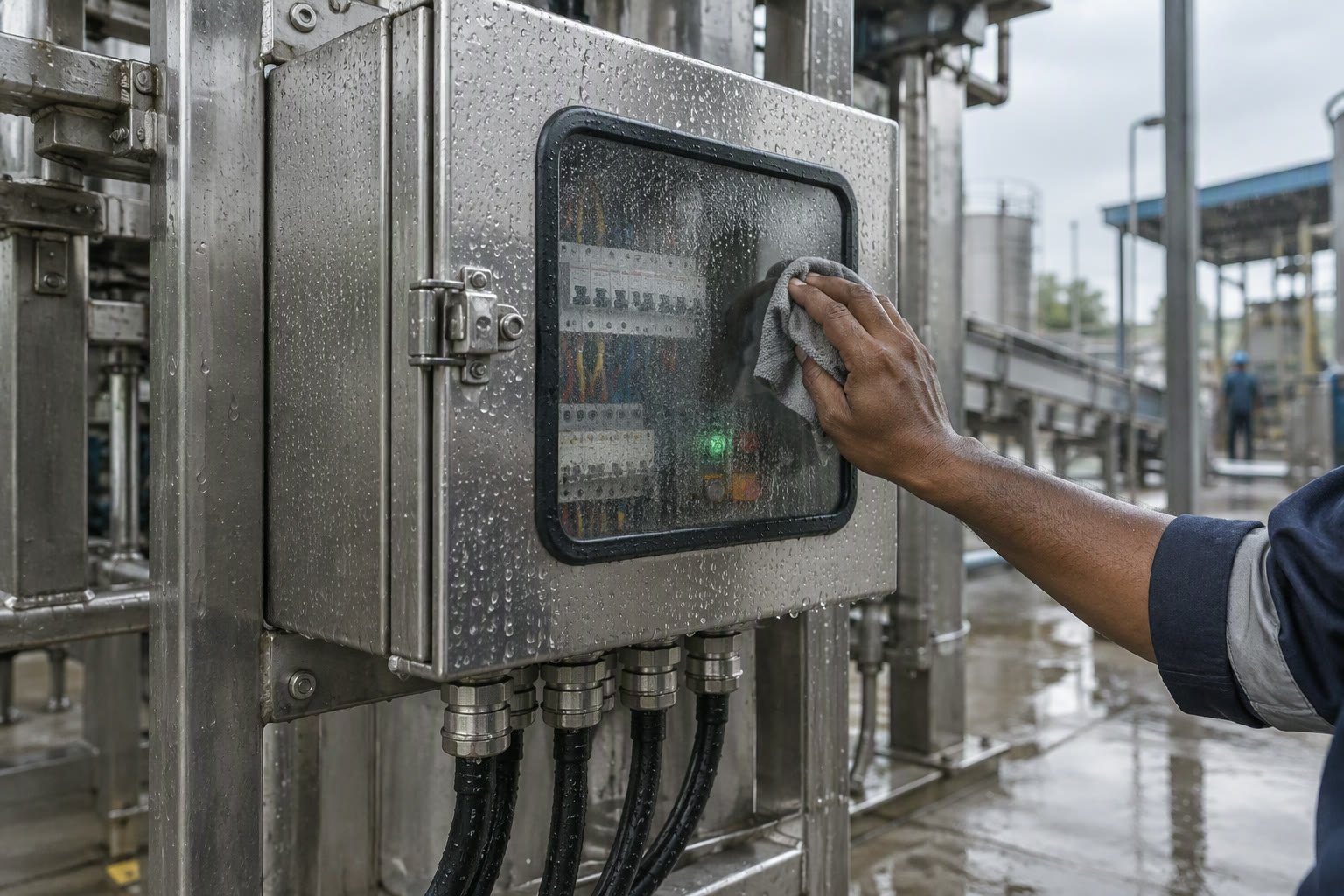
Humidity is a bigger threat than most designers expect. A panel that cools overnight pulls moist air in through every imperfect seal, and the water condenses on cold metal in the morning. The result is corrosion on terminals and intermittent faults that vanish by afternoon.
- Fit a pressure-compensating breather instead of an open vent.
- Use an anti-condensation heater with a thermostat in panels that cycle in temperature.
- Keep electronics powered or use a small heater during idle periods in humid months.
- Seal spare cable entries permanently, not with tape.
- Specify conformal coating on boards that live in damp enclosures.
Materials and finish
| Material | Good for | Limitations |
|---|---|---|
| MS sheet, powder coated | Indoor panels, best cost | Rust at scratches and cut edges |
| SS 304 | Food, pharma, washdown | Higher cost, harder to fabricate |
| Aluminium | Light weight, good heat spreading | Cost, denting |
| Polycarbonate | Small boxes, visibility | UV ageing, flammability |
For most Indian machine shops, a 2 mm MS panel with a proper powder coat and good gaskets is the practical choice. Stainless is justified where washdown chemicals are used, not because it looks better.
A specification that a fabricator can build
- Enclosure rating required, in IP terms, with the standard referenced.
- Sheet thickness and material, plus the finish colour and powder coat specification.
- Internal layout drawing with DIN rail positions and cable duct routing.
- Cable entry plate with gland sizes per cable.
- Cooling method and its power supply.
- Anti-condensation heater, thermostat and breather if specified.
- Earth bar, door earth strap and a labelled terminal schedule.
- Nameplate with the panel rating and the supply details.
Ask for the enclosure with the gasket and glands fitted, not supplied loose. Loose accessories get fitted on site by whoever is in a hurry, and that is where the rating disappears.
Testing before it goes to the shop floor
- Close every door and check the gasket compresses evenly all round.
- Spray water at the seals from a hose, not a jet, and look inside for droplets.
- Run the panel for an hour at full load and log the internal temperature.
- Check that the heater and thermostat work with the panel de-energised.
- Confirm the earth continuity from the door to the main earth bar.
A hose test will not prove an IP65 rating, but it will find the gland you forgot. Formal testing belongs with the enclosure supplier, and the certificate should match the box you actually installed, not a similar model.
Related: robot controller PCB design, robot safety standards in India, choosing an industrial robot, CAN bus wiring, industrial Ethernet.
Is IP65 enough for an Indian machine shop?
Usually yes for a panel that sits away from direct coolant, provided the glands and door seals are proper. Grinding dust and high-pressure washdown need IP66 or better, and washdown with chemicals points to stainless steel.
Why does my sealed panel get water inside?
Condensation, not rain. Moist air enters through imperfect seals or cable entries and condenses when the panel cools. Fit a breather, seal spare entries and add an anti-condensation heater.
Can I just add a fan to cool the panel?
A fan with a filter cools well but breaks the seal and needs regular filter cleaning. In dusty shops, a heat exchanger or a small panel air conditioner keeps the enclosure closed.
What does IP69K mean?
Protection against high-pressure, high-temperature water jets, used mainly in food and pharmaceutical washdown. It is not the same as long-term immersion, which is IP68.
Does a higher IP rating always cost more?
Generally yes, and it also traps more heat. Match the rating to the actual environment rather than specifying the highest number, then solve the thermal problem deliberately.
Cleanroom and washdown specifications go beyond IP ratings, as the pharma robotics guide explains.
IP69K is the rating food washdown areas usually need, and the food robot guide shows where it applies.
Abrasive dust is one of the hardest environments for a robot, which is why deburring cells need a realistic IP rating.
Foundry-rated builds exist for a reason; the die casting robot is exposed to heat, oil mist and aluminium flash together.
A harsh environment raises the upkeep, and the maintenance cost guide shows how much.
Sources and further reading
- IEC 60529 — degrees of protection provided by enclosures.
- ISO 10218-2 — robot cell integration requirements.
- OSHA machine guarding — protective housing practice.