Solar panel cleaning is one of the few robotics markets in India where the payback is easy to calculate and the labour problem is immediate. Dust, bird droppings and agricultural residue cut generation on every rooftop plant, and cleaning a large array by hand is slow, water-heavy and sometimes dangerous. A cleaning robot turns that recurring cost into a capital purchase with a measurable return. This guide covers the three machine types, indicative Indian prices, a worked payback model and the questions that decide whether a robot suits a particular plant.
Why soiling costs more than most owners assume
Soiling loss is the difference between the energy a clean array would produce and what it actually produces. In high-dust regions of India, studies and plant reports commonly put unmitigated soiling losses somewhere between 10% and 25%, depending on season, tilt angle, wind, nearby construction or farmland, and how often it rains.
Light rain does not reset the array. It can cement dust into a film, and bird droppings or sticky agricultural residue need mechanical removal. Panels cleaned only when someone remembers tend to sit in the worst part of that range during the dry months.
| Soiling source | Typical pattern | What removes it |
|---|---|---|
| Road and construction dust | Even film, worst in dry months | Dry brush or microfibre, frequent light passes |
| Bird droppings | Localised, stubborn, can cause hot spots | Wet cleaning with a soft brush |
| Agricultural dust and chaff | Seasonal, can stick after dew | Wet cleaning, sometimes twice in a week |
| Pollution and smoke | Slow film, reduces transmittance | Regular wet cleaning |
The three cleaning approaches
“Solar cleaning robot” covers machines with very different levels of autonomy. Buying the wrong class is the most expensive mistake in this category.
| Type | How it works | Indicative price | Best fit |
|---|---|---|---|
| Manual water-fed pole and brush | A person walks the array with a telescopic brush and water feed | ₹15,000–₹60,000 for equipment | Small rooftops, low labour cost, irregular layouts |
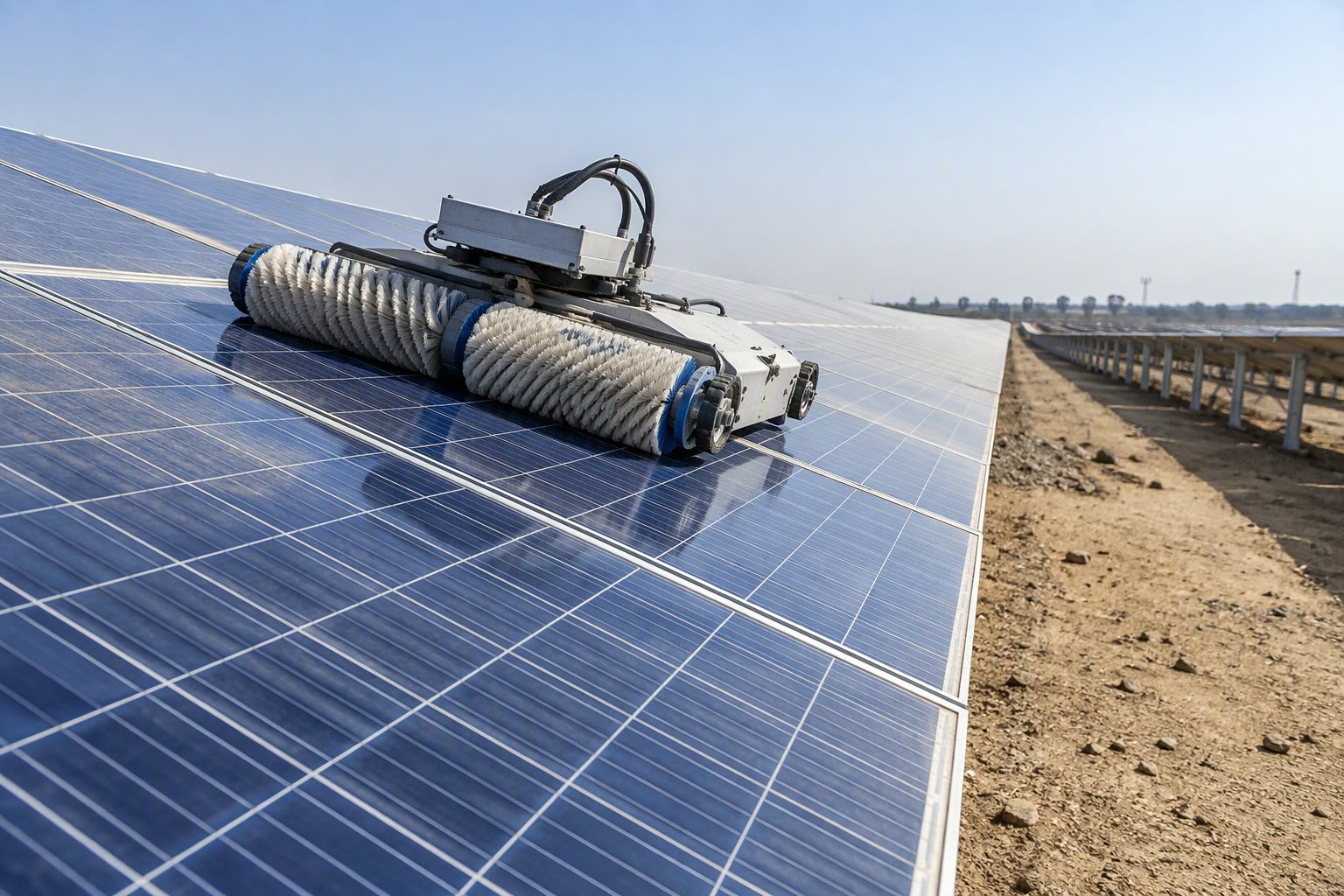
| Semi-autonomous portable robot | Placed on a row, moves across the panels, moved by hand between rows | ₹1.2–3 lakh per unit | Rooftop plants of 100 kW to 1 MW with repeated rows |
| Autonomous row-crossing robot | Drives along the array, crosses gaps, returns to a dock, reports status | ₹4–10 lakh per unit or more | Large rooftops and utility-scale plants with uniform mounting |
| Utility-scale robotic system | Gantry or rail-mounted system covering long rows, integrated with SCADA | Project-specific; commonly quoted per MW | Ground-mount plants above several MW |
These are indicative market bands for planning, not quotations. Mounting type, row length, tilt, water availability and control integration move the price substantially. Always get at least three quotes on the same scope.
Water-fed or waterless
Both approaches work, and the choice is usually about water logistics rather than cleaning quality.
- Waterless dry cleaning uses microfibre or soft brushes. It is fast, uses no water and suits daily dust. It struggles with bird droppings and cemented film.
- Water-fed cleaning removes sticky contamination but needs a tank, a supply route and drainage planning. Hard water can leave mineral spots if the panels dry dirty.
- Hybrid robots carry a small tank for spot wetting and a dry brush for the main pass. They are the common compromise on Indian rooftops.
If the site has no reliable water supply, do not buy a water-dependent robot and hope. Size the tank and the refill route first, or choose dry cleaning and accept more frequent passes.
A worked payback model
Numbers below are illustrative and should be replaced with the plant’s actual generation, tariff and soiling data. The structure is what matters.
| Item | Assumption | Annual value |
|---|---|---|
| Plant size | 500 kW rooftop | — |
| Specific yield | 1,450 kWh per kW per year | 725,000 kWh |
| Soiling loss without cleaning | 10% | 72,500 kWh lost |
| Value of lost generation | ₹7 per kWh | ₹5.08 lakh |
| Robot cost | Two semi-autonomous units plus spares | ₹4.5 lakh |
| Annual running cost | Labour, water, power, maintenance | ₹60,000 |
| Recovered generation | Assume 80% of the soiling loss is recovered | ₹4.06 lakh |
| Net annual benefit | Recovered value minus running cost | ₹3.46 lakh |
| Simple payback | Robot cost divided by net benefit | About 16 months |
Change the soiling loss to 5% and the payback stretches beyond three years. Change the tariff to ₹4 per kWh and it stretches again. This is why a site survey and a month of before-and-after generation data matter more than any vendor’s brochure.
What decides whether a robot fits the plant
- Row length and continuity. Robots dislike short, broken rows and large height changes between tables.
- Mounting type and tilt. Frame rails, clamps and cable trays can obstruct travel. Walk the array with the vendor before ordering.
- Gaps between rows. A row-crossing robot needs a safe path; a portable unit needs a person to carry it.
- Water and power access. A charging dock and a refill point should be planned at installation, not improvised later.
- Wind. Light robots can be lifted in gusty conditions; check the operating wind limit and the tie-down procedure.
- Spares and service. Brushes, wheels, batteries and control boards should be available in India with a stated lead time.
Safety and panel damage
The biggest risk is not the robot falling off; it is a brush or wheel dragging grit across the glass. A dry brush loaded with sand can scratch anti-reflective coating over months. Look for brush materials designed for coated glass, a debris-lift path ahead of the brush, and a pressure setting that does not press grit into the surface.
Electrically, cleaning robots operate near live DC strings. Any machine that touches the array should be rated for the environment, and the plant’s isolation procedure should be followed during installation and maintenance. This is a job for the O&M team, not an unsupervised contractor.
Manual cleaning is not free either
A 500 kW rooftop might take two workers several days per cycle, and cycles are needed every two to four weeks in dusty seasons. Add water, transport, supervision and the safety risk of working at height or on fragile modules. The comparison is not robot versus nothing; it is robot versus a recurring labour contract that is hard to schedule and harder to verify.
For plant owners evaluating automation more broadly, the manufacturing robotics guide covers how automation decisions are justified in Indian industry, the motor selection guide explains the drive sizing behind any mobile robot, and the power guide covers the battery and rail decisions a field robot needs.
A student version of the same problem
Solar cleaning is also a strong final-year project because the requirement is clear and measurable. A small prototype with a brushed DC motor, a microfibre roller and an IR or ultrasonic edge sensor can demonstrate the core idea for under ₹8,000. The hard parts are traction on a wet incline, edge detection and power management, not the cleaning itself.
If you build one, measure how much dust it removes and how much water it uses, and compare that with a manual wipe on a control panel. That measurement is what turns a demo into a project report. The report format guide shows how to present it.
Solar EPC work is often the first place a contractor meets robots, and the construction robotics guide covers the wider picture.
Frequently asked questions
How often should solar panels be cleaned in India?
In dusty regions, every two to four weeks during dry months and more often near construction or farmland. Light rain helps but does not replace cleaning. The right interval comes from comparing generation before and after cleaning on the actual plant.
Do cleaning robots scratch panels?
They can if grit is dragged under a dry brush. Choose brushes and pads designed for coated glass, keep the brush clean, and avoid dry cleaning after heavy dust without a debris-lift pass. Any abrasive contact is a risk over years.
What size plant justifies a robot?
Rooftops from roughly 100 kW upward can justify a portable unit if rows are uniform and labour is a recurring problem. Below that, manual cleaning is often cheaper. Utility-scale plants usually need row-crossing or gantry systems.
Can one robot cover multiple rooftops?
A portable semi-autonomous unit can be moved between sites, but transport and setup time eat into the economics. For multiple nearby rooftops, a service model with one operator and a vehicle often works better than one robot per site.
Is waterless cleaning effective in Indian dust?
For daily dust, yes, if the brush and microfibre are clean and passes are frequent. For sticky or cemented contamination, water or a hybrid approach is needed. Many sites use dry cleaning most of the year and wet cleaning after the first rains.
Background used for this page:
- Published soiling-loss studies and plant operator reports for Indian conditions; the 10–25% range is indicative and site-specific.
- MNRE guidance on solar plant operation and maintenance.
- Publicly advertised Indian prices for cleaning robots and manual cleaning services; confirm current quotes with vendors.