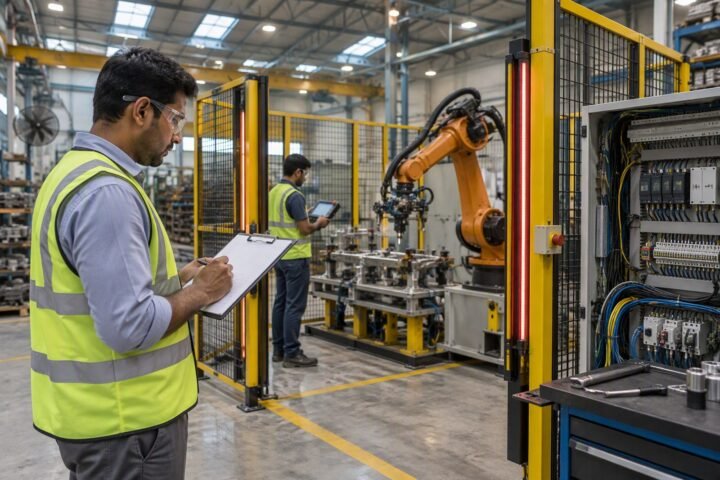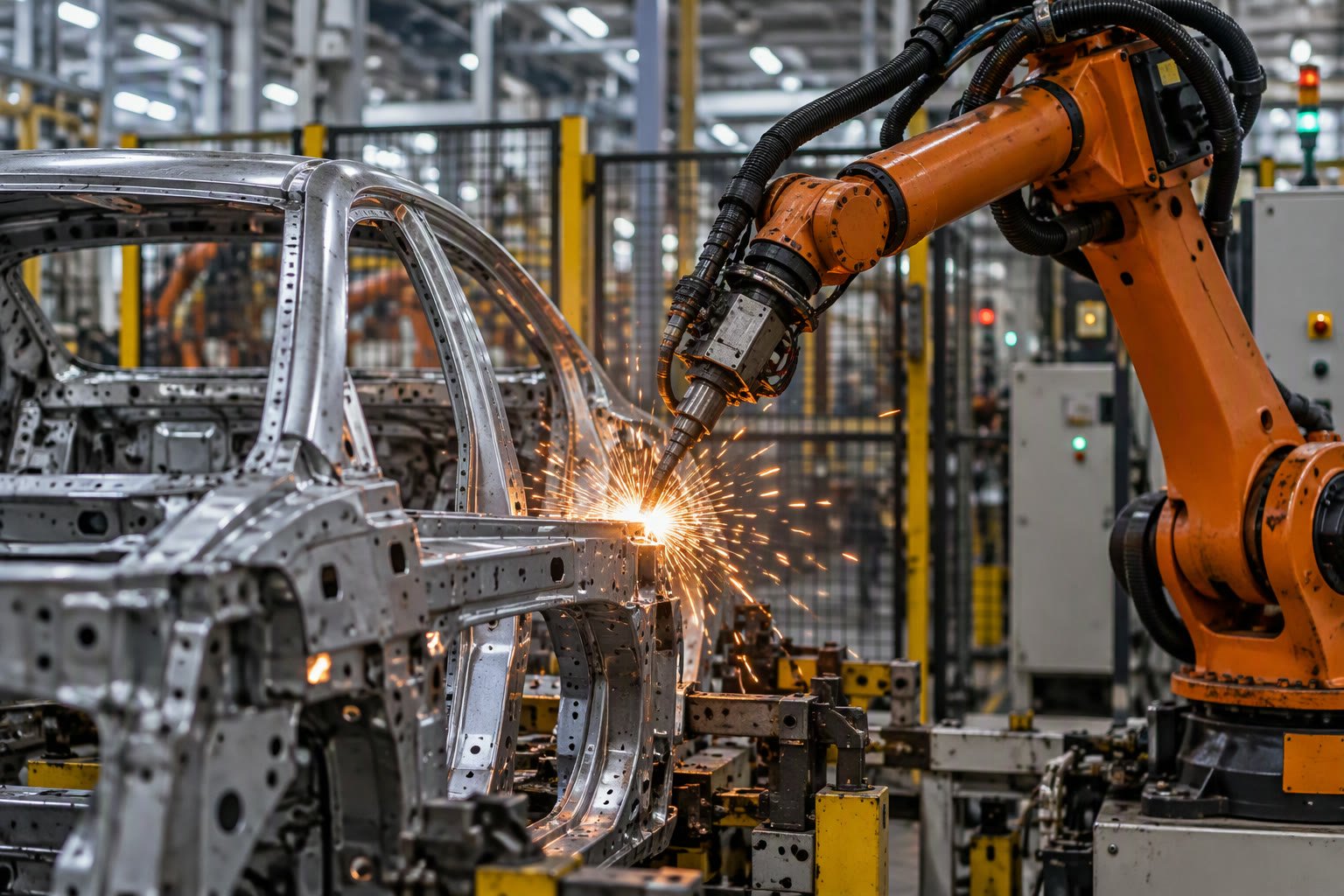
India installs roughly 8,500 industrial robots a year, and almost none of them look like the humanoids in the news. They are six-axis arms welding car bodies in Pune, SCARAs placing components in Chennai, and delta robots packing biscuits in Gujarat. This guide explains what is actually running on Indian factory floors, what a cell costs, and what a fresher needs to know to work on one. Robotics in manufacturing in India is mostly six-axis arms, SCARAs and delta robots, not humanoids.
The numbers behind Indian manufacturing robotics
The International Federation of Robotics puts India’s annual installations at about 8,500 units in 2023, with an operational stock just under 60,000. That is a large number in absolute terms and a small one per worker: India’s robot density is roughly six robots per 10,000 manufacturing employees, against a global average above 150. South Korea, Singapore, China and Germany are an order of magnitude ahead.
Two things follow from that gap. First, most Indian factories are not automating from scratch; they are automating one cell at a time, usually a job that is dirty, hot, repetitive or hard to staff. Second, the growth is concentrated in a handful of industries and clusters rather than spread evenly across the country.
| Industry | Typical application | Why robots win |
|---|---|---|
| Automotive and auto components | Spot welding, MIG welding, painting, machine tending, press tending | Cycle time, weld consistency, heat and fume exposure |
| Electronics | Pick and place, screwdriving, dispensing, testing | Repeatability below 0.1 mm, small parts, high volume |
| Pharmaceuticals | Vial handling, blister packing, palletising | Cleanroom consistency and batch documentation |
| Food and beverage | Packing, palletising, sorting, case erecting | Hygiene, cold rooms, staff turnover |
| Plastics and injection moulding | Part removal, degating, stacking | Machine uptime; moulds stay closed longer |
| Metal fabrication | Cutting, bending, welding, grinding | Finish consistency and skilled-welder shortage |
Geographically, the work follows the clusters: Pune and Chennai for automotive, Bengaluru for electronics and aerospace, Ahmedabad and Hyderabad for pharma, Coimbatore for pumps and foundries, Ludhiana and Rajkot for auto components and castings. A fresher looking for robot programming work is better off targeting those clusters than applying at random.
The six robot types you will actually meet
| Type | Axes | Typical payload | Best at | Weak at |
|---|---|---|---|---|
| Articulated six-axis | 6 | 3–500 kg | Welding, machine tending, palletising, painting | Large footprint, higher cost, complex programming |
| SCARA | 4 | 1–20 kg | Fast horizontal pick and place, assembly | Limited vertical reach and wrist orientation |
| Delta | 3–4 | 0.5–5 kg | Very high-speed packing and sorting | Small workspace, light payloads only |
| Collaborative arm | 6–7 | 3–20 kg | Cells without fencing, low-volume high-mix work | Slower, costlier per kg, force limits |
| Cartesian / gantry | 2–3 | 5–500 kg | Long linear travel, press tending, CNC loading | Large structure, limited flexibility |
| AGV / AMR | Mobile | 50–1,000 kg | Moving material between stations | Needs facility mapping and traffic rules |
For a first job, articulated six-axis and SCARA are the two that matter. Almost every automotive and component plant runs six-axis machines from FANUC, ABB, KUKA, Yaskawa or Kawasaki, and a programmer who can jog, teach and modify a program on one of those is employable quickly. SCARA work is more common in electronics and small assembly.
What a robot cell contains besides the robot
The robot is usually less than half the project. A working cell is a system, and each part has its own failure modes:
- End effector: pneumatic gripper, vacuum cup, magnetic gripper, welding torch or dispenser. The payload calculation must include the tool and the part, plus 10–20% margin.
- Controller and teach pendant: the robot’s own computer. Programs, I/O mapping and safety configuration live here.
- Fixtures and part presentation: a robot cannot pick a part that arrives in the wrong place. Most “robot problems” are fixture problems.
- Safety system: fencing, interlocked doors, light curtains, area scanners, e-stops and a safety relay. This is not optional and not cheap.
- Vision: a camera and lighting for locating parts that are not precisely fixtured, or for inspection.
- PLC and fieldbus: the cell talks to conveyors, presses and the plant network over Profinet, EtherNet/IP or EtherCAT.
- Compressed air: grippers and vacuum need clean, dry air at stable pressure. A weak compressor shows up as dropped parts.
What a cell costs in India
Robot list prices are only the starting point. Integration, fixturing, safety and commissioning commonly add 50–150% of the robot price, and imported spare parts add lead time. The ranges below are indicative Indian market figures for planning, not quotations. Cost is the first question for any small factory weighing robotics in manufacturing.
| Item | Indicative price | Notes |
|---|---|---|
| 6-axis robot, 6 kg payload | ₹3.5–6 lakh | Robot and controller; Chinese brands at the low end, Japanese and European at the high end |
| 6-axis robot, 20–50 kg payload | ₹6–12 lakh | Palletising and heavy machine tending |
| SCARA, 3–6 kg | ₹5–9 lakh | Assembly and small-part handling |
| Delta, 3 kg | ₹7–14 lakh | Food and pharma packing lines |
| Cobot, 5 kg | ₹18–30 lakh | Imported; Indian cobots are entering below this |
| Safety fencing and interlocks | ₹1–3 lakh | Depends on cell perimeter and door count |
| Integration and commissioning | ₹2–8 lakh | The variable most often underestimated |
| Vision system | ₹1.5–6 lakh | Camera, lens, lighting, software licence |
A single welding cell with a 6 kg robot, fixture, safety and integration typically lands between ₹8 lakh and ₹18 lakh. Payback is usually calculated on displaced labour, scrap reduction and cycle time; a two-shift operation recovers the cost far faster than a single-shift one. For the per-metre number behind that cell, the MIG weld cost per metre method walks through wire, gas, labour and arc-on time. Any integrator who quotes payback without asking about shift pattern is guessing.
How the programming actually works
Most Indian cells are programmed in one of three ways, and they are not exclusive:
- Teach pendant: the programmer jogs the robot to each point and records it. This is how the majority of small and mid-size cells are built, and it is the skill to learn first.
- Offline programming: a CAD model of the cell is simulated in software such as ABB RobotStudio, FANUC ROBOGUIDE or KUKA Sim, and the program is downloaded. Worth it when the robot must keep producing during programming, or when the path is complex.
- PLC-driven: the robot program is short and the PLC decides what happens next. Common in machine tending and palletising, where the sequence matters more than the path.
Every robot brand has its own language — KRL, RAPID, KAREL, INFORM — but the concepts transfer: linear versus joint moves, user frames, tool centre points, digital I/O, interrupts and program flow. Learning the concepts on one platform makes the second platform much easier.
Safety rules that are not negotiable
Industrial robots move fast, carry momentum and do not see people. The relevant standards are ISO 10218-1 and ISO 10218-2 for industrial robot systems, and ISO/TS 15066 for collaborative applications. In practice, a safe cell has:
- Physical guarding around the full workspace, with interlocked access doors that stop motion when opened.
- Light curtains or area scanners where operators must approach the cell during the cycle.
- E-stops at every operator position, wired to a safety relay rather than through the robot’s normal program logic.
- Restricted space and operating space defined and marked, so no one stands inside the robot’s reach during automatic operation.
- Risk assessment documented before commissioning, and updated whenever the fixture, tool or layout changes.
- Lockout-tagout during maintenance. A robot arm that is “stopped” may still be powered.
Collaborative robots remove the fence only after a risk assessment shows the application is safe without it. A cobot carrying a knife or a hot part is not automatically safe because it is a cobot.
Where a fresher fits in robotics in manufacturing
Manufacturing robotics hires on demonstrated skill more than on degree name. The entry roles are robot operator, robot programmer trainee, controls trainee and service engineer. What gets an interview:
- One brand, properly: FANUC and ABB have the largest installed base in India. Knowing the teach pendant, frames and I/O of one brand beats vague familiarity with five.
- PLC basics: ladder logic, digital and analog I/O, and one fieldbus. Siemens and Delta are common in Indian plants.
- Electrical safety and panel reading: you will trace wires and read drawings on day one.
- Mechanical awareness: belt tension, gripper alignment, fixture repeatability.
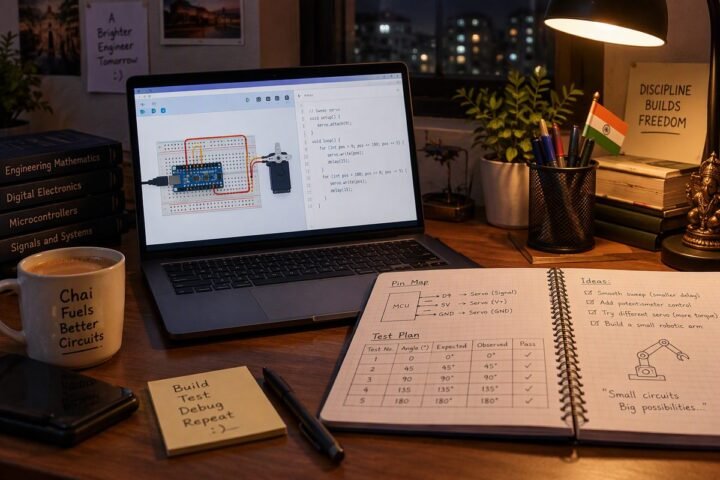
- A project you can explain: a small Arduino or PLC cell that picks and places a part is enough to show you understand sequencing, sensors and safety.
Certification courses exist from robot OEMs, MSME technology centres and private training institutes. They help with the first interview; they do not replace time on a real cell. The fresher jobs guide covers salaries and application routes, and the skills roadmap sequences what to learn.
Should a small Indian factory automate?
Fabric and garments introduce handling problems that rigid-part robot demos do not cover. The textile automation guide for India compares inspection, spreading, cutting and dispatch, with trial criteria and a clearly labelled retrofit payback example.
Not every repetitive job justifies a robot. The honest test is:
- Is the task stable? If the part or process changes every few months, a robot cell becomes obsolete quickly.
- Is the volume high enough? Below roughly 200,000 cycles a year, a fixture and a human often beat a robot on total cost.
- Is the job hard to staff? Welding, painting, press tending and night shifts are where robots pay back fastest in India.
- Is the process consistent? A robot repeats exactly what it is taught, including a bad part fit. Fix the process first.
- Can you support it? Someone in the plant must own the cell, keep spares and call the integrator when it stops.
For a first cell, pick one painful, high-volume, stable job and automate only that. A successful single cell builds the internal confidence and skills to do the second one. A failed “factory of the future” project sets the programme back years.
Common questions
How many industrial robots does India have?
Annual installations are around 8,500 units and the operational stock is just under 60,000, according to IFR World Robotics figures for 2023. Robot density is roughly six per 10,000 manufacturing workers, far below the global average.
Which industries use robots most in India?
Automotive and auto components account for the largest share, followed by electronics, pharmaceuticals, food processing, plastics and metal fabrication. The installations cluster around Pune, Chennai, Bengaluru, Ahmedabad, Coimbatore and the NCR.
What does an industrial robot cost in India?
A 6 kg six-axis robot with controller is roughly ₹3.5–6 lakh. A complete welding cell with fixture, safety and integration usually lands between ₹8 lakh and ₹18 lakh depending on scope.
Do I need a degree to program robots?
No, but you need demonstrated skill. Diploma and ITI holders work as robot operators and programmers every day. A short OEM or MSME course plus one real cell project is often enough for an entry role.
Are cobots replacing industrial robots?
Not in India. Cobots suit low-volume, high-mix work and fenceless cells, but they are slower and cost more per kilogram of payload. Six-axis robots still dominate welding, palletising and machine tending.
Related: robotics jobs for freshers, robotics skills roadmap, what is robotics, TB6612FNG motor driver.
Warehouse and logistics automation is a separate market from factory cells; the warehouse robotics guide covers AMRs, AS/RS costs and payback. Inside the cell, the robot safety standards guide covers the ISO 10218 argument and stop-distance maths.
The same payback thinking applies to plant maintenance: solar panel cleaning robots in India works through a 500 kW example.
For capital planning, industrial robot cost in India breaks down the arm, safety and integration lines.
See also: cobot welding for small businesses and the arc-on time maths behind payback.
For where high-speed picking fits in a factory, see robotics in manufacturing.
Most cells are coordinated by a PLC, so controls literacy is part of the job.
Machine tending is the most common first robot cell in Indian job shops; see machine tending robots, costs and payback.
Plants that run robots for years treat maintenance as a schedule, not a repair: see the robot maintenance checklist.
Palletizing is one of the most common end-of-line robot cells in Indian plants; see costs and payback.
Humanoids are being piloted in factories but are not production tools yet; see what is real in 2026.
Most factory cells combine a robot controller with a PLC: the division of labour explained.
How those cells are laid out on the floor is covered in the robot cell layout guide.
The same logic applies off site, and the construction robotics guide compares factory automation with site work.
Sources and further reading
- IFR World Robotics — installation, stock and robot density figures by country.
- ISO 10218-1 — safety requirements for industrial robots.
- ISO/TS 15066 — collaborative robot safety guidance.
- A3 Robotics — application notes on welding, palletising and machine tending.
Last reviewed: October 2026. Installation figures are IFR 2023 estimates; prices are indicative Indian market ranges for planning, not quotations. Not bench-tested by this site.