A cobot is not a cheap industrial robot. It is a different purchase with different costs bundled into it. The arm price is the number everyone compares, and it is rarely the number that decides whether the project pays back.
This guide breaks down what collaborative robot pricing looks like in India, what a quotation should include, where the hidden costs sit, and how to run the payback arithmetic before you commit.
What the arm price actually covers
Most cobot quotations in India are for the arm, the controller and the teaching pendant. Sometimes a basic gripper and a stand are included. Sometimes the safety assessment, integration, training and commissioning are quoted separately, and sometimes they are quietly assumed to be your problem.
| Payload class | Indicative arm price | Typical use |
|---|---|---|
| 3–5 kg | ₹8–16 lakh | Machine tending, small pick and place, inspection |
| 10–12 kg | ₹14–24 lakh | Palletising small cartons, screwdriving, assembly |
| 16–20 kg | ₹20–35 lakh | Heavier tending, packing, end-of-line tasks |
| Dual-arm or mobile cobot | ₹30 lakh and above | Research, flexible cells, lab automation |
These bands are for planning. Brand, reach, accuracy, IP rating and the local support contract move the number significantly. A cleanroom or washdown variant can add 20 to 40 percent.
The costs that decide the project
Budget the full cell, not the arm. In a typical Indian small or mid-size plant, the arm is often 50 to 65 percent of the total. The rest is everything that makes it useful.
- End effector: gripper, vacuum cup, screwdriver or welding torch, plus its controller.
- Fixtures and part presentation: the jig that puts the part in the same place every cycle.
- Stand or base: a rigid pedestal or a mobile cart with levelling feet.
- Safety: risk assessment, light curtain, scanner or fence, and the interlock wiring.
- Integration: PLC or machine interface, handshake signals, error handling.
- Programming: teaching, vision setup and recipe management.
- Training: operators and maintenance staff, not just the project engineer.
- Support: warranty terms, response time and spare parts availability in India.
Two of these deserve extra attention. Part presentation is where most cobot projects fail, because a robot that cannot find the part consistently needs a person to fix it, and that defeats the purpose. Safety is the other, because a cobot is only collaborative when the application and the risk assessment say so.
Cobot versus industrial robot cost
A six-axis industrial robot with a similar payload often costs less than a cobot. The difference is the cell: fencing, safety relays, a dedicated programmer and a fixed layout. A cobot trades some speed and accuracy for simpler deployment and the ability to work near people.
| Cost line | Industrial robot cell | Cobot cell |
|---|---|---|
| Robot | Lower | Higher |
| Safety | Fence, interlocks, relays | Assessment, sometimes scanners |
| Installation | Longer, specialised | Shorter, often in-house |
| Programming | Specialist, offline tools | Teach pendant, hand-guided |
| Throughput | Higher | Lower to moderate |
| Flexibility | Low without rebuild | High, redeployable |
If the task is high-volume and fixed for years, the industrial cell usually wins on cost per cycle. If volumes are uncertain or the task will move, the cobot’s redeployability is worth real money.
Lease, rent or buy
Buying is the default and usually the cheapest over five years. Leasing spreads the capital cost and can include service, which helps when cash is tight or the application is unproven. Renting is useful for a seasonal peak or a short trial.
- Buy when the task is stable and the payback is under three years.
- Lease when you want a fixed monthly cost and a service contract bundled in.
- Rent when the need is under six months or you are still testing the concept.
- Avoid buying a used cobot without the controller, software licence and service history.
Ask what happens at the end of a lease: buyout price, return condition and who pays for decommissioning. Those clauses decide the real cost.
The payback arithmetic
Payback is annual savings divided by total project cost. Savings come from labour hours removed, scrap reduced, output increased or quality improved. Be conservative on each line.
# simple payback in years
# one operator shift replaced, 8 h/day, 300 days/year
labour_rate = 180          # INR per hour, loaded cost
hours_saved = 8 * 300      # 2400 h per year
annual_labour_saving = labour_rate * hours_saved   # 4,32,000

scrap_saving = 90000       # INR per year, from fewer rejects
output_gain = 150000       # INR per year, from extra good parts

project_cost = 1800000     # arm, gripper, fixture, safety, integration

payback_years = project_cost / (annual_labour_saving + scrap_saving + output_gain)
# about 2.9 years

# include maintenance and software each year
annual_upkeep = 90000
payback_with_upkeep = project_cost / (annual_labour_saving + scrap_saving + output_gain - annual_upkeep)
# about 3.9 years
If the payback moves beyond four years when you add upkeep, the application probably needs a simpler fixture, a cheaper arm or a different task. Do not fix a weak case with an optimistic labour rate.
Where cobots actually earn their keep
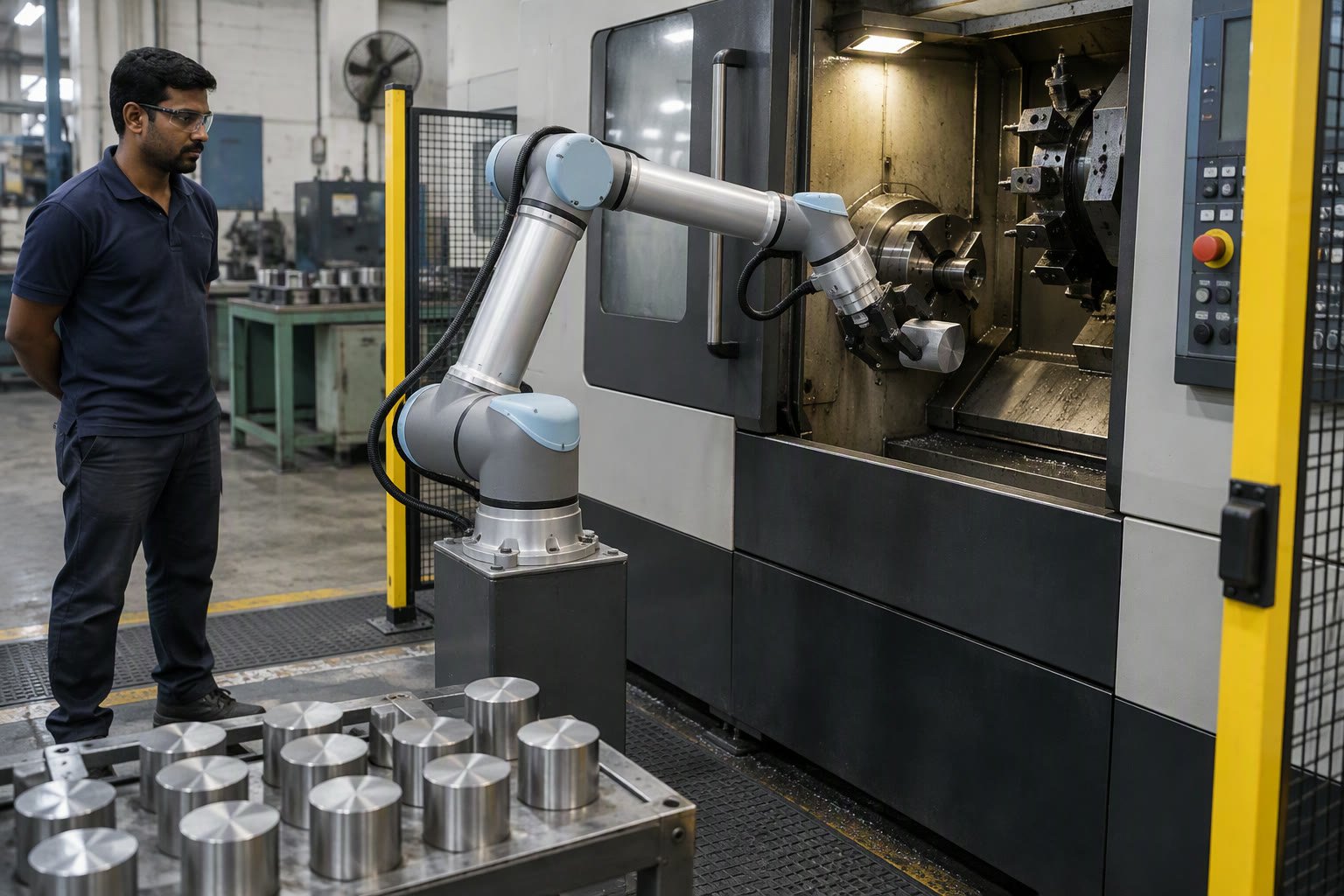
The best first cobot applications are repetitive, light, boring and hard to staff. Machine tending on a CNC or injection moulding machine is the classic: the robot loads a blank, waits, unloads and repeats, and the operator moves to inspection or deburring.
- CNC or press tending with a simple pick and place.
- Packaging cartons at the end of a line.
- Screwdriving or dispensing with a fixed fixture.
- Visual inspection with a camera and a reject chute.
- Lab sample handling where repeatability matters more than speed.
Poor first applications include anything with flexible parts, deep bins with tangled components, tight tolerances without vision, or a cycle time that only works if the robot never stops.
Safety is part of the price
A cobot does not remove the need for a risk assessment. It changes the answers. You still have to consider pinch points, the tool, the workpiece, the mounting and the possibility of a person standing between the robot and a hard surface.
The assessment may conclude that the application needs no fence, a light curtain, a scanner, or a fence after all. Each outcome has a cost, and the quotation should state which one it assumes. A vendor who says “cobots are inherently safe” has not read the standard.
A quotation checklist
- Arm model, payload, reach and repeatability at the rated payload.
- Controller, pendant, cables and mounting flange included or not.
- End effector and its controller, with spare fingers or cups.
- Fixture design responsibility and acceptance criteria.
- Safety assessment, guarding and interlock scope.
- Integration with the machine or PLC, including handshake signals.
- Programming hours, recipes and operator training.
- Warranty period, response time, spare parts stock in India.
- Software licence terms and what happens if you stop paying.
- Commissioning date with a penalty clause for delay.
Get two quotations with the same scope. Vendors quote different boundaries, and the cheapest arm often arrives with the largest integration bill.
Buying used
Used cobots can cut the arm cost by 30 to 50 percent, but the risk sits in the controller, the software licence and the service history. Buy only with a demonstration under load, the original controller, and a written statement of hours and repairs.
Check whether the model is still supported, whether spare parts are available in India, and whether the teaching software is licensed to you or to the previous owner. A bargain arm with an unsupported controller is a paperweight.
The realistic outcome
A well-scoped first cobot cell in an Indian SME typically takes two to four months from purchase order to production, including fixture build, safety assessment and training. The payback range is wide: 18 months for a two-shift machine-tending cell with a hard-to-fill operator role, four years or more for a single-shift task with an easy labour supply.
Neither outcome is guaranteed. The difference is almost always the fixture and the task choice, not the brand of the arm.
What is the cheapest cobot available in India?
Entry 3 kg class arms start around ₹8 lakh for the arm and controller, but a working cell with a gripper, fixture, safety and integration usually lands between ₹12 and ₹18 lakh. Treat any quote below that as incomplete until the scope is written down.
Can a cobot run without a safety fence?
Sometimes. It depends on the risk assessment, the tool, the payload, the speed and the layout. Many applications still need a light curtain or a scanner. The assessment decides, not the marketing brochure.
How much does it cost to integrate a cobot with a CNC machine?
Interface work commonly runs ₹1–3 lakh for a straightforward door, chuck and handshake sequence, more if the machine is old or has no spare I/O. The fixture is often the larger cost.
Do cobots need compressed air?
Only if the gripper or fixture uses pneumatics. Electric grippers avoid the air line but cost more. Either way, route and secure the cables so they cannot snag during a full sweep.
How long do cobot arms last?
Most industrial cobots are rated for tens of thousands of hours with preventive maintenance. Joint wear, cable fatigue and controller obsolescence are the practical limits, so keep the service records and spare cable sets.
Price is only one part of the decision: compare the cobot buying criteria, check the cobot versus industrial robot trade-offs, and run the numbers with our robot ROI calculator.
Budget for the risk assessment and force measurements, not just the arm; cobot safety validation is a real line item.
Sources and further reading
- Universal Robots — cobot specifications and application notes.
- FANUC — collaborative robot range and safety documentation.
- ISO 10218-1 — safety requirements for industrial robots.
- International Federation of Robotics — installed base and market data.