A cobot is not a safer robot. It is a robot that can be made safe for a specific task. That distinction decides whether a collaborative arm saves you money or quietly becomes a slow, expensive industrial robot behind a fence.
This guide compares cobots and industrial robots on payload, speed, safety, cost in India and the applications where each actually wins.
The decision in one table
| Factor | Cobot | Industrial robot |
|---|---|---|
| Typical payload | 3–16 kg | 6–300 kg and above |
| Speed | Moderate | High |
| Safety approach | Risk assessment with power and force limits | Fence, interlock and safety devices |
| Installation | Days, often movable | Weeks, fixed foundation |
| Programming | Hand-guided and graphical | Teach pendant, offline programming |
| Footprint | Small | Large with guarding |
| Repeatability | Good | Excellent |
| Best fit | Low volume, high mix, shared space | High volume, high speed, large parts |
If the task runs eight hours a day at the same cycle and the part weighs 25 kg, a cobot is the wrong tool regardless of how easy it is to install. If the part changes every few hours and an operator works alongside the robot, an industrial robot usually costs more than it saves.
Safety: the detail that changes budgets
Collaborative robots are designed to limit force and power, but the application decides whether that is enough. A cobot holding a sharp welding torch or a 10 kg sheet metal part is not automatically safe because the arm is rounded.
ISO 10218 and the technical specification ISO/TS 15066 define collaborative operation modes and force limits. A proper risk assessment can still conclude that guarding, light curtains or a restricted space are needed. Budget for that assessment; it is not optional and it is not free.
What they cost in India
Indicative 2026 ranges, before GST, for the robot and a basic cell. Integration, tooling and safety add more on both sides.
| Item | Indicative range | Notes |
|---|---|---|
| Cobot, 5–10 kg payload | ₹8–20 lakh | Arm only; gripper and pedestal extra |
| Cobot with basic cell | ₹15–30 lakh | Gripper, stand, safety assessment, integration |
| Industrial robot, 6–20 kg | ₹15–30 lakh | Arm only; controller usually included |
| Industrial cell with guarding | ₹25–50 lakh | Fence, safety devices, integration |
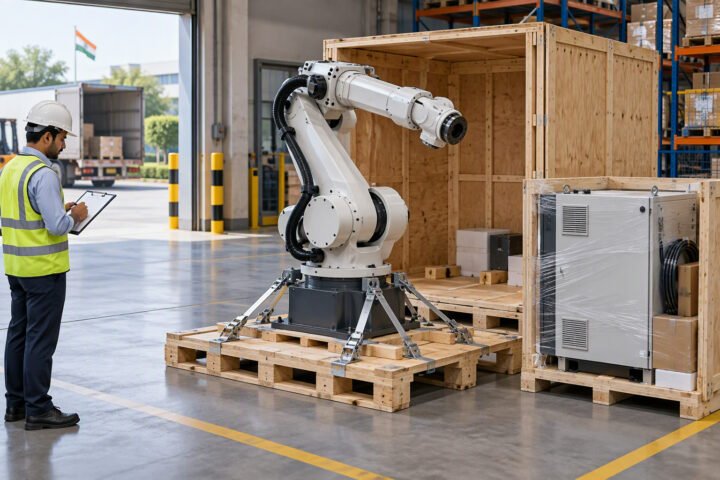
| Industrial robot, 100 kg+ | ₹35–80 lakh | Foundation, tooling and safety add significantly |
The cobot premium is real but smaller than it looks once guarding and civil work are included for an industrial cell. The bigger difference is utilisation: a cobot that runs at 60% speed but starts in a week can beat a faster robot that takes three months to commission.
Where cobots win
- High-mix, low-volume production. Reprogramming by hand is faster than offline programming for small batches.
- Shared workspace. Loading a machine or inspecting parts next to the robot.
- Fast deployment. Move the cell, re-teach in an afternoon, run tomorrow.
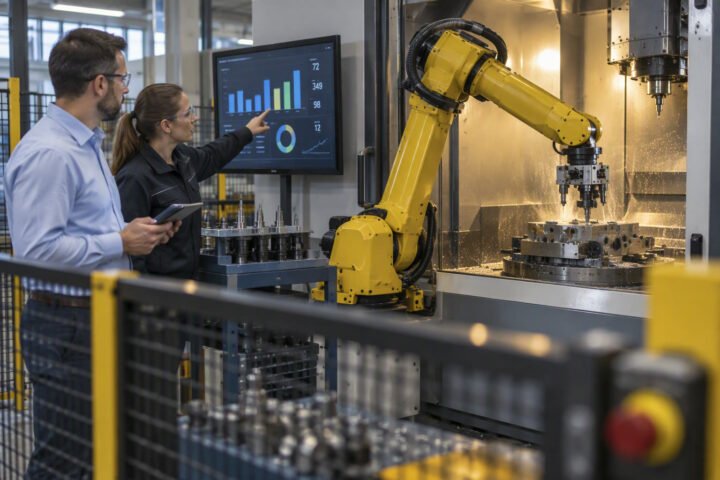
- Machine tending on small parts. Feeding a CNC or press where the payload is under 10 kg.
- Laboratories and education. Safe enough to learn on without a full industrial safety system.
Where industrial robots win
- High-volume cycles. Every second of cycle time compounds over three shifts.
- Heavy payloads. Foundry, palletizing, large weldments.
- Path accuracy. Welding, dispensing and machining where repeatability is measured in tenths of a millimetre.
- Harsh environments. Foundry dust, coolant mist and heat that punish exposed joints.
- Long duty cycles. Robots designed for continuous industrial use with proven service networks.
The hybrid answer
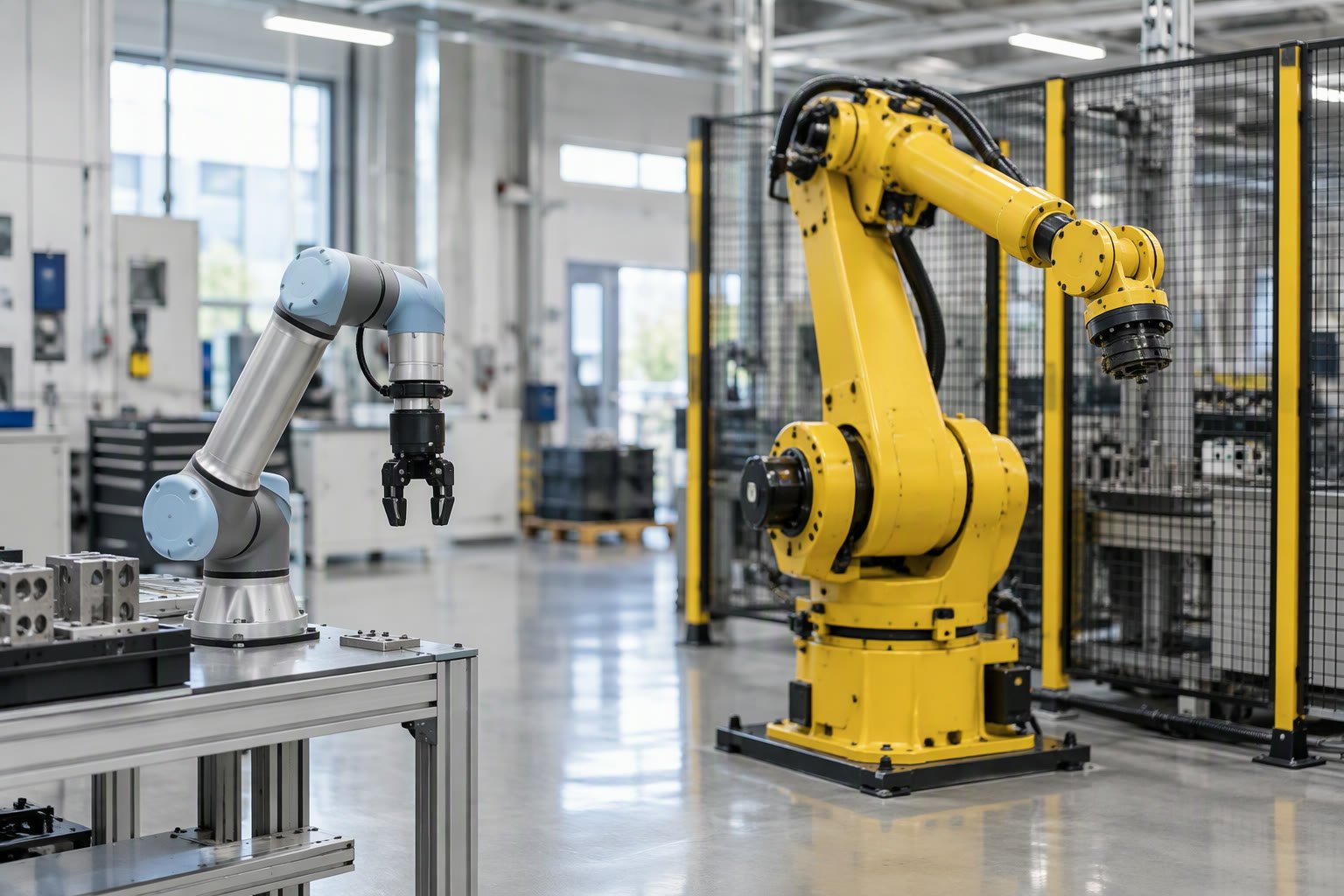
Many Indian cells are neither pure cobot nor pure industrial. A cobot handles the load/unload while a hard guard or light curtain protects the pinch points, or an industrial robot runs a high-speed operation inside a fence while a cobot does the flexible secondary task outside it.
Design the cell around the task, then pick the arm. Starting with “we want a cobot” is how projects end up with a slow robot, a fence anyway, and a business case that no longer works.
Mistakes in selection
| Mistake | Consequence | Better approach |
|---|---|---|
| Assuming cobot means no guarding | Safety review blocks commissioning | Do the risk assessment before purchase |
| Comparing arm price only | Cell cost surprises | Compare installed cost including safety and tooling |
| Ignoring cycle time | Cell cannot meet output | Simulate or trial the real cycle first |
| Buying for one part only | No flexibility benefit | Check the part family and changeover time |
| No spare parts plan | Weeks of downtime | Ask for local spares and service response times |
Related: cobot buying guide, industrial robot cost in India, cobot welding for small business, robot safety standards, machine tending robots.
Is a cobot safer than an industrial robot?
Not automatically. A cobot is designed to limit force and power, but the tool, workpiece and task decide the real risk. Every collaborative application still needs a risk assessment under ISO 10218 and ISO/TS 15066.
What payload can a cobot handle?
Most cobots carry 3 to 16 kg. Above that, an industrial robot is usually the better choice on speed, stiffness and cost per kilogram.
Do cobots need fencing in India?
Often yes, at least partial guarding. Indian safety practice and customer audits usually expect a documented risk assessment, and many applications conclude that light curtains or a fence are needed.
Which is cheaper, a cobot or an industrial robot?
The arm price is often similar for small payloads. Cobots cost less to install in shared spaces, while industrial robots cost less per unit of speed and payload at high volume.
Can a cobot replace two workers?
Rarely on speed alone. Cobots usually justify themselves by running unattended for part of the shift, improving consistency, or freeing an operator for another task.
The spec sheet difference often comes down to accuracy versus repeatability.
Check payload at the real centre of gravity before comparing prices.
A cobot still needs safeguards in many installations, and the light curtain guide explains when a curtain is the right choice.
The assessment that goes with a collaborative arm is in the cobot risk assessment guide.
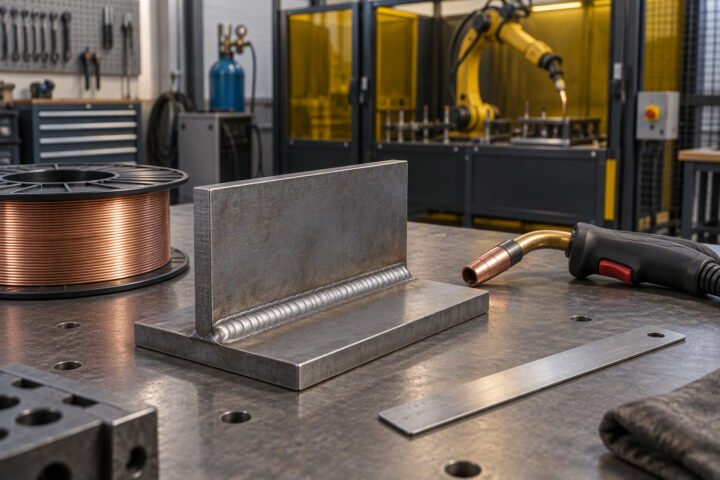
If the job is welding, read the welding robot price guide for India before deciding between a cobot and a caged arm.
Once you know which arm class fits, the industrial robot selection checklist covers payload, reach and cycle arithmetic.
A moulding machine is a fenced, high-speed machine, which usually points away from a cobot; the take-out guide compares the options.
Cobots usually change tools manually, while industrial arms use automatic changers, as the robot tool changer guide explains.
Collaborative operation is a mode, not an inherent property; see what ISO/TS 15066 actually requires.
Cobots are rarely suitable for solvent painting because of the hazardous-area requirement; see the painting robot specification.
Sources and further reading
- ISO 10218 — industrial robot safety requirements.
- ISO/TS 15066 — collaborative robot force and power limits.
- Universal Robots — cobot specifications and application examples.
- FANUC — industrial robot ranges and cell integration guidance.
- International Federation of Robotics — installation and market statistics.