A warehouse automation budget is not one number. It is five layers, and most projects buy the third layer before fixing the first. Software, flow, storage, movement and people each carry cost, and the cheapest order is rarely the order vendors propose.
This guide breaks an Indian warehouse automation project into its layers, gives indicative rupee ranges for planning, and sets out a phased path that produces savings before the big capital commitment.
The five layers
| Layer | What it does | Typical first cost |
|---|---|---|
| Process and slotting | Pick paths, ABC slotting, batching | ₹0–3 lakh (consulting and time) |
| WMS or WES | Stock accuracy, task allocation, visibility | ₹3–25 lakh plus annual licence |
| Movement | AMR, AGV, conveyors, sorters | ₹8 lakh to several crore |
| Storage | Shelving, AS/RS, vertical lifts | ₹5 lakh to several crore |
| Pick assistance | Pick-to-light, scanners, wearables | ₹1–15 lakh |
The order matters because a robot moving goods through a badly slotted warehouse simply automates the waste. Fix the flow first, and the automation scope often shrinks.
Process and slotting come first
Before buying anything, measure the current operation for two weeks: orders per day, lines per order, travel distance per picker, stock accuracy and the top 20 percent of SKUs that generate most picks.
- Slot fast movers near dispatch, not by category.
- Batch orders that share SKUs to cut travel.
- Separate replenishment from picking to stop congestion.
- Fix bin locations and label everything before adding robots.
- Measure pick accuracy; automation amplifies bad data.
These changes cost time and discipline, not capital. In many Indian warehouses they deliver 15 to 30 percent travel reduction, which changes the payback case for everything that follows.
WMS and stock accuracy
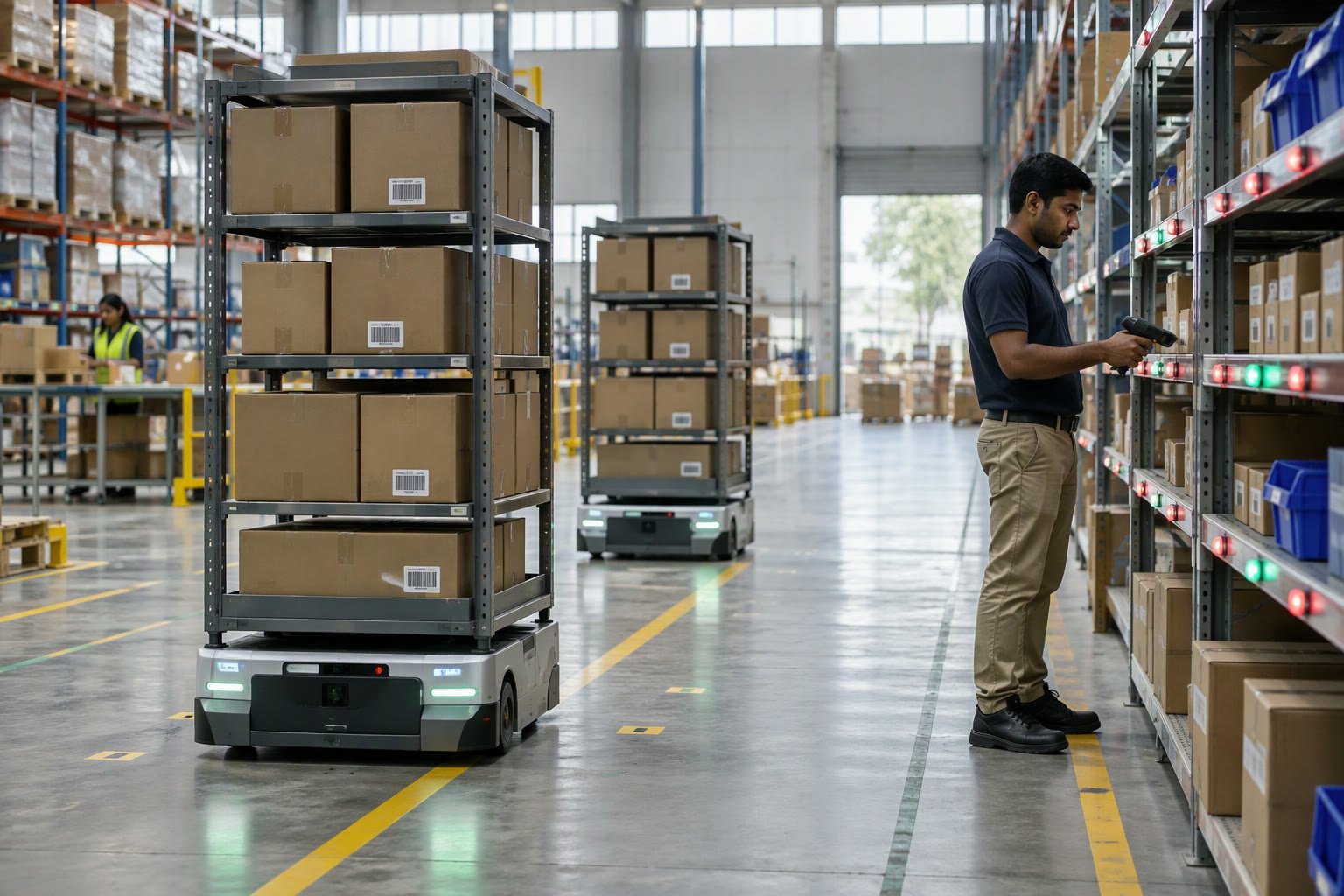
An AMR fleet without a WMS is a convoy of robots looking for stock that the system says exists. Stock accuracy above 98 percent is the entry ticket for most automation.
Small operations can start with a lightweight WMS or a well-configured ERP module. The cost is in integration and process change, not the licence. Budget for barcode labelling, handheld scanners and a cycle-count routine.
Ask whether the WMS can expose tasks through an API. If it cannot, fleet software will be bolted on with spreadsheets, and the automation will stall at the first exception.
Movement: AMR, AGV, conveyor or sorter
Movement is where budgets explode. The right choice depends on volume, distance, variability and whether the building can be modified.
| Option | Indicative cost | Best for |
|---|---|---|
| AMR, 500 kg class | ₹10–20 lakh per robot | Changing layouts, shared aisles |
| AGV, 500 kg class | ₹6–12 lakh per vehicle | Fixed high-volume routes |
| Conveyor line | ₹8,000–25,000 per metre | Fixed transfer between zones |
| Cross-belt sorter | ₹40 lakh to several crore | High-volume parcel sorting |
Add charging infrastructure, mapping, integration and spares. A 10-robot fleet needs a fleet manager, a charging strategy and someone on staff who owns the system after commissioning.
The AMR versus AGV guide covers the decision in detail, including the acceptance test that keeps a pilot honest.
Storage: when racks stop being enough
Selective racking is cheap and flexible. Automated storage becomes worth it when floor space is expensive, when stock accuracy is critical, or when throughput per square metre is the constraint.
- Vertical lift modules for small parts in a compact footprint.
- Shuttle-based AS/RS for pallets at high throughput.
- Mini-load for totes and cartons.
- Mobile racking when density matters more than speed.
These systems are building projects, not equipment purchases. Check floor flatness, ceiling height, fire compliance and power before comparing quotations.
Pick assistance is the cheapest win
Pick-to-light, put-to-light and scanner-directed picking cost a fraction of a robot fleet and often deliver the biggest accuracy gain per rupee. They also prepare the data discipline a fleet needs later.
Start here if the operation is manual, the SKU count is high and the errors are costly. Then automate movement once the process is stable.
The payback arithmetic
Warehouse automation payback comes from labour hours, accuracy, space and throughput. Be conservative and count only what you can measure.
pickers = 12
hours_per_shift = 8
shifts_per_day = 2
days_per_year = 300
loaded_rate = 160          # INR per hour

annual_labour = pickers * hours_per_shift * shifts_per_day * days_per_year * loaded_rate
# 92,16,000 INR

travel_reduction = 0.20     # from slotting and pick assistance
labour_saving = annual_labour * travel_reduction
# 18,43,200 INR

accuracy_saving = 400000    # fewer replacements and re-ships
project_cost = 4500000      # WMS, AMRs, charging, integration

payback_years = project_cost / (labour_saving + accuracy_saving)
# about 2.0 years
If the payback depends on removing headcount in month one, the plan is too aggressive. Redeploy people to exceptions, quality and dispatch, and count the value of the work they no longer do.
A phased plan that survives scrutiny
- Phase 0: measure the operation for two weeks and fix labelling.
- Phase 1: slotting, batching and pick assistance, with a target of 15 percent travel reduction.
- Phase 2: WMS or WES with API access and 98 percent stock accuracy.
- Phase 3: a single-robot or single-zone pilot with a written acceptance test.
- Phase 4: scale the proven cell, add charging and a fleet manager.
Each phase should pay for itself or prove a number the next phase depends on. A project that jumps to phase 3 has no baseline and no way to prove the savings.
Mistakes that cost the most
- Buying robots before fixing stock accuracy.
- Ignoring the network; a fleet that loses Wi-Fi stops.
- Forgetting charging space in the aisle design.
- Assuming the vendor will integrate with the ERP for free.
- Running the pilot at weekend volume instead of peak.
- No named internal owner after commissioning.
Automation is an operating change with equipment attached. The projects that pay back are the ones where someone owns the process, not just the purchase order.
How much does warehouse automation cost in India?
A first phase with slotting, pick assistance and a WMS commonly lands between ₹8 and ₹30 lakh. A multi-robot AMR fleet with integration typically starts around ₹40 lakh and scales with robot count and software.
Do I need a WMS before robots?
You need stock accuracy and a system that can assign tasks through an API. That can be a full WMS or a well-configured ERP module, but spreadsheets will not carry a fleet.
How many robots does a warehouse need?
Size from trips per shift and trip time, not floor area. A pilot with one or two robots on the real route gives the number you can defend.
Can automation work in an old building?
Often yes, with AMRs and pick assistance. AS/RS and conveyors usually need floor, height and fire compliance work, which can dominate the budget.
What is a realistic payback period?
Two to four years for a well-scoped first phase in a labour-intensive operation. Payback under 18 months usually means the baseline was overstated or the scope was too small to be real.
Fleet energy draw matters more than single-cell draw, and the robot cell energy guide explains how to scale it.
For dense storage rather than movement, the ASRS cost guide sets out the capital range and throughput maths.
Cold-store handling has its own cost profile, described in the food industry robot guide.
Software and integration are often the quiet overrun in warehouse projects; the fleet software costs are listed separately.
Warehouse automation usually starts after the pallet is wrapped, and the end-of-line packaging guide covers the stages before it.
Sources and further reading
- MHI — material handling industry standards and resources.
- International Federation of Robotics — mobile robot and logistics automation data.
- GS1 India — barcoding and identification standards.
- A3 Robotics — AMR and AGV guidance.