A robot’s electricity bill is usually smaller than its compressed-air bill. Buyers budget for the arm and forget the compressor, the chiller and the idle hours.
This guide works through what a robot cell actually draws, how to calculate it, and the operational changes that cut energy cost without touching production.
What draws power in a robot cell
| Load | Typical draw | Notes |
|---|---|---|
| Six-axis robot, 20 kg payload | 1.5–3.5 kW average | Peaks higher during acceleration |
| Robot controller and cabinet | 0.3–0.8 kW | Continuous, even when idle |
| Compressed air for grippers | 1–4 kW equivalent | Depends on leaks and duty cycle |
| Vision system | 0.2–0.6 kW | Cameras, lights, edge PC |
| Welding power source | 4–12 kW during weld | Duty-cycle dependent |
| Chiller or cooling | 1–5 kW | Laser and high-duty welding cells |
A worked annual figure
Robot average draw      = 2.4 kW
Controller and cabinet  = 0.5 kW
Vision                  = 0.3 kW
Compressed air (equiv.) = 1.2 kW
Total                   = 4.4 kW

Running hours           = 16 h/day × 300 days = 4,800 h
Annual energy           = 4.4 × 4,800 = 21,120 kWh
At ₹8.50/kWh            = ₹1,79,520 per year
That is a modest number for a cell costing ₹40 lakh or more. The point is not that energy dominates the business case; it is that idle consumption and air leaks quietly add 20 to 35 percent to the figure, and they are free to fix.
The idle problem
Most cells are not busy every hour they are powered. Controllers stay on overnight, lights stay on, compressors keep pressure in a leaking line, and chillers run for a laser that is not welding. Idle load is often 15 to 40 percent of the total, and it produces nothing.
The fix is a schedule. Put the cell into a low-power state at shift end, isolate the air supply with a solenoid valve, and switch off vision lighting. None of this affects production, and all of it is reversible if you get it wrong.
Compressed air: the hidden cost
Compressed air is one of the most expensive utilities in a plant, often costing five to ten times as much per unit of energy delivered as electricity. A 1 mm hole leaking at 6 bar can waste more than ₹15,000 a year. In a cell with ten push-fit connections, leaks are almost certain.
- Use a solenoid valve to isolate the cell air when idle.
- Check push-fit fittings quarterly with a leak detector or soap solution.
- Size vacuum generators for the actual cup volume; oversized venturis waste air continuously.
- Consider a small dedicated compressor if the plant header pressure forces the whole system to run higher than needed.
Regenerative drives and braking
During deceleration, a robot’s motors can return energy to the drive. Some controllers include regenerative units that feed it back to the DC bus or the supply; others burn it in a braking resistor as heat. If the cell has many fast axes and a high duty cycle, ask the supplier whether regeneration is included.
The saving is real but modest, typically 5 to 15 percent of robot energy on high-cycle applications. It matters more in large plants with several robots than in a single cell.
Power quality and demand charges
Indian industrial tariffs include demand charges based on the maximum kVA drawn. A cell that starts all axes and a welder at once can set a peak that you pay for all month. Staggering startup and avoiding simultaneous weld and robot acceleration reduces the peak without changing throughput.
Power factor correction is usually a plant-level project, but new cells should be specified with drives that meet the plant’s harmonic requirements. A cell that trips the plant’s capacitor bank is a commissioning problem nobody enjoys.
What to measure
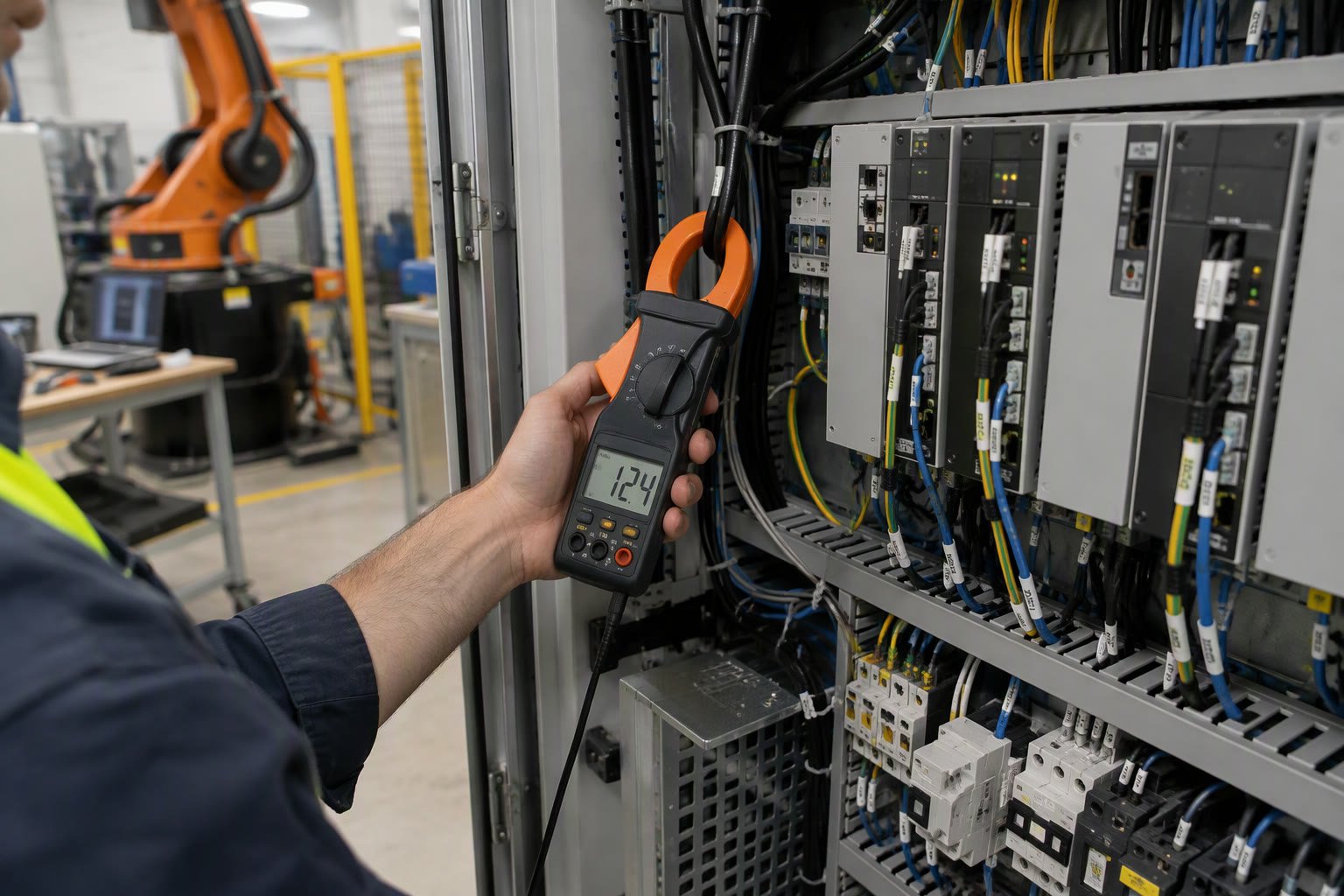
- Clamp-meter the cell for a full shift, including idle periods.
- Log compressed-air consumption separately if the cell has its own meter.
- Record the peak kVA during a normal production day.
- Calculate cost per part, not cost per day, so the number survives a volume change.
- Re-measure after a leak repair or idle schedule and record the difference.
Cost per part is the number that belongs in the ROI model, alongside maintenance and consumables. For the maintenance rhythm that keeps efficiency from drifting, see the robot maintenance checklist, and for the air consumers themselves the gripper buying guide.
A realistic expectation
Energy is rarely the reason to buy or reject a robot cell. But across a plant with ten cells, idle hours and air leaks can cost several lakh a year, and fixing them requires a valve, a schedule and an afternoon. Treat energy as a maintenance item, not a procurement criterion.
How much electricity does an industrial robot use?
A 20 kg payload six-axis robot averages roughly 1.5–3.5 kW in production, plus 0.3–0.8 kW for the controller. A typical cell with vision and air totals about 4–5 kW average.
What does a robot cell cost to run per year in India?
At 16 hours a day and 300 days, a 4.4 kW cell uses about 21,000 kWh, or roughly ₹1.8 lakh a year at ₹8.50 per kWh. Idle hours and air leaks can add 20–35 percent.
Is compressed air a big cost in a robot cell?
Yes, often larger than the robot's electricity. Leaks and oversized vacuum generators waste air continuously, and a small leak can cost more than ₹15,000 a year.
Does a robot regenerate energy when braking?
Some controllers feed braking energy back to the DC bus or supply, saving 5–15 percent on high-cycle applications. Ask whether regeneration is included when comparing controllers.
How do I cut idle energy use?
Schedule a low-power state at shift end, isolate air with a solenoid valve, and switch off lighting and chillers. Measure before and after to confirm the saving.
Energy is one line in the robot cost per hour guide, and it is usually smaller than capital recovery.
Sources and further reading
- Bureau of Energy Efficiency — Indian industrial energy efficiency programmes.
- ISO 50001 — energy management systems.
- Atlas Coppro — compressed air efficiency guidance.
- A3 Automate — robotics integration resources.