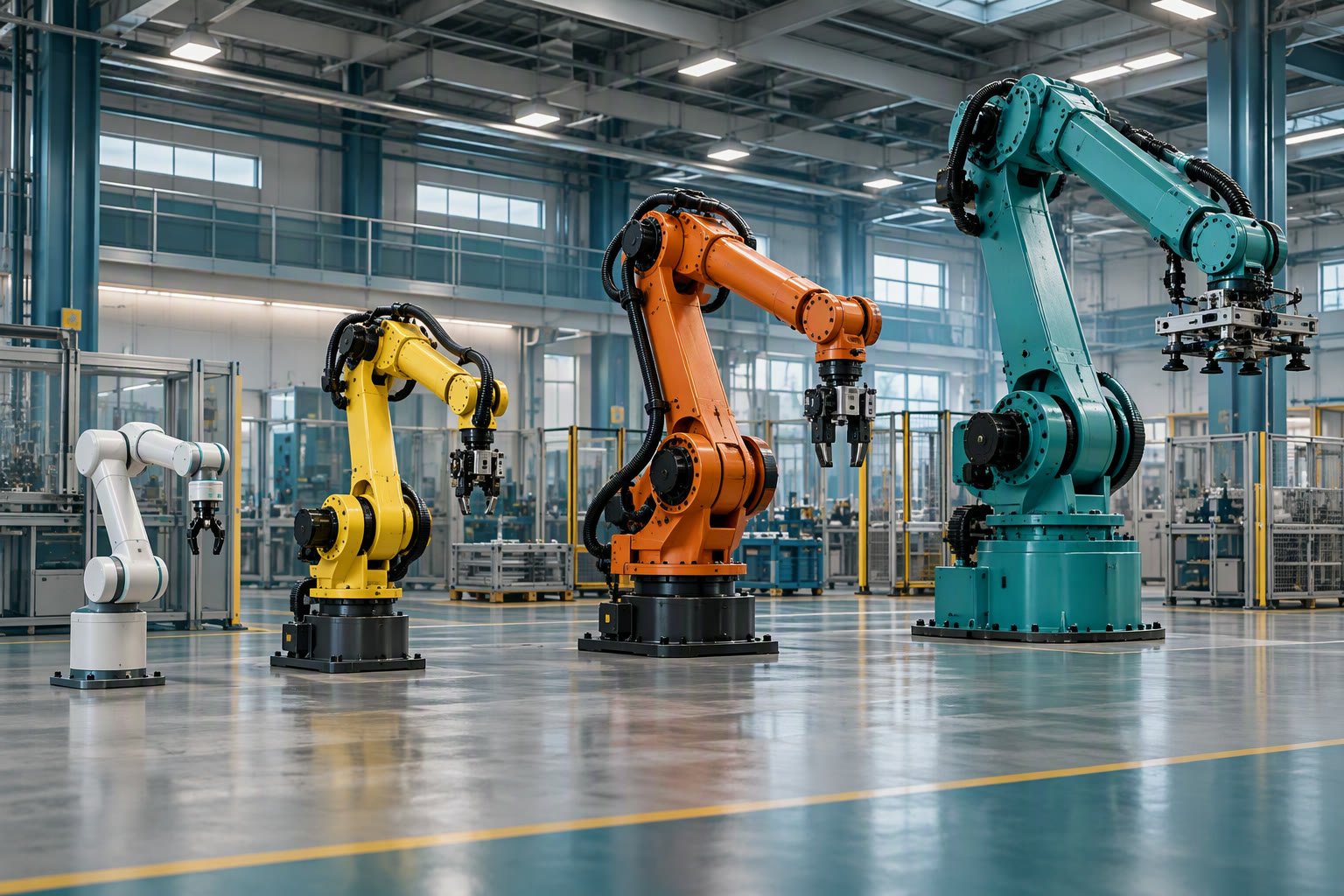
FANUC, KUKA, ABB and Yaskawa build good robots. The decision is rarely about which arm is best. It is about which one your local integrator can service, stock spares for and program fluently.
This comparison sticks to what is defensible: positioning, programming style, service reality in India and the questions that separate a good quote from a costly one.
The four majors at a glance
| Brand | Reputation | Typical strength | Watch for |
|---|---|---|---|
| FANUC | Very large installed base, long product life | Reliability, wide model range, strong automotive presence | Proprietary ecosystem, option licensing |
| KUKA | Strong in automotive and heavy payload | Rigid mechanics, good path accuracy | Service network thinner outside major clusters |
| ABB | Broad portfolio, strong software story | RobotStudio simulation, paint and welding lines | Model-specific quirks, licence costs |
| Yaskawa (Motoman) | Efficient motion, good value in Asia | Speed, compact controllers, welding packages | Smaller local support in some regions |
All four meet the same safety standards and all four will run a well-specified cell. Nobody wins on the datasheet alone, and a comparison that claims one brand is simply “better” is marketing, not engineering.
Programming style differences that affect your team
- Teach pendant language: each brand has its own, and technicians specialise. Retraining costs weeks.
- Offline programming: ABB RobotStudio, FANUC ROBOGUIDE, KUKA Sim and Yaskawa MotoSim all work, with different licence models.
- Fieldbus support: all support EtherNet/IP, PROFINET and others, but option availability and cost vary.
- Vision integration: each brand has preferred partners; third-party vision is possible but costs integration time.
- Safety options: safe speed, safe zone and collaborative variants differ by model generation.
If you already employ technicians trained on one brand, that is a real cost advantage. Switching brands to save ₹1 lakh on the arm and then paying for retraining and slower fault-finding is a bad trade.
What actually decides the purchase in India
| Factor | Why it matters more than brand |
|---|---|
| Local integrator | They commission, debug and support the cell |
| Spare parts stock | A board that ships in 3 days beats a better arm that waits 6 weeks |
| Service response time | Downtime cost usually exceeds the price difference |
| Existing skill base | Retraining is slow and easy to underestimate |
| Software licence terms | Options can cost more than expected over the life of the cell |
| Second-hand market | A brand with resale value lowers your exit cost |
Questions to ask each vendor
- Who is the nearest authorised service engineer, and what is the contracted response time?
- Which spare parts are stocked in India, and which are imported?
- What does the software licence include, and what costs extra?
- Can you demonstrate the cycle time on our parts, not a demo part?
- What is the expected life of the controller, and when does support end?
- Can you provide three Indian references in our application?
- What is the resale or trade-in position in five years?
Where the Chinese and Indian options fit
Chinese robot brands have improved quickly and often quote 20–40% below the majors. They make sense when the application is simple, the integrator is willing to support them and you accept a thinner resale market. Indian assembly and integration firms increasingly build around imported mechanicals with local controls, which can be a good middle path.
The honest test is the same for any brand: can the supplier demonstrate the cycle time on your part, stock the spares you will need, and support the controller for the life of the cell? If the answer is yes at a lower price, the brand badge matters less.
A decision process that avoids regret
- Write the application spec, cycle time and payload first.
- Ask two integrators, not two brands, to quote.
- Score each quote on service, spares, training and total cost, not arm price.
- Insist on a paid feasibility test on your parts for anything complex.
- Check the software licence and option costs in writing.
- Verify spare part lead times before signing.
- Plan training for at least two people per shift.
Related: industrial robot cost in India, cobot vs industrial robot, used industrial robot guide, robot integration checklist, industrial robot programming.
Which industrial robot brand is best, FANUC, KUKA, ABB or Yaskawa?
None is universally best. All four build capable arms. The deciding factors are local service, spare parts availability, your team's existing programming skills and the integrator supporting the cell.
Is FANUC better than KUKA?
They suit different priorities. FANUC has a very large installed base and broad model range; KUKA is strong in heavy payload and automotive work. Choose based on local support and application fit, not the badge.
Are Chinese industrial robots reliable?
Modern Chinese arms are much improved and often cost 20–40% less, but resale value and service depth are usually thinner. They suit simple applications where the integrator will support them.
What should I compare in robot quotes?
Total installed cost, service response time, spare parts lead time, software licence and option costs, training, and a demonstrated cycle time on your own parts.
How long does an industrial robot last?
Major-brand arms commonly run 15–20 years in light duty. Controller support and spare parts availability usually end before the mechanics wear out.
Brand choice only matters inside a whole cell, and our arc welding cost model prices the fixtures and fume extraction too.
If ABB is the likely platform, start with RAPID fundamentals before comparing pendants.
Sources and further reading
- FANUC — model range and controller documentation.
- KUKA — robot portfolio and service information.
- ABB Robotics — RobotStudio and product data.
- Yaskawa Motoman — application packages and controllers.