Most robot projects are not limited by the arm. They are limited by how long it takes to make the arm do the right thing repeatedly. Programming is where cycle time, part variation and operator confidence are won or lost, and it is the line item most often underestimated in an Indian quotation.
There are three ways to program an industrial robot: on the teach pendant, offline in simulation, and through a PLC or host controller that commands the robot over a fieldbus. Real cells usually combine all three. This guide explains when each makes sense and what the work costs.
Teach pendant programming
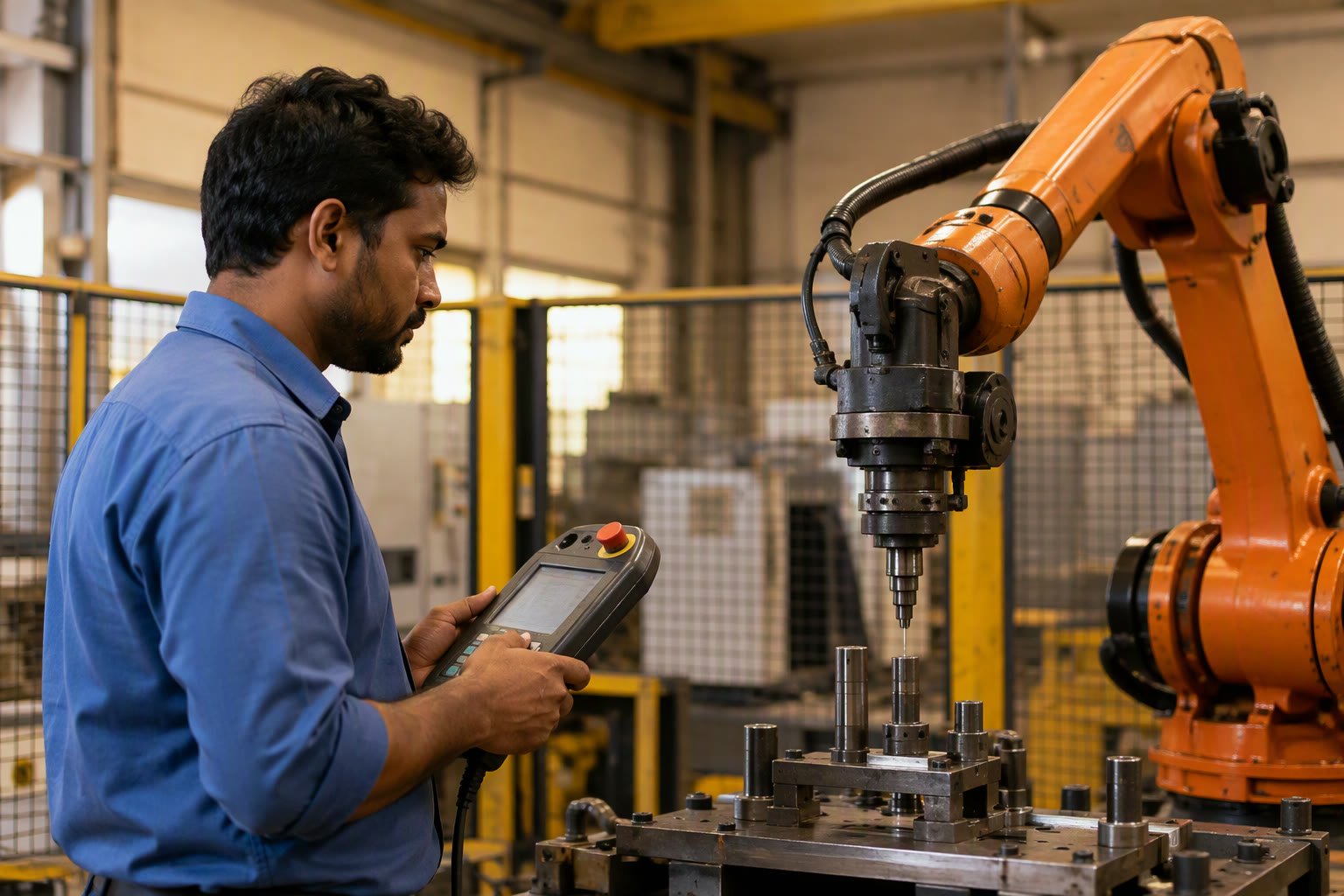
The teach pendant is the handheld controller that comes with the robot. You jog the arm to each point, record it, and build a sequence. Modern pendants support structured programs with loops, conditionals and named subroutines, so simple cells can be programmed entirely from the pendant.
This is the right method for: a small number of part variants, positions that can be taught by eye, and processes where the fixture is the master. It is fast to start and needs no CAD model of the cell. It becomes painful when there are dozens of variants, when points have to be calculated rather than taught, or when the customer wants to reprogram the cell without calling an engineer.
Offline programming
Offline programming (OLP) builds the robot program in a software model of the cell, using CAD data for the robot, fixture, tool and part. You test reach, collisions and cycle time before the robot is on site. Tools such as RoboDK, ABB RobotStudio, FANUC ROBOGUIDE and KUKA Sim are common.
The catch is accuracy. A program generated from CAD assumes the real cell matches the model. If the fixture sits 5 mm off, or the robot’s absolute accuracy is worse than its repeatability, the downloaded program will need touch-ups. OLP pays off when the process is large, the cell is complex, or production cannot be stopped for programming. For a small pick-and-place cell with three taught points, it is often slower than the pendant.
PLC and host control
In most production cells the robot does not decide what to do. The PLC owns the sequence: it tells the robot which program to run, when to start, and what happened. The robot reports status and faults back over PROFINET, EtherNet/IP, EtherCAT or Modbus.
This split matters for maintenance. If the PLC is the master, a line engineer can change the sequence logic without touching robot code, and safety logic stays in a certified safety controller. If the robot is the master, every change needs a robot programmer. Choose deliberately, and document the handshake signals, because most commissioning delays come from a mismatch between what the robot expects and what the PLC sends.
The languages you will meet
| Brand | Language | Notes |
|---|---|---|
| ABB | RAPID | Structured, readable; RobotStudio is the native environment |
| KUKA | KRL | Widely used in automotive; strong offline tooling |
| FANUC | TP and KAREL | TP for most work; KAREL for advanced logic |
| Yaskawa | INFORM | Compact syntax; common in welding cells |
| Universal Robots | URScript and PolyScope | Graphical tree plus Python-like scripting |
| Staubli | VAL3 | Structured and capable; common in SCARA applications |
Learning one language well transfers better than learning six superficially. The concepts — frames, tool centre point, motion types, I/O, interrupts — are shared. A programmer who understands frames and coordinate transforms can move between brands in weeks.
What programming actually costs
Programming is usually quoted as part of integration, but it helps to budget it separately. Indicative 2026 ranges for an Indian integrator:
| Task | Typical effort | Indicative cost |
|---|---|---|
| Simple pick-and-place, 3–8 points | 2–5 days | ₹40,000–1,20,000 |
| Machine tending with PLC handshake | 1–3 weeks | ₹1–3 lakh |
| Welding with seam tracking | 2–5 weeks | ₹2–6 lakh |
| Vision-guided picking | 3–6 weeks | ₹3–8 lakh |
| Offline program for a large cell | 2–6 weeks | ₹1.5–5 lakh |
These are planning figures, not quotes. The variable that moves them most is how well the process is defined before programming starts. A programmer who has to discover part variation during commissioning is doing engineering, not typing, and it shows up in the invoice.
A commissioning sequence that avoids rework
- Define the sequence on paper. Every state, every fault, every manual intervention. Get the operator to read it.
- Fix the frames first. Base, tool and workpiece frames must be measured and documented before teaching points.
- Build one cycle, then ten. Prove a single pick before adding vision or variant logic.
- Test faults on purpose. Remove a part, block a sensor, stop the conveyor. A cell that only works when everything is perfect is not commissioned.
- Train the operator, not just the engineer. Recovery from a jam is the most common daily task.
- Hand over backups. Controller image, program archive, I/O list, frame measurements and a change log.
Learning robot programming in India
There is no substitute for time on a real controller. Vendor training centres in Pune, Chennai, Bengaluru and Gurugram run short courses, and many integrators will let a junior engineer shadow a commissioning if asked. Simulation software is useful for learning frames and motion types, but it does not teach you why a cable fails or how a fixture actually deflects.
A practical path is: learn PLC basics and fieldbus concepts, learn frames and transforms, spend a week on a pendant with a real robot, then build one small cell end to end. That sequence produces someone who can be useful on a site, which is what employers actually hire for.
Related: SCARA robots, industrial robot costs, robotics skills roadmap, embedded systems careers, robot vision cameras.
How long does it take to program an industrial robot?
A simple pick-and-place sequence takes a few days. Machine tending with PLC handshakes takes one to three weeks, welding two to five weeks, and vision-guided picking three to six weeks, depending on part variation and process definition.
Do I need to learn a programming language to work with industrial robots?
Yes, but the concepts matter more than the syntax. Frames, motion types, I/O and interrupts transfer between brands; experienced programmers move between RAPID, KRL and TP in weeks.
What is offline robot programming?
It is building and testing the robot program in a CAD model of the cell before the real robot is available. It reduces downtime and proves reach and cycle time, but needs an accurate cell model and touch-up on site.
Can I program a robot with a PLC only?
You can command it, but the robot still runs its own program for motion and safety. The PLC usually acts as master, telling the robot which program to run and when to start.
Which robot brand is best for learning?
Any brand with a training centre and a simulator near you. Universal Robots and ABB have broad training availability in India, and both teach the same underlying concepts.
Controllers increasingly talk to a PLC; if ladder logic is new to you, start with PLC programming for beginners.
Before teaching a single point, set the TCP; every path depends on it.
Program structure and cell sequence are different jobs; read PLC vs robot controller.
For the pendant side of programming, see teach pendant programming.
Robot programs often wait on PLC handshake bits.
If you want open-source motion planning rather than a teach pendant, start with the MoveIt 2 tutorial.
For the ABB-specific version, RAPID programming basics walks through frames, motion types and waits.
Programming quality affects recovery time after a stop, and the OEE worked example shows how those minutes reach the availability factor.
Robot programming commands a premium on top of PLC work, as the PLC programmer salary guide explains.
Sources and further reading
- RoboDK — offline programming and simulation documentation.
- ABB RobotStudio — vendor offline programming environment.
- ISO 10218-1 — safety requirements that shape how cells are programmed and stopped.
- FANUC — controller and programming manuals for TP and KAREL.