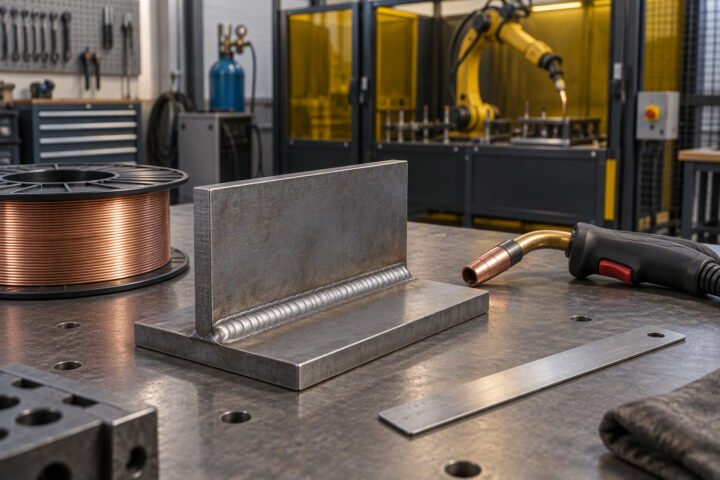
A welding robot costs more than a handling robot for the same arm. The torch, power source, positioner, fume extraction and fixturing decide the price.
This guide breaks down what a welding cell costs in India, how to work out whether it pays, the process choices, and the acceptance tests that stop you paying for a cell that cannot hold a seam.
What is different about welding
A handling cell moves a part from A to B. A welding cell has to hold an arc, at the right angle, at the right speed, with the right gas coverage, for the length of the seam. That adds equipment and it adds process risk: porosity, undercut and spatter are quality outcomes, not just motion outcomes.
| Item | Handling cell | Welding cell |
|---|---|---|
| Robot | Standard arm | Welding arm with torch mounting and hollow wrist |
| Process equipment | Gripper | Power source, wire feeder, torch, gas kit |
| Positioning | Fixture | Fixture plus positioner or two-station table |
| Extraction | None | Fume extraction or a welding cell with filtration |
| Quality | Part placed | Seam tracked, weld inspected |
| Safety | Guard and interlock | Guard, arc flash screen, fume, hot work |
Cell configurations
| Configuration | Description | Best for |
|---|---|---|
| Fixed table | Robot welds a stationary part | Small parts with short seams |
| Single positioner | Part rotates to present the seam | Round parts, shafts, rings |
| Two-station | Weld one side while loading the other | Medium volume, manual load |
| H-frame or ferris | Two or more stations on a rotating frame | High volume, low mix |
| Gantry or rail | Robot travels along a long part | Beams, frames, long fabrications |
The positioner is not a luxury. It puts the seam in the flat or horizontal position, which lets a smaller robot weld faster and produces a better bead than welding overhead. Many disappointing cells are disappointing because the positioner was cut to save money.
Cost breakdown for India
Planning ranges for budgeting, not quotations. The power source, positioner capacity and fixture complexity move the number more than the robot brand does.
| Item | Planning range | Notes |
|---|---|---|
| Welding robot arm, 6 kg class | ₹8,00,000–₹18,00,000 | Includes controller; hollow wrist common |
| MIG power source and wire feeder | ₹1,50,000–₹5,00,000 | Synergic models cost more |
| Torch and consumables kit | ₹40,000–₹1,50,000 | Water-cooled torch for high duty |
| Single-axis positioner | ₹2,00,000–₹6,00,000 | Capacity and accuracy drive price |
| Two-station table and servo control | ₹4,00,000–₹10,00,000 | Adds a servo axis and interlocks |
| Fixtures | ₹1,00,000–₹6,00,000 | Often underestimated |
| Fume extraction | ₹1,00,000–₹4,00,000 | Required for indoor cells |
| Guarding, safety and installation | ₹3,00,000–₹8,00,000 | Include the safety validation |
| Commissioning and training | ₹1,50,000–₹5,00,000 | Weld parameter development |
A small single-station MIG cell with a 6 kg arm commonly plans in the ₹18 lakh to ₹30 lakh band. A two-station cell with a positioner and proper extraction usually lands between ₹30 lakh and ₹55 lakh. Large gantry and multi-robot systems go well beyond that.
The maths that decides payback
Welding payback depends on arc-on time, not on robot speed. A manual welder spends part of the shift positioning, cleaning, changing wire and waiting; a robot welds continuously while the arc is on and the part is presented. The gain is usually in duty cycle, not in travel speed.
Available welding time per shift = shift - breaks - setup - maintenance
Arc-on hours = available time * arc-on ratio

Manual example: 8 h shift, 6 h available, 25% arc-on = 1.5 h
Robot example:  8 h shift, 7 h available, 75% arc-on = 5.25 h

If the seam needs 0.9 h of arc time per unit:
Manual output = 1.5 / 0.9 = 1.7 units per shift
Robot output  = 5.25 / 0.9 = 5.8 units per shift
Now price it. If a welded assembly earns ₹400 of contribution per unit, the extra 4.1 units per shift are worth about ₹1,640 per shift before labour savings. At 300 shifts a year that is roughly ₹4.9 lakh, which does not repay a ₹25 lakh cell quickly on its own. The payback usually comes from a combination of throughput, labour, scrap and the ability to take work that manual welding cannot hold consistently.
Run the numbers with your own contribution per unit, your own arc-on ratio and your real shift pattern. A cell that looks attractive at three shifts may not pay at one.
Process choice changes everything
| Process | Speed | Best for | Watch out for |
|---|---|---|---|
| MIG/MAG | Fast | Mild steel, thick sections | Spatter, fume, gas coverage |
| TIG | Slow | Stainless, thin sheet, visible welds | Skill in parameter setup, heat distortion |
| Laser | Very fast | Thin sheet, high volume | Joint fit-up tolerance, capital cost |
| Plasma | Fast | Thick plate | Noise, fume, consumables |
| Spot | Very fast | Sheet assemblies | Gun access, electrode wear |
Pick the process before the robot. A robot bought for MIG cannot be turned into a laser cell by changing the torch, and the fixture, extraction and safety design all follow the process.
Fixturing and fit-up
Robots weld what they are given. A gap that a manual welder bridges with a weave becomes a burn-through or a lack of fusion when the robot follows the program exactly. Fit-up tolerance, tack position and fixture repeatability matter more than the robot’s repeatability figure.
- Control the gap at the fixture, not at the torch.
- Put tacks where the robot will not weld over them.
- Design access for the torch angle, not just the part.
- Allow for thermal distortion, especially on thin sheet.
- Plan a rework station; some joints will always need it.
Seam tracking and sensing
If parts vary, seam tracking pays for itself. Laser seam tracking follows the joint; touch sensing finds the start point; arc sensing works on thicker sections. Each adds cost and setup, and each needs a part family that behaves consistently enough for the sensor to work.
Do not add tracking to compensate for a fixture that cannot hold the part. Tracking corrects small variation, not a part that moves 8 mm between operations.
Safety and the working environment
- Arc flash needs opaque screens, not just a mesh fence.
- Fume extraction must be designed with the cell, not added after the first complaint.
- Hot work permits and fire precautions apply to the surrounding area.
- The positioner adds a hazard: a rotating fixture can trap a hand.
- Load and unload stations need interlocks that prevent welding while a door is open.
Acceptance tests that matter
| Test | What it proves |
|---|---|
| Weld on the production part, not a coupon | The fixture and program work together |
| Visual inspection of every test part | Bead shape, spatter, undercut |
| Destructive test on a sample | Penetration and fusion |
| Cycle time over 30 parts | Throughput claim |
| Repeatability after a fixture change | Production changeover |
| Arc-on ratio over a shift | The real productivity gain |
Running costs people forget
The cell does not stop costing money when it is installed. Wire, gas, nozzles, contact tips, torch liners and anti-spatter all wear, and a robot cell uses them at a steady rate because it welds continuously.
- Consumables per metre of weld: wire, gas, tips and nozzles.
- Torch maintenance, especially with water-cooled torches and high duty cycles.
- Fixture wear and re-clamping accuracy over thousands of cycles.
- Power consumption, including extraction and the positioner.
- Programmer time for new part variants, which is often the largest hidden cost.
Budget 5 to 10 percent of the cell cost per year for maintenance and consumables, and keep a small stock of tips, nozzles and liners on site. A stopped cell waiting for a ₹300 contact tip is an expensive way to save inventory.
Mistakes that cost the most
| Mistake | Consequence |
|---|---|
| No positioner | Slow welding in poor positions |
| Fixture built after the robot arrives | Weeks of delay and rework |
| Fit-up not controlled | Burn-through and repair |
| Extraction added later | Costly retrofit and unhappy operators |
| No weld parameter development | Beautiful motion, poor welds |
| Acceptance on coupons only | Cell fails on real parts |
| No rework plan | Scrap or manual patching |
Related: cobot welding for small business, industrial robot cost, robot ROI calculation, cell layout, cycle time calculation.
What does an industrial welding robot cell cost in India?
A small single-station MIG cell commonly plans from about ₹18 lakh, a two-station cell with a positioner from about ₹30 lakh, and larger gantry systems well above that. Quotations vary with power source, fixture and extraction.
Do I need a positioner for a welding robot?
Usually yes. A positioner presents the seam in a flat or horizontal position, which improves weld quality and lets a smaller robot weld faster. Welding overhead is slow and produces poorer beads.
How do I calculate welding robot payback?
Start from arc-on time, not robot speed. Compare manual and robot arc-on hours per shift, convert to units using the seam time, then value the extra output and the labour and scrap savings against the cell cost.
What is arc-on time?
The proportion of available working time that the arc is actually burning. Manual welding is often around 20 to 30 percent, while a well-designed robot cell can reach 70 to 80 percent.
Is a welding cobot cheaper than a welding robot?
The arm may be cheaper, but the power source, torch, positioner, extraction and fixtures dominate the cost. Compare complete cells on the same part and volume, not arm prices.
Budget the arm before the torch: how to choose an industrial robot covers payload margin and cell costs.
Fixture cost is a large share of a welding cell, and our fixture design guide breaks down what drives it.
For thin-sheet jobs where distortion is the main problem, see the laser welding robot cost breakdown before choosing an arc process.
Fabricators often automate bending before welding, so read the press brake robot bending guide alongside these welding costs.
Welding cost per part depends on arc time and handling time, which the cycle time calculation guide separates.
Welding is the application where offline programming pays back fastest, because seams are defined by CAD.
Long weldments are often welded on a gantry rather than an arm, and the cost difference is significant.
Long weldments often need the robot to travel with the joint, which is where a linear track or 7th axis earns its cost.
Budget for seam tracking hardware when parts arrive with gaps, distortion or fit-up tolerance.
A welding cell without a positioner is limited to whatever angle the robot can reach, which is why the positioner belongs in the budget from the start.
MIG welding dominates welding automation content, but spot welding is a separate discipline with its own gun and schedule reasoning.
Steel fabrication is the most automated part of construction, as the construction robotics guide explains.
Sources and further reading
- ISO 10218 — robot system safety for welding cells.
- ISO 13849 — safety-related control system performance levels.
- Lincoln Electric — welding process and automation guidance.
- Fronius — welding power source and robot interface documentation.