Most robot projects fail in the gaps between vendors, not inside the robot. The arm arrives, the conveyor is late, the safety review finds a missing interlock, and the acceptance test was never written down. A checklist prevents that.
This is the sequence we would use for an Indian factory cell: specification, site readiness, safety, commissioning, acceptance and handover, with the documents to demand at each stage.
Phase 1: specification
- Part family, dimensions, weight range and surface finish.
- Required cycle time at production rate, not best case.
- Annual volume and shift pattern.
- Upstream and downstream equipment, with interface details.
- Quality checks the cell must perform.
- Environment: dust, coolant, temperature, washdown.
- Operator skill level and maintenance capability.
Write the cycle time as a number the vendor must demonstrate, not “fast enough”. The acceptance test in phase 5 will refer back to it.
Phase 2: site readiness
| Item | Check |
|---|---|
| Floor | Load capacity, flatness, anchor points |
| Power | Voltage, phase, capacity, earthing, UPS for controls |
| Air | Pressure, flow, dryness, drain points |
| Network | Switch ports, VLAN, IP plan, Wi-Fi coverage |
| Space | Cell footprint, maintenance access, pallet routes |
| Environment | Dust, fumes, temperature, lighting |
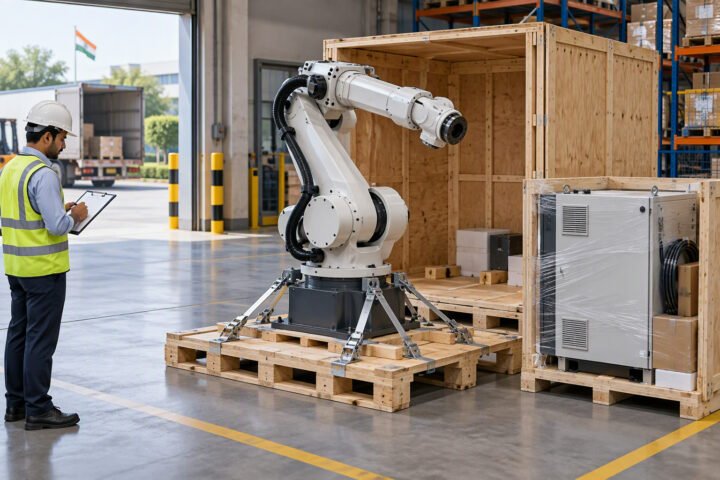
Site readiness is the most common source of delay. A cell that arrives before the floor is anchored and the power is available sits in a crate while the project clock runs.
Phase 3: safety
- Risk assessment completed before the layout is frozen.
- Guarding, light curtains and interlocks specified to the assessment.
- Emergency stops reachable from every operating position.
- Safety functions tested and recorded, not assumed.
- Lockout/tagout procedure written for maintenance.
- Operator training on safe entry and restart.
ISO 10218 and the Factories Act obligations apply in India. The risk assessment should be a document you can show an auditor, not a conversation.
Phase 4: integration and commissioning
| Area | What to verify |
|---|---|
| Handshake | Every signal has an owner, default and timeout |
| Fault handling | Each fault has a code, message and recovery step |
| Manual mode | Jog, step and single-cycle available |
| Recovery | Power loss and restart behaviour defined |
| Data | Cycle counts, faults and status logged |
| Spares | Critical spares on site before handover |
Phase 5: acceptance test
Separate the supplier-site test from the installed-site test using the robot FAT/SAT acceptance checklist. Agree sampling, thresholds, retests and qualified safety-validation responsibilities before the order; the figures below are example contract targets, not universal standards.
An acceptance test should run for a defined period at production rate with production parts. The duration, number of cycles and availability target must be agreed for the application; the table below is illustrative.
| Criterion | Example target | How measured |
|---|---|---|
| Cycle time | ≤ 45 s per part | Timer over 200 cycles |
| Availability | ≥ 95% | Uptime / scheduled time |
| Quality | ≤ 0.5% reject | Measured parts |
| Safety | All functions pass | Functional test record |
| Documentation | Complete | Document checklist |
Do not sign acceptance on a demo. Demos use ideal parts, ideal operators and no production pressure. Run the test with the people who will actually operate the cell.
Phase 6: handover documents
- Electrical drawings and I/O list.
- Network diagram and IP schedule.
- Robot backup and program archive.
- PLC program and HMI project files.
- Safety risk assessment and test records.
- Operation and maintenance manuals.
- Spare parts list with lead times.
- Training record with names and dates.
Budget contingency
Plan 10–20% contingency on the installed cost. The overruns are predictable: extra guarding, a conveyor modification, a network switch nobody ordered, or a week of commissioning lost to a missing part. Contingency is not pessimism; it is the cost of doing this once.
Failures this checklist prevents
| Failure | Cost | Prevented by |
|---|---|---|
| Cell arrives before site is ready | Weeks of delay | Phase 2 sign-off |
| Safety review after installation | Rebuild guarding | Risk assessment before layout freeze |
| Vague acceptance criteria | Dispute with vendor | Written test in the purchase order |
| No spares | Long downtime | Spares list at handover |
| Only one trained operator | Cell idle on leave days | Train two per shift |
| Missing backups | Program lost after failure | Archive at handover and after changes |
Related: industrial robot cost, robot ROI, robot safety standards, PLC vs robot controller, robot maintenance checklist.
What should a robot acceptance test include?
Cycle time at production rate, availability over a defined run, quality or reject rate, safety function tests and a complete documentation check, all using production parts and operators.
How long should a robot cell acceptance test run?
Common practice is several hours or a few hundred cycles, enough to expose intermittent faults. High-volume cells often run a full shift.
Who is responsible for safety in a robot cell?
The employer and the integrator share responsibility. The employer must ensure a risk assessment and safe system of work; the integrator must deliver a cell that meets the assessment.
What documents should I receive at handover?
Electrical drawings, I/O list, network diagram, robot and PLC backups, safety assessment and test records, manuals, spare parts list and training records.
How much contingency should I budget?
Ten to twenty percent of the installed cost, depending on how much of the surrounding line is being modified.
Operator training is part of handover; the teach pendant guide covers what they need to know.
Signal ownership matters; see a worked PLC and robot handshake.
Put a measured cycle time in the acceptance test, with part, tool, path and external waits defined.
Network and fieldbus items are covered in industrial Ethernet for robots.
Imaging items belong in the checklist too, starting with the machine vision lighting guide.
Offline programming changes the commissioning sequence, as the simulation software guide explains.
Add relay function testing to the handover list using the safety function verification steps.
Add the lease terms to the handover checklist using the contract clauses that matter.
The IO handshake in the RAPID example is the same conversation the integration checklist describes.
Put the acceptance test in the contract, using the ISO 9283 test method rather than a vendor demo.
Approve the dress pack route as a drawing during integration, using the routing rules to check it.
Control architecture belongs in the integration scope, so review the reference architecture before signing off.
Approve fixture drawings during integration, and the commissioning checks give you the acceptance list.
Ask the integrator whether programs will be delivered from offline programming or taught on site, and price the difference.
Regulated plants need a longer interface list, and the pharma robotics guide covers the validation additions.
Add external-axis checks to the commissioning list when the cell includes a 7th axis.
Add sensor-to-robot communication and tracking-speed limits to the integration checklist for weld cells.
For a grinding cell, add tool wear checks, dust extraction and spindle speed interlocks to the commissioning list.
Paint cells add colour change, gun purge and booth airflow to the integration checklist.
The machine handshake in a die casting cell must prevent the die closing on the arm, so test it as a safety function.
A retrofit needs its own acceptance test, including repeatability measured at the tool after the new controller is commissioned.
Error proofing and traceability belong on the assembly cell commissioning list, not added later.
Budget for the integration work described here, and compare the figures in the integration cost breakdown before you approve the project.
Sources and further reading
- ISO 10218 — robot safety requirements for manufacturers and integrators.
- IEC — machinery electrical and safety control standards.
- Bureau of Indian Standards — Indian standards for machinery and electrical equipment.
- FANUC — cell integration and commissioning guidance.