In food plants the robot is cheap and the cleaning is expensive. A cell that adds forty minutes of washdown to every shift can lose more output than it gains, no matter how fast the arm moves.
This guide covers where robots pay in Indian food and beverage plants, what hygienic design actually requires, how cleaning time changes the business case, and the practical costs and pitfalls.
Where the work is
| Application | Typical robot | Why it works |
|---|---|---|
| End-of-line case packing and palletising | Four-axis or six-axis | Dry area, no product contact, easiest entry point |
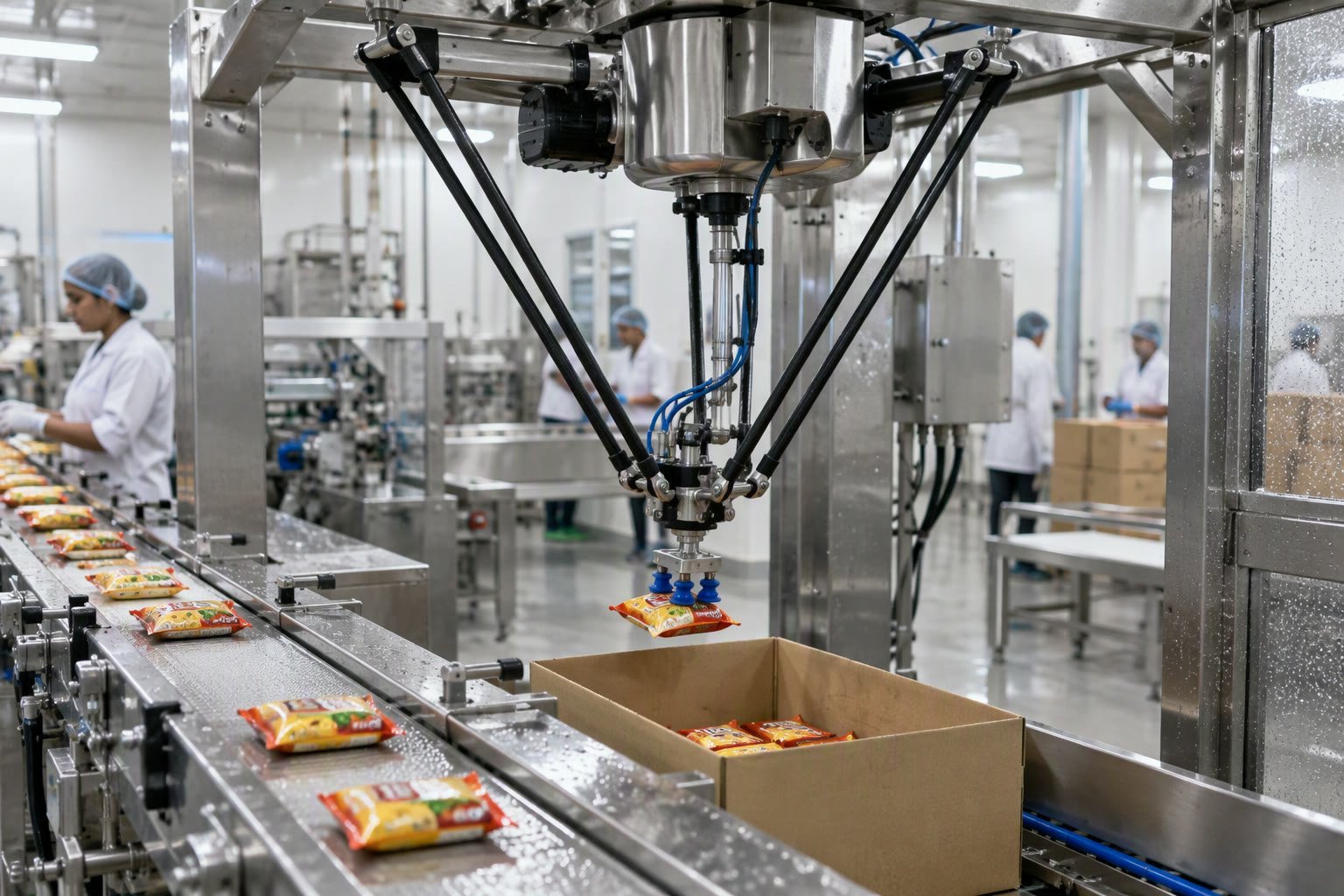
| Primary pick and place of wrapped products | Delta (parallel-link) | Very high speed, light payloads, overhead mounting |
| Bakery and snack tray loading | Delta or SCARA | Repetitive placement at speed |
| Dairy and beverage carton handling | Six-axis with washdown | Wet environment, stainless construction |
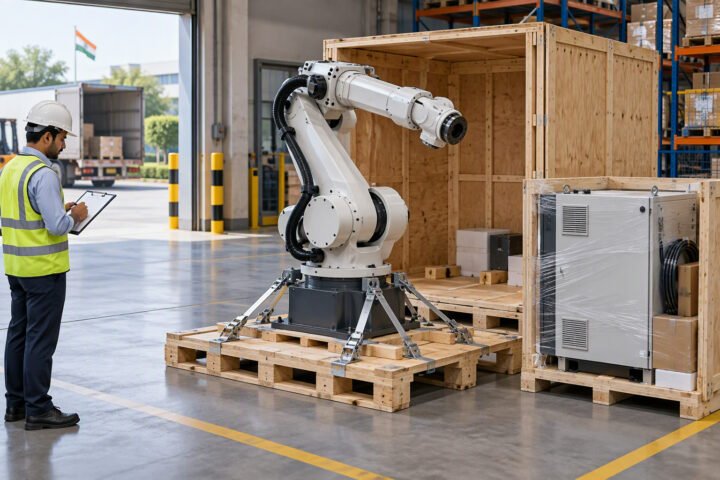
| Cold store palletising | Six-axis, cold-rated | Removes people from −18 °C environments |
| Vision-guided grading and sorting | Delta with vision | Consistent presentation, defect rejection |
The largest and least glamorous opportunity is end-of-line palletising. It is dry, it has no product contact, the hygiene requirement is modest, and it removes the most physically punishing job in the plant. It is also the cheapest cell to build and the easiest to validate with a food safety team.
Hygienic design is a specification, not a coating
Painting a standard robot white does not make it food-safe. Hygienic design is a set of decisions about surfaces, geometry, materials and cleanability, and each one has a cost.
- Materials. 304 or 316L stainless for product-zone frames; anodised aluminium is acceptable away from product contact if it is coated and undamaged.
- Surface finish. Smooth, crevice-free surfaces. Bolted joints, folded sheet edges and exposed threads all trap residue.
- Ingress protection. IP66 for hose-down areas, IP69K for high-pressure, high-temperature washdown. The difference matters and is explained in the IP rating guide.
- Lubricants. Food-grade (H1) lubricants with certificates, and a documented re-lubrication procedure.
- Drainage. Frames designed so water runs off and does not pool in hollow sections.
- Fasteners. Captive or tool-free where possible, so cleaning does not require a maintenance technician.
EHEDG guidance and the machinery hygiene principles behind it are the reference documents your food safety team will use. Involve them at the layout stage; retrofitting hygiene into a cell after the first swab test is expensive and slow.
Cleaning time is the hidden cycle time
A robot cell in a wet area may need cleaning once per shift, and that cleaning is not fifteen minutes. Guards come off, cups are removed and soaked, the arm is washed, the frame is foamed and rinsed, and everything has to be reassembled and inspected before production restarts.
Cell output comparison, two shifts of 8 hours

Without cleaning allowance
  2 shifts x 8 h = 16 h = 960 min
  Cycle 4.0 s  ->  about 14,400 units/potential

With 45 min cleaning per shift
  Available = 960 - 90 = 870 min
  Cycle 4.0 s  ->  about 13,050 units

Loss from cleaning = roughly 9-10% of potential output.
A 20% faster robot recovers only part of that.
Two design decisions recover most of this. First, design for cleaning in place: fixed spray nozzles, sloped surfaces and quick-release guards cut washdown time dramatically. Second, choose the smallest number of product-contact parts. A gripper with six removable suction cups takes three times longer to clean than one with two.
Wet parts break vacuum grippers
The most common disappointment in food pick-and-place is the gripper, not the robot. Vacuum cups on wet, chilled or porous surfaces leak; product with sauce, flour or condensation defeats suction entirely. Where vacuum fails, the alternatives are mechanical fingers, soft robotic grippers, or needle grippers for porous items.
Test the gripper on real product, at real temperature, for a full shift before committing. A gripper that works on a sample at room temperature may fail on a chilled line within an hour. The design trade-offs are covered in the vacuum gripper guide and gripper design basics.
Vision earns its place in grading and sorting
Food is variable, which is exactly where vision helps. Sorting by colour, size and surface defects, or locating randomly oriented product on a conveyor, is a task humans do poorly for long periods and cameras do consistently.
Two cautions. Vision in a washdown area needs IP-rated housings and a lighting design that survives steam and condensation. And vision models must be trained on your product across the season, not on a sample from one week. The approach is described in the defect detection guide and the vision-guided robotics guide.
Costs in India
| Cell | Indicative cost | Notes |
|---|---|---|
| End-of-line palletising, dry area | ₹25–55 lakh | Standard robot, guarding, gripper, conveyor interface |
| Delta pick-and-place, dry area | ₹35–80 lakh | Delta robot, vision, infeed, controls |
| Washdown six-axis cell | ₹55 lakh–1.3 crore | IP69K, stainless, hygienic gripper, drainage |
| Cold store palletising | ₹45 lakh–1 crore | Cold-rated lubricants, heated cabinet, insulated cabling |
| Hygienic gripper, custom | ₹3–12 lakh | Often the largest single uncertainty |
The business case that survives audit
Food manufacturers rarely justify robots on labour cost alone, because seasonal labour is available and cheap in much of India. The cases that hold up are different.
- Consistency. A robot places every case the same way, which reduces damage, improves pallet stability and cuts downstream complaints.
- Ergonomics and attrition. Palletising at 12 cases a minute is a job people leave. Replacement and training costs are real, and injuries are worse.
- Hygiene. Fewer hands in a primary packing area is a food safety argument that auditors and customers accept.
- Cold environments. Automating work at −18 °C removes a serious health and safety exposure.
- Throughput at peak. Seasonal peaks are exactly when labour is hardest to scale.
Build the model with the ROI framework, and include cleaning time, changeover and seasonal utilisation. A cell that runs four months a year at 70 percent utilisation has a very different payback from one running twelve months at 90 percent.
Integration with the line
The robot is one component in a line that includes infeed conveyors, metal detection, checkweighing, labellers and case sealers. Every interface is a place where product jams and where hygiene audits find problems.
Conveyor transitions should be as short and as open as possible, with no ledges that hold product residue. The conveyor integration guide covers the mechanical and control interfaces, and the cell layout guide covers the space needed for cleaning access — which is more than most layouts allow.
Choosing a supplier
Ask for a hygienic design statement, not a brochure. It should list materials, surface finishes, ingress protection, lubricant specification and the cleaning method the cell is designed for. Ask to visit a site running a comparable cell and watch the cleaning, not the production.
Watching the cleaning tells you more than watching the robot. If the operators are improvising with a hose and a brush, the design did not account for hygiene, and you will inherit that problem.
Are robots used in Indian food processing plants?
Yes, mainly in end-of-line palletising, case packing, delta pick-and-place, bakery and snack tray loading, dairy carton handling and cold store palletising. Primary product-contact applications are fewer but growing.
Do food robots need to be washdown rated?
Only in wet or product-contact areas. Dry end-of-line palletising can use standard equipment with basic guarding. Wet areas need IP66 or IP69K, stainless frames, food-grade lubricants and drainage design.
What does a food industry robot cell cost in India?
Indicative ranges: dry-area palletising ₹25–55 lakh, delta pick-and-place ₹35–80 lakh, washdown six-axis ₹55 lakh–1.3 crore, cold store palletising ₹45 lakh–1 crore. Custom hygienic grippers add ₹3–12 lakh.
Why do vacuum grippers fail on food products?
Wet, chilled, porous or sauce-covered surfaces leak air, so suction cannot hold. Mechanical fingers, soft grippers or needle grippers often work better. Always test on real product at real temperature for a full shift.
How much output does cleaning cost a food robot cell?
A 45-minute washdown per shift typically removes 9–10% of potential output. Designing for cleaning in place and minimising removable parts recovers most of it, often worth more than a faster robot.
Sources and further reading
- EHEDG — European Hygienic Engineering and Design Group guidelines.
- FSSAI — Food Safety and Standards Authority of India.
- ISO 22000 — food safety management systems.
- A3 Association for Advancing Automation — robotics integration resources.