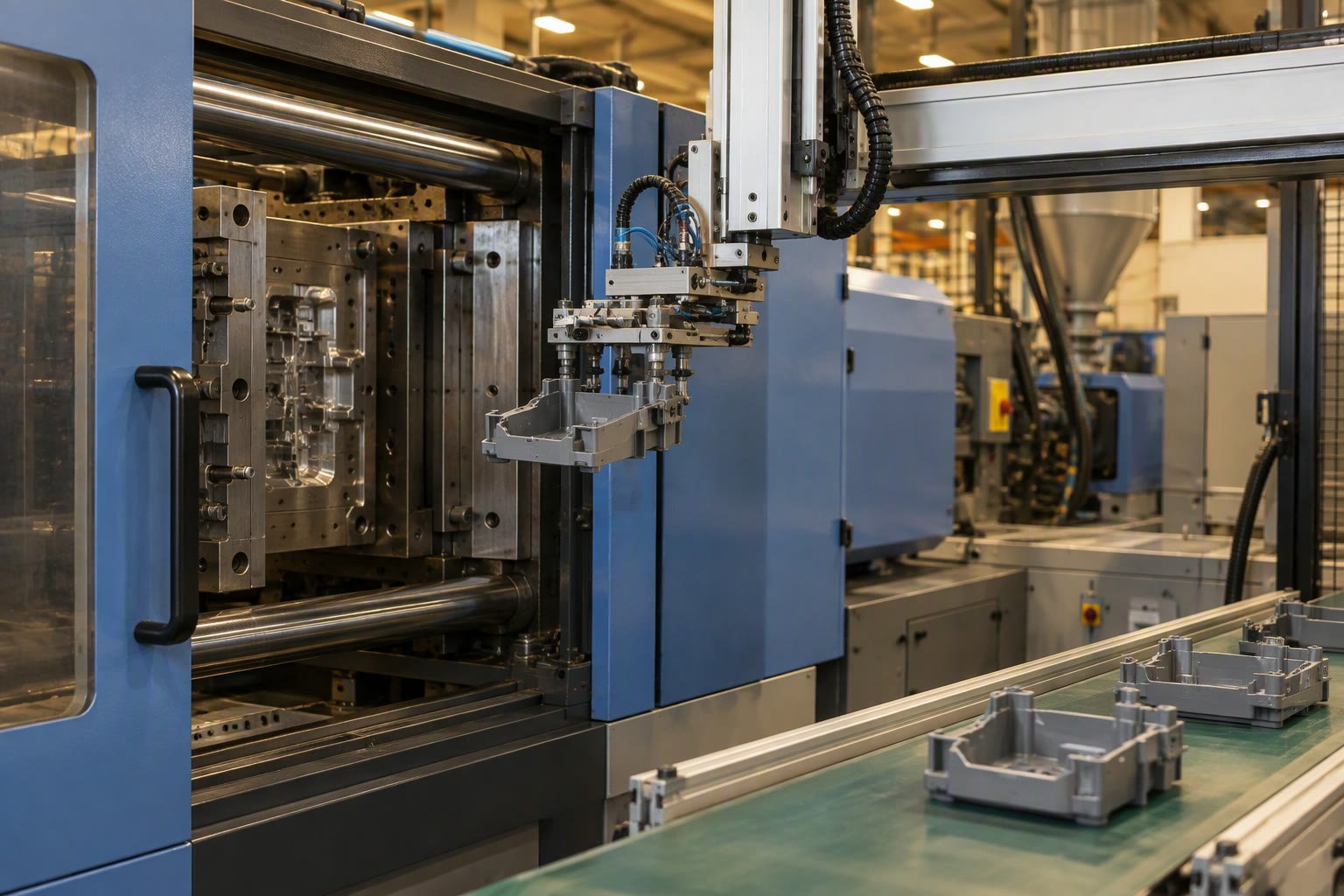
An injection moulding machine produces a part every twenty to forty seconds. The robot that removes it is cheap compared with the machine, and the payback is often under a year.
This guide covers the three robot types used on moulding machines in India, what each costs, how cycle time decides the choice, and the numbers that make a payback case a plant manager will sign.
Why moulding shops automate the take-out first
A moulding machine rarely runs at its rated cycle because the operator is the bottleneck. Opening the guard, reaching in, removing the part, trimming the sprue and closing the guard adds seconds that repeat several thousand times a week. A take-out robot removes that variability and lets the machine run closer to its design cycle.
There is also a quality and safety argument. A part removed at a consistent angle and speed is less likely to be marked or dropped, and nobody’s hand is inside the platens while the machine is live.
The three robot types you will be quoted
| Type | Typical price (India) | Best for | Limits |
|---|---|---|---|
| Sprue picker (1–2 axis) | ₹1.8–₹4.5 lakh | Simple parts, sprue removal only | No complex path, no secondary handling |
| Servo take-out robot (3–5 axis) | ₹4.5–₹12 lakh | Most parts up to 3 kg, insert moulding | Reach fixed by machine size |
| Six-axis industrial robot | ₹12–₹30 lakh installed | Large parts, trimming, stacking, downstream work | Needs guarding and a bigger footprint |
Sprue pickers are the cheapest entry point and are often the right first purchase for a small shop. Servo take-out robots dominate mid-size plants because they can follow a curved path out of the mould without touching the core. Six-axis robots appear when the robot must also trim, stack, inspect or load an insert.
Cycle time: the number that decides the payback
Start with the machine cycle and the manual take-out time. If the machine cycle is 30 seconds and manual handling adds 6 seconds of guard-open time, the cell is losing 6 seconds per shot. At 20 hours a day, that is roughly 2,400 shots a day and about 4 hours of lost machine time per day at that cycle.
Shots per day       = 3600 / cycle × running hours
Lost seconds/day    = seconds saved per shot × shots/day
Machine hour value  = machine hourly rate (₹500–₹1,500 for 100–250 T)
Daily saving        = lost hours × machine hour value
Payback (months)    = robot cost / (daily saving × 26)
Use the machine’s real hourly cost, not just the power bill. A 150-tonne machine with a skilled operator and occupancy cost often sits between ₹800 and ₹1,200 per hour in an Indian plant. Even a modest 2-second saving per shot on a 25-second cycle is worth several lakh a year.
What the robot does not include
- Machine interface — the Euromap or SPI signal kit that lets the robot and machine talk. Budget ₹40,000 to ₹1.2 lakh.
- End-of-arm tooling — vacuum cups, grippers or a sprue grab. ₹25,000 to ₹1.5 lakh depending on part shape.
- Guarding and safety — interlocks on the access gate and a safe zone around the robot. ₹80,000 to ₹3 lakh.
- Conveyor or stacking station — often needed to get parts away from the cell. ₹50,000 to ₹2.5 lakh.
- Programming and commissioning — ₹40,000 to ₹1.5 lakh for a standard take-out recipe.
Buyers who quote only the robot price are usually surprised at installation. The full cell is typically 1.4 to 1.8 times the robot cost, which is why the payback case should be built on the installed total.
Safety and the machine interface
The robot must not be able to move into the mould area while the platens are closing. The standard approach is a mould-area safety signal from the machine that inhibits robot motion, plus a robot-in-mould signal that inhibits machine close. Both are hard-wired or on a safety bus, and both must be validated during commissioning.
Guard the robot’s own envelope as well. A take-out robot that swings a part outside the machine still needs a fence or light curtain, and the gate needs an interlock that stops the robot, not just the machine.
Choosing between a local integrator and the machine OEM
The moulding machine supplier often offers a matched robot at a bundled price. That is convenient and usually reliable, but it locks you into their spares and service. A local integrator can mix brands and often responds faster, at the cost of more integration work and less standardisation.
For a single machine, the bundled option is often correct. For a shop with ten machines, standardising on one robot platform makes spares, training and programming far cheaper over five years.
A realistic phased plan
- Automate the highest-cycle machine with the simplest part first. Prove the payback.
- Standardise the EOAT across similar parts so changeover is minutes, not hours.
- Add downstream trimming or stacking only after the take-out is stable.
- Connect the cell to production data so cycle time and downtime are visible.
- Expand to the next machine using the same platform and recipe library.
If the plant already runs industrial robots, the six-axis cost guide will help you price the larger option. For the safety case around the cell, see the safety relay versus safety PLC comparison, and for the payback model itself our robot ROI guide.
How much does an injection moulding robot cost in India?
A sprue picker starts around ₹1.8 lakh, a servo take-out robot runs ₹4.5 to ₹12 lakh, and a six-axis installation ₹12 to ₹30 lakh. Add 40 to 80 percent for tooling, guarding, interface and commissioning.
What is the payback period on a take-out robot?
Often six to eighteen months when the machine is the bottleneck. The saving comes from seconds removed per shot multiplied by shots per day and the machine's real hourly cost.
Do I need a six-axis robot for take-out?
Usually not. A servo take-out robot handles most parts up to a few kilograms, including curved extraction. Six-axis robots are justified when the same robot must trim, stack or load inserts.
What interface does the robot need with the machine?
A Euromap or SPI signal interface for safe mould-area handshaking, plus hard-wired or bus-based safety signals so neither machine moves into the other's space.
Can one robot serve two moulding machines?
Rails and traversing robots can, but the utilisation must justify it. Two machines with long cycles and short take-out times can share a robot; short-cycle machines usually cannot.
Molding cells run hot and continuously, and the robot cell energy guide covers the cooling and idle draw that follows.
Medical-grade moulding adds validation to the cell, described in the pharma robotics guide.
Moulding and casting share the same constraint: the robot must finish inside a fixed machine-open window, as the die casting guide shows in numbers.
Sources and further reading
- Euromap — moulding machine and robot interface standards.
- SPI — plastics industry robot interface guidance.
- Yushin — take-out robot specifications and cycle examples.
- A3 Automate — robotics integration resources.