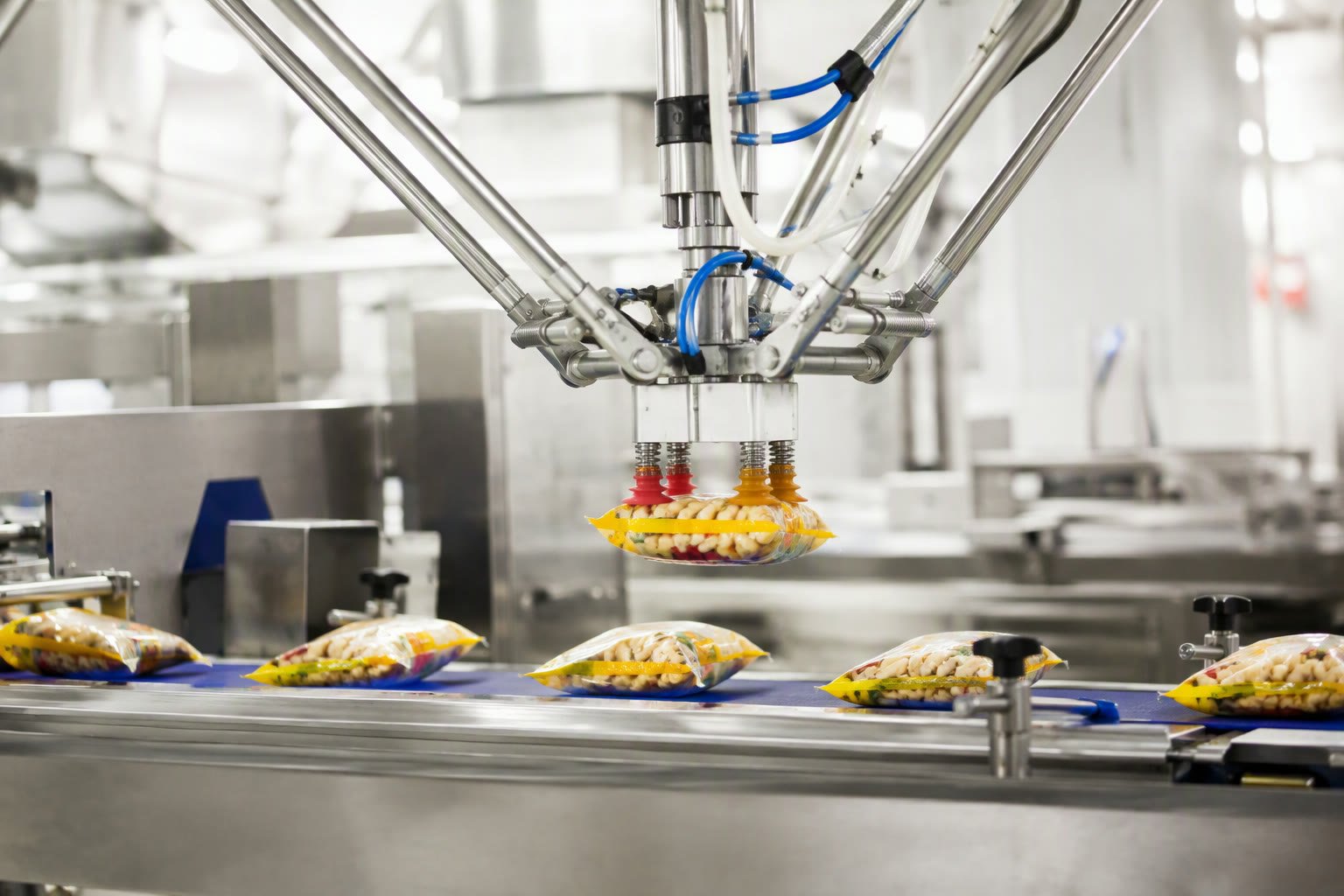
A delta robot is the fastest way to move a small object from one point to another. Three or four lightweight arms hang from a fixed frame and converge on a small platform. All the motors sit in the base, so the moving mass is tiny and the machine can accelerate at several g, dozens of times a minute, all day.
That makes delta robots the default choice for food packing, pharmaceutical blister handling and small electronics. It also makes them a poor choice for anything heavy, precise in 3D, or awkward to present. This guide covers where the line sits and what a delta cell costs in India.
How a delta robot works
Three upper arms are driven by motors in the fixed base. Each connects through a parallelogram linkage to the moving platform, which keeps the tool orientation fixed unless a fourth axis is added. Because the motors do not move with the arm, inertia stays low and speed stays high. The trade-off is that the useful workspace is a dome-shaped region below the frame, not a full sphere.
Most delta controllers solve the inverse kinematics continuously: you give a target point and the controller computes the three motor angles. That is why programming a delta is usually simpler than programming a six-axis arm for the same pick-and-place task.
Where delta robots win
| Application | Why delta fits | Watch out for |
|---|---|---|
| Snack and bakery packing | High pick rate, light products, overhead conveyor | Hygienic design and washdown |
| Pharmaceutical blister and vial handling | Repeatable, fast, cleanable | Validation documentation |
| Small electronics | Short moves, high acceleration | ESD and fine placement tolerance |
| Sorting and grading | Vision-guided, many picks per minute | Camera latency and belt tracking |
| Kit assembly | Multiple small parts into one tray | Part presentation and jam recovery |
If the part weighs more than a few kilograms, or the tool has to rotate through a large angle, a six-axis or SCARA machine is usually the better investment. Delta robots are specialists, and they reward processes that suit them.
Price bands in India
Indicative 2026 planning ranges, before GST. A delta is rarely sold as a bare arm; most projects are quoted as a complete pick-and-place cell with vision, belting and guarding.
| Configuration | Payload | Indicative price | Comment |
|---|---|---|---|
| Entry delta, no vision | 1–3 kg | ₹4–10 lakh | Fixed pick points, simple PLC handshake |
| Delta with vision | 1–5 kg | ₹10–22 lakh | Camera, lighting and tracking software included |
| Hygienic food-grade cell | 1–5 kg | ₹15–35 lakh | Stainless frame, washdown, IP-rated components |
| Four-axis delta | 3–8 kg | ₹18–40 lakh | Rotating tool axis for orientation |
| Hobby or educational delta | Under 1 kg | ₹15,000–80,000 | Kit or 3D-printed, for learning only |
The gap between the entry and vision rows is mostly perception, not mechanics. A delta without vision can only pick from known positions; adding a camera and tracking software multiplies the usable applications and the price.
Cycle time is the specification that matters
Delta vendors quote picks per minute under a standard pick-and-place pattern, usually a short vertical lift, a horizontal move and a return. Those numbers are useful for comparison and optimistic for your line. Real throughput depends on how far the product travels, how quickly the belt moves, how long the gripper takes to close, and how often the vision system has to re-acquire a part.
Ask for a cycle time measured on a pattern that matches your conveyor pitch and product spacing. Then add a realistic efficiency figure, typically 80–90% of the theoretical rate, for jams, changeovers and operator interventions.
What drives the cost up
- Vision and tracking. Camera resolution, lighting, encoder integration and software licences.
- Hygienic construction. Stainless steel, sloped surfaces, washdown-rated motors and cables.
- Gripper design. Vacuum cups, soft grippers and quick-change tooling are process-specific.
- Safety and guarding. Even a fast delta needs a risk assessment and restricted access.
- Line integration. Conveyor tracking, reject handling, MES or weigh-scale data.
- Validation. Pharma and food customers often require documented cleaning and changeover procedures.
Building one instead of buying
Hobby delta kits are a good way to learn inverse kinematics, but they are not a shortcut to a production cell. Production deltas need stiffness, repeatability, cable management and a controller that can track a moving conveyor. A printed delta that works on a desk will flex under real acceleration and lose the placement accuracy the process needs.
If the goal is learning, build the kit and drive it with a simple inverse kinematics routine. If the goal is production, buy a machine with a service contract and spend the engineering budget on part presentation and gripper design, which is where the real risk sits.
Checklist before you enquire
- Part weight and grip surface. Confirm the gripper can hold the part at peak acceleration, not just at rest.
- Pick and place locations. Measure the real distance and height difference; do not use the datasheet’s maximum.
- Product spacing. Vision tracking needs consistent gaps and a known belt speed.
- Environment. Flour dust, washdown, condensation and temperature all change the specification.
- Changeover frequency. Frequent product changes favour quick-release tooling and stored recipes.
- Service. Ask for the nearest service engineer and the spare-parts lead time in writing.
Related: SCARA robots, industrial robot cost breakdown, gripper design basics, robotics in manufacturing, robot vision cameras.
What is a delta robot used for?
Delta robots are used for high-speed pick-and-place of light objects, especially in food packing, pharmaceuticals, electronics and sorting. Their motors are fixed in the frame, so the moving parts are light and fast.
How much does a delta robot cost in India?
Indicative 2026 ranges are ₹4–10 lakh for an entry delta without vision, ₹10–22 lakh with vision, and ₹15–35 lakh for a hygienic food-grade cell, before GST.
What is the payload limit of a delta robot?
Most industrial deltas handle 1–8 kg. Above that, a SCARA or six-axis robot is usually more practical and more rigid.
Can a delta robot rotate the gripper?
A three-axis delta keeps the tool orientation fixed. A four-axis delta adds a rotating shaft for orientation, which costs more and reduces payload.
Is a delta robot hard to program?
For fixed pick points it is simple, because the controller solves inverse kinematics. The complexity usually sits in vision, conveyor tracking and recipe management rather than in robot motion.
Delta arms use compact high-ratio reducers at the motor joints.
Sources and further reading
- ISO 9283 — robot performance testing, including repeatability and path accuracy.
- ABB Robotics — delta (IRB 360) specifications and application notes.
- Omron industrial automation — delta robots and vision-guided picking.
- EHEDG — hygienic equipment design guidance for food processing.