Harmonic and cycloidal drives both give robot joints high reduction in a small package, and they fail in different ways. Harmonic drives win on precision. Cycloidal drives win on shock load.
This guide compares the two, explains the mechanics well enough to specify them, and covers where each belongs on a robot arm, a mobile base or a positioner.
Harmonic drive: how it works
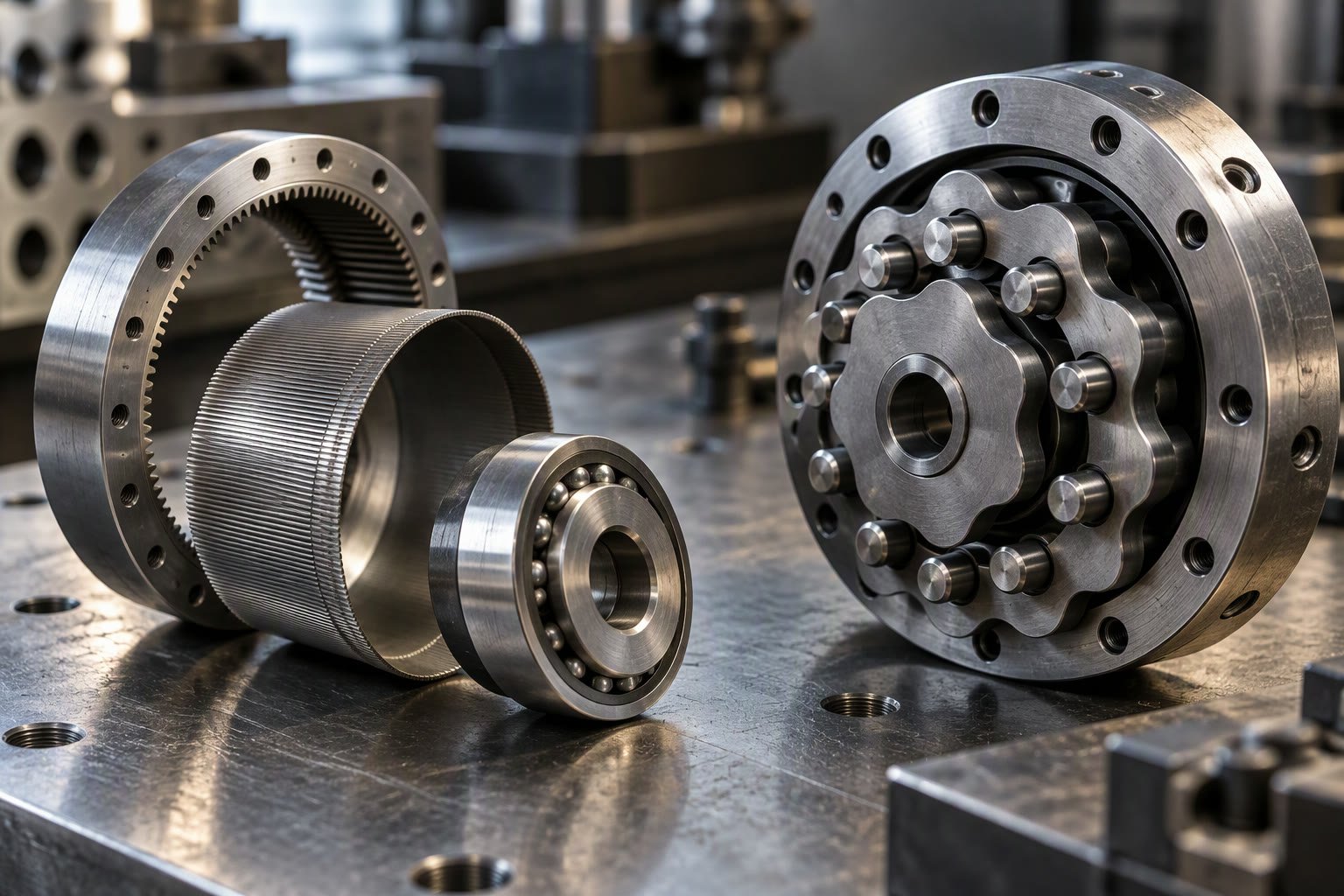
A harmonic drive, also called a strain wave gear, has three parts. The wave generator is an elliptical bearing on the input shaft. The flexspline is a thin-walled cup with external teeth that deforms as the wave generator turns. The circular spline is a rigid ring with internal teeth, usually two more teeth than the flexspline.
As the wave generator rotates, the flexspline teeth engage the circular spline at two opposite points. Because the tooth counts differ by two, the output rotates by two teeth per input revolution, giving very high reduction in a single stage.
- Single-stage ratios typically 30:1 to 160:1, with some units higher.
- Near-zero backlash, often under one arcminute.
- Very low inertia and low mass for the ratio.
- High torsional stiffness relative to size.
- Coaxial input and output, which simplifies joint design.
The trade-off is the flexspline. It flexes every revolution, so it is a fatigue component with a finite life, and it does not like shock loads or being back-driven hard against its limit.
Cycloidal drive: how it works
A cycloidal drive uses an eccentric input shaft that drives one or two cycloidal discs around inside a ring of pins. The disc has a lobed profile that engages the pins, and the eccentric motion produces a slow rotation of the output. A set of rollers or pins handles the output motion.
- Ratios typically 6:1 to 119:1 in a single stage.
- High shock load capacity because load is shared across many pins.
- Compact radial size but longer axially than a harmonic unit.
- Backlash is small but usually larger than a harmonic drive.
- Very robust and common in heavy robot bases and positioners.
Cycloidal drives tolerate impact and overload better than harmonic drives, at the cost of slightly more backlash and a larger axial envelope.
Side-by-side comparison
| Property | Harmonic | Cycloidal |
|---|---|---|
| Typical ratio, one stage | 30:1 to 160:1 | 6:1 to 119:1 |
| Backlash | Very low, under 1 arcmin | Low, often 1–5 arcmin |
| Shock resistance | Moderate | High |
| Mass and inertia | Low | Higher |
| Axial length | Short | Longer |
| Efficiency | 70–85% typical | 85–93% typical |
| Failure mode | Flexspline fatigue | Pin, disc or bearing wear |
| Cost in India | High | High, varies by size |
| Typical use | Arm joints, wrists, cobots | Base joints, positioners, heavy axes |
Efficiency matters for battery robots. Both are less efficient than a planetary gearbox, and that loss becomes heat inside the joint. For a cobot arm running all day, the heat path is part of the design, not an afterthought.
Where each belongs on a robot
| Axis | Typical choice | Reason |
|---|---|---|
| Arm base, heavy payload | Cycloidal or planetary | Holds static load, tolerates shock |
| Shoulder pitch | Cycloidal or large harmonic | High torque, some impact risk |
| Elbow | Harmonic | Light, precise, compact |
| Wrist roll and pitch | Harmonic or small strain wave | Backlash dominates accuracy |
| Mobile robot drive | Planetary, not harmonic | Cost, efficiency, shock from floor |
| Pan-tilt sensor head | Harmonic or small cycloidal | Precise pointing without backlash |
On a 6-axis industrial robot, the pattern is common: cycloidal or a heavy-duty reducer at the base and shoulder, harmonic drives at the wrist. On cobots, harmonic drives appear in more joints because low mass and low backlash matter more than shock tolerance.
Sizing a drive for a joint
- Static torque: the load moment at full extension, including the arm’s own mass.
- Dynamic torque: acceleration torque plus static torque plus friction.
- Peak torque: emergency stop, collision or a hard reversal.
- Output speed: what the joint needs, times the ratio for motor speed.
- Torsional stiffness: matters for a wrist that must hold position under load.
- Life: harmonic flexspline life is rated in cycles at a given torque.
Size on peak torque with a margin, then check the continuous torque and life. A drive chosen only on continuous torque will fail early if the cell has frequent hard stops. Use the manufacturer’s catalogue curves, not a rule of thumb.
Backlash and why it decides accuracy
Backlash is lost motion when the direction reverses. On a wrist, one arcminute at 300 mm from the joint is only about 0.09 mm, which sounds trivial. On a 1 m arm with several joints, the errors stack, and the tool can be off by a millimetre or more after a reversal.
Harmonic drives are popular in wrists for exactly this reason. A cycloidal base joint with a few arcminutes of backlash contributes less error because the arm segments beyond it are short compared with the reach, and the base motion is often not reversed mid-path.
Mounting, lubrication and heat
Both drives are precision assemblies, and both punish careless mounting. A harmonic reducer must be supported so that the flexspline sees only the intended torque. Side load on the output flange, or a pulley tightened against it, shortens life quickly. Use a separate bearing to carry radial load from belts, gears or the robot’s own weight.
- Follow the manufacturer’s runout and concentricity limits for the mating parts.
- Use the specified lubricant; grease grade affects life and starting torque.
- Respect the axial and radial load limits on the output flange.
- Provide a defined thermal path, especially in an enclosed joint.
- Check the unit after the first hours of running for temperature rise.
Efficiency losses appear as heat at the joint. In a cobot that runs continuously, that heat has to leave through the housing or it will derate the motor and drift the encoder. A joint that is warm after ten minutes of cycling is telling you something about the duty cycle.
Buying reality in India
Genuine harmonic reducers and cycloidal reducers are specialist components with long lead times and real cost. Imported units carry duty and freight, and used units from robot refurbishment are common. Counterfeit or re-labelled units exist in the market, especially online.
- Buy through an authorised distributor where possible.
- Ask for the backlash and torque test sheet for the individual unit.
- Check the ratio marking against the part number, not the listing title.
- For prototypes, a planetary gearbox with a belt reduction is often a better first step.
- Budget for the motor, brake and encoder, not just the reducer.
When a planetary gearbox is the right answer
For most student and small commercial robots, a planetary gearbox is cheaper, easier to source and adequate. Cycloidal and harmonic drives become worthwhile when backlash, mass or ratio density actually limit the design. If you are not measuring backlash in your accuracy budget, you probably do not need one yet.
Related: planetary vs spur gearbox, robot arm kinematics, motor selection, accuracy vs repeatability, SCARA robots.
What is the difference between a harmonic drive and a cycloidal drive?
A harmonic drive uses a flexing cup and an elliptical wave generator for very high ratio with near-zero backlash. A cycloidal drive uses eccentric discs running inside pins, giving high shock resistance with slightly more backlash.
Which is more precise, harmonic or cycloidal?
Harmonic drives are more precise because backlash is usually under one arcminute. Cycloidal drives typically have a few arcminutes, which matters more in wrist joints than in base joints.
Why are harmonic drives used in robot wrists?
They are light, compact, coaxial and have very low backlash, so they hold tool position accurately after direction reversals. That combination suits wrist roll and pitch axes.
Are cycloidal drives stronger than harmonic drives?
They handle shock and impact better because load is shared across many pins and discs. Harmonic flexsplines are fatigue components and are more sensitive to overload.
Should I use a harmonic drive on a mobile robot?
Usually not. Cost, efficiency and shock from the floor favour planetary gearboxes on wheels. Harmonic and cycloidal drives belong where precision or torque density justifies the price.
Gearbox choice follows joint torque, and the robot arm joint and bearing guide works through the numbers.
Sources and further reading
- Harmonic Drive — strain wave gearing theory and catalogue data.
- Nabtesco — cycloidal precision reducer documentation.
- ISO 10218 — industrial robot safety context for joint design.
- KHK Gears — gear types, backlash and selection reference.