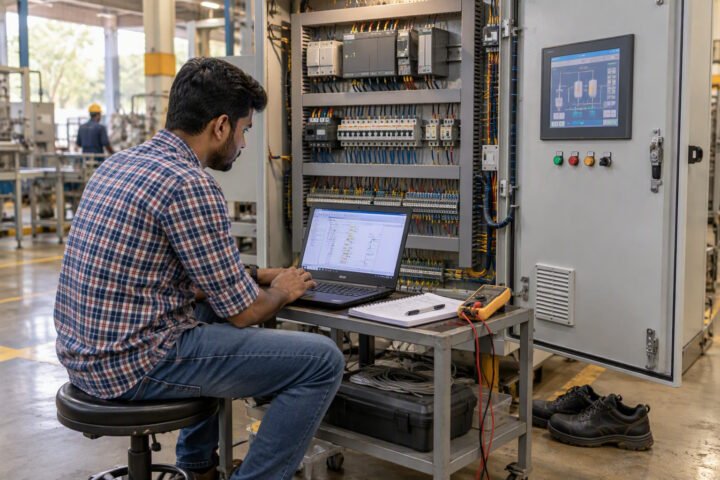
Embedded systems hiring in India rewards four things: C you can defend, one microcontroller family you know deeply, the ability to debug with instruments, and code that lives in version control. RTOS work, PCB layout and the rest can be learned on the job if those four are solid. The plan below is ordered by what interviews test, not by what syllabi teach.
What the job is, in five tasks
- Bring up a board someone else designed, and prove each interface works.
- Write and fix drivers, usually from a reference manual and a timing diagram.
- Measure: current in sleep, latency under interrupt load, temperature at the regulator.
- Support production: test jigs, calibration steps, firmware versioning on the line.
- Diagnose field failures from logs and returned units.
Most of the work is on a product that already ships. New design is a minority of the week, and the code you write will outlive the board it was written for, which is why readability and version control matter more than clever tricks.
C fundamentals that interviews actually test
- Pointers and arrays, including the difference between an array name and a pointer, and when each decays.
- Struct layout, padding and alignment, because a protocol frame that packs wrongly fails silently.
- Bit masking and shifts, and integer promotion and overflow rules.
- volatile, const and static, each with the reason it exists rather than its definition.
- Function pointers, which are how callbacks and driver tables are built.
- Memory layout: stack, heap, initialised and uninitialised data, and how startup code reaches main.
- State machines, because almost every embedded behaviour is one.
- Why dynamic allocation is often banned, and what you use instead.
How much maths matters
Less calculus than students fear, and more arithmetic discipline than they expect. You need fixed-point scaling when a chip has no floating point, filters such as a moving average or a first-order IIR, a PID loop you can tune by observation, and unit conversion that does not lose precision. Controls engineering roles add Laplace transforms, discretisation and stability analysis. Firmware roles mostly need you to trust a calculation enough to defend it in a review.
Microcontrollers, RTOS and buses, in the right order
Learn in this order. Each row assumes the one above it works, and each has a test that is hard to fake.
| Layer | What to learn | How you prove it |
|---|---|---|
| GPIO and timing | Pin multiplexing, drive strength, debounce, busy waits | Blink at 1 kHz and measure the period on a scope |
| Interrupts | Priorities, latency, what an ISR may and may not do | Count encoder pulses at full speed without missing one |
| UART | Framing, baud error, ring buffers, timeouts | A protocol that recovers when you pull a wire mid-frame |
| I2C | Addressing, pull-ups, clock stretching, bus recovery | Recover a stuck bus in firmware instead of power cycling |
| SPI | Modes, chip select, DMA | A sensor read at full rate with a logic analyser capture to show it |
| ADC and sensors | Reference voltage, noise, oversampling, calibration | Calibrate a sensor against a meter and plot the error |
| Timers and PWM | Prescalers, compare modes, dead time | Drive a motor at a set duty and measure both sides of the driver |
| RTOS | Tasks, priorities, queues, mutexes, priority inversion | Two tasks sharing one bus for 24 hours without corruption |
| Low power and bootloaders | Sleep modes, watchdog, update and rollback | A device that runs for weeks on a cell and updates over the air |
Debugging, PCB basics and Git
These three separate a hobbyist from a hire, and almost none of them appear in a college syllabus.
- Instruments: a multimeter used properly, an eight-channel logic analyser, and enough oscilloscope to read a noisy edge. Add SWD or JTAG stepping with breakpoints and watchpoints, and timestamped logging.
- Method: bisect a regression with version control, change one variable per test, and write the root cause before the fix.
- PCB basics: reading a schematic, decoupling close to the pins, a ground return path you can point at, crystal layout, footprint checks against the datasheet drawing, and a design rule check before ordering. Expect a second revision; everyone needs one.
- Git: a branch per change, commit messages that say why, tags for shipped firmware, no build artefacts, and no credentials in the repository.
A nine-month self-study plan
| Month | Focus | Build | Check |
|---|---|---|---|
| 1 | C refresh: pointers, structs, bit operations | Rewrite a small tool in C with a test input file | You can explain every line you wrote |
| 2 | One microcontroller, deeply | Replace delay calls with a timer and an interrupt | Jitter measured before and after |
| 3 | UART, I2C and SPI | A node with two sensors on different buses | All three buses captured on a logic analyser |
| 4 | Debugging and tooling | Fix a bug in an existing open-source firmware | A written root cause, not a guess |
| 5 | RTOS | Tasks, a queue and a mutex around one shared bus | 24-hour run with no corruption |
| 6 | A second platform | Port the month 3 node to another family | The port takes days, not months |
| 7 | Low power and watchdogs | A logger that wakes every minute | Average current measured, not estimated |
| 8 | PCB | A two-layer breakout with decoupling and a header | It works, or you can say why revision two will |
| 9 | Portfolio | One product-like project with README and test report | A stranger can rebuild it from the repository |
What to do this month
- Choose one microcontroller family and stop switching. The Arduino Uno is a fine development board for month two, and the ESP32 adds Wi-Fi and a second core when you need them.
- Download the reference manual, not the tutorial. Read the GPIO and UART chapters and take notes on the registers.
- Buy a logic analyser and learn one capture workflow. It costs less than a scope and settles arguments.
- Create one repository today and commit the code you already have.
- Write a half-page list titled “what I can prove”, with a measurement against each claim. Anything without a number comes off the resume.
What should you build so it looks like work?
Coursework demos read as coursework. Work-like projects have a protocol, a failure mode, a measurement and a maintenance story.
- A sensor node with a documented protocol and defined behaviour when the link drops.
- A data logger with a binary format and a host-side parser you also wrote.
- A motor controller with a current limit, fault codes and a recovery procedure.
- An RS-485 node speaking Modbus RTU, because that is what plants use.
- A bootloader with a rollback path, and a failed-update test to prove it works.
- A test jig a production line could actually use.
Where your college syllabus stops short
Most Indian embedded courses stop at the datasheet and the development board. They rarely cover version control, instrument training, timing analysis, unit tests, cost, manufacturability, reading someone else’s code or writing a change note. Employers assume these gaps and test for them, which is why a student with a documented fix beats a student with a high mark and no artefact. The free project pack covers the test log and report side, and the careers page shows where these skills lead.
Common questions
Is Arduino enough to get hired?
Not on its own, because the board hides the parts interviews ask about: registers, interrupt latency, memory limits and the build process. Use it to learn the concepts, then move the same project to a bare microcontroller or a second family. Employers hire for the transfer, not for the board. Parts for either route are covered in where to buy robotics parts in India.
Do I need a postgraduate degree?
For most firmware and testing roles, no. A postgraduate degree matters for research, silicon and some advanced controls positions. For everything else the portfolio decides, and documented work counts for more than coursework with nothing to show.
How long before I am interview-ready?
Dependent on hours, not months. At eight to ten hours a week, the plan above produces a defensible portfolio in about nine months; at twenty hours a week, the same plan compresses to about five. The binding constraint is usually the measurement habit, not the theory.
Last reviewed: October 2026. Tool and platform guidance reflects common student practice; check current vendor documentation before buying or wiring anything.
Warehouse robots are embedded and software work as much as mechanical; the warehouse robotics guide shows where the integration work sits.
How to become a robotics engineer in India shows where an embedded systems specialism fits into the wider robotics career.
See also: robotics and embedded salary bands in India.
PLC and fieldbus skills overlap heavily with embedded systems careers which is a useful second route into automation.
Factory controls roles often want PLC programming alongside embedded C.
Interview prep for embedded roles is covered question by question in embedded systems interview questions.
If panels are not your interest, the adjacent path is firmware; see how it differs from an automation career.
Sources and further reading
Background documents used for this page:
- IFR World Robotics — international data on robot installations and demand for skills.
- National Career Service, Government of India — public job listings and career resources.