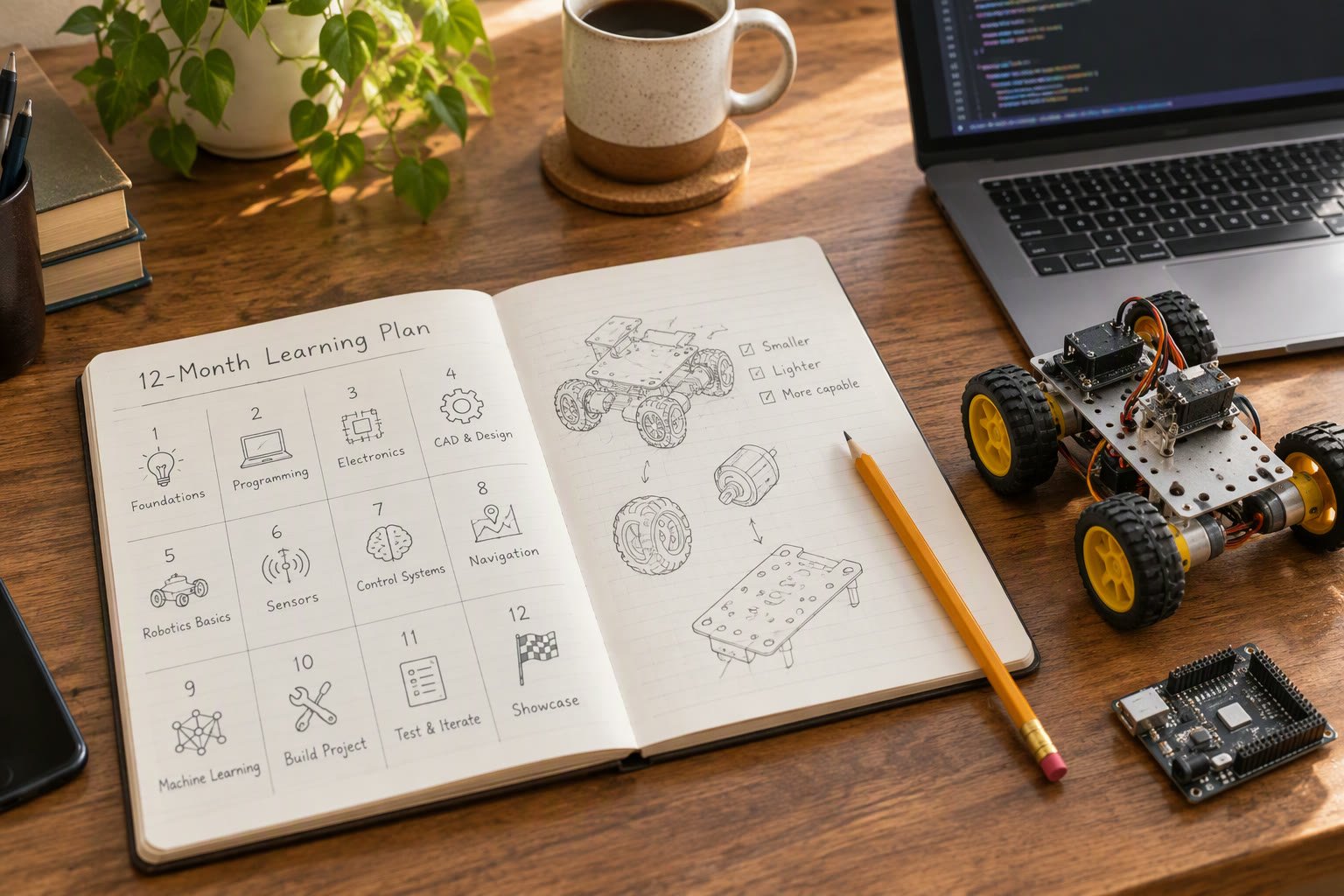
Twelve months is enough to go from a first breadboard to a portfolio that survives a technical interview, if each month produces something you can show. The order below puts measurement and debugging before frameworks, and ROS 2 in month nine rather than month one, because a robot that does not move reliably cannot be debugged inside a simulation. This robotics skills roadmap puts measurement and debugging first and ROS 2 in month nine.
The twelve-month plan, month by month
| Month | Learn | Build | Milestone check |
|---|---|---|---|
| 1 | Breadboard, voltage, current, resistance, the multimeter | LED, button, resistor divider, a transistor switching a small load | You measure a divider and a resistor and explain the difference from the calculated value |
| 2 | One board, C basics, digital I/O, PWM, serial | Sensor readout printed and plotted over serial | Functions and a timer replace delay-only loops |
| 3 | Motors, drivers, batteries, buck converters | Line follower with a calibration routine | It completes a track from a cold start, with a test log and no brown-out |
| 4 | Sensors, filtering, calibration | Obstacle avoider with a filter on the distance reading | You record false readings and show what the filter changed |
| 5 | Interrupts, I2C, SPI, a second board family | Wi-Fi sensor node posting to a local dashboard | It recovers from a power cut without anyone touching it |
| 6 | Mechanics, tolerances, CAD, servo torque | Three-axis arm or a gripper | The part fits by the second print, and torque was calculated before buying servos |
| 7 | Feedback control, PID, encoders or an IMU | Heading-hold or balance robot | A step response plot before and after tuning, with overshoot explained |
| 8 | Linux, Python, Git, build tools | A host-side tool that logs and plots your robot’s data | A clean clone runs on another machine, with a README that works |
| 9 | ROS 2 nodes, topics, launch files, frames | The month 7 robot wrapped as a ROS 2 node | Teleop works from a clean shell and the launch file is versioned |
| 10 | Camera calibration, OpenCV basics | Line or object detection with a measured accuracy | Accuracy reported on 50 frames, including the failures |
| 11 | Integration, failure handling, documentation | One robot that senses, decides and acts | A three-minute demo video and a report someone else can follow |
| 12 | Writing, resume, applications | Portfolio polish, three repositories, one report | Ten applications out, each matched to a role family |
What to do this month
- Buy parts for month one only: a breadboard, a few resistors, two LEDs and a multimeter. Nothing else.
- Measure one resistor and one divider, and write both numbers next to the calculated value and the tolerance.
- Pick the board you will use all year and stop comparing boards.
- Start one notes file named after the month. Every measurement goes in it with the date.
- Fix a weekly slot. Two short evenings beat one long weekend, because debugging needs a fresh head.
Free resources, by category
No month here needs a paid course. It needs one source per topic, finished.
- Official documentation and reference manuals. The microcontroller vendor’s reference manual, the board’s own language reference, and the ROS 2 documentation with its tutorials. These match the silicon; random videos often do not.
- University lecture notes and recorded courses. Control theory, signals, linear algebra and embedded systems, preferably with problem sets and worked solutions.
- Datasheets and application notes. Every sensor, driver and regulator you touch. Application notes on motor drive, power layout and noise are free and better than most tutorials.
- Protocol specifications. UART framing, I2C, SPI and Modbus frame formats. Read the frame once and the tutorials start making sense.
- Tool documentation. The Git book, CMake docs, the KiCad manual, your debugger’s user guide.
- Source code of maintained open projects. Read one firmware repository a month. Reading code is faster than another video.
Collecting links is not studying. Keep a single notes file per month with the source you used and the measurement you took, and delete the rest of the tabs.
What counts as finished
- It starts from a cold power cycle without you holding anything in place.
- Someone else can rebuild it from your README and bill of materials.
- There is a measured number, not an adjective.
- One failure is written down with its root cause and the fix.
- The commit history shows the path, rather than one dump at the end.
- You can name the cost and the purpose of every part.
- You can explain the whole thing for five minutes without notes.
If a month ends without these, the month is not finished. Move the build into the first week of the next month instead of stacking a new topic on an unproven one.
How to document the work on GitHub
- One repository per build, with a photograph at the top of the README.
- README sections in this order: what it does, bill of materials in rupees, pin map, how to build and flash, test results, known issues, licence.
- Commit messages that say why a change was made, not just what changed.
- Tag the version you demonstrated. When someone asks what you showed at the review, there is an answer.
- Open an issue for every bug you find in your own code, and close it with the fix. It reads as engineering discipline.
- Keep passwords, keys and calibration secrets out of the repository, and do not commit build folders.
- Pin the three repositories you want read. Nobody scrolls past the first screen.
An interviewer reads the README first and the code second, if at all. The pin map and the test results do more work than the source. Price each build with the project cost calculator before you order, so the BOM in the README is the real one.
What to cut from the robotics skills roadmap when time is short
| If you have | Cut | Keep |
|---|---|---|
| Three months, not twelve | Mechanical design, PCB and perception months | Breadboard basics, one board, one bus, one closed-loop build, ROS 2 basics |
| Evenings only | The second board family | Depth on one board and the measurement habit |
| Placement season in month four | Everything after month seven, for now | A demo-ready build by month four, with documentation written in parallel |
| No 3D printer | Custom mechanics; buy an acrylic chassis | The electronics, control and test story |
| Weak maths | Advanced control theory | PID tuning by observation and unit discipline |
| Software-only interest | PCB and fabrication months | Linux, Python, ROS 2, perception and simulation |
Does this roadmap fit your situation?
It fits if you can give eight to ten hours a week, have a laptop and one board, and want an engineering role rather than a certificate. It does not fit everyone, and pretending otherwise wastes a year.
- You need income within three months: the technician and service route hires faster. Take it, then run this plan at half speed.
- Your branch load is heavy: stretch the plan to eighteen months rather than skipping milestones.
- You want software only: skip the mechanics and PCB months and go deeper on Linux, ROS 2 and simulation.
- Your parts budget is small: start with a build under ₹2,000 and reuse every part in the next one.
A roadmap is a sequence, not a contract. The test is whether each month produced something a stranger can inspect. The final-year project list is a good place to choose the month 11 build, and the line follower build is the month 3 baseline with the pin map and test plan already written. Power design is the part most students rush; the robot battery guide covers it before it costs you a board.
Common questions
Is ROS 2 worth learning if I want an embedded job?
It is worth a month, not a year. Most embedded roles never touch it, but the integration vocabulary helps in any company that builds a complete robot, and it is the difference between firmware that sits in a box and firmware that talks to a system. Start with ROS 2 for beginners in month nine, not month one.
Can I do this on a very small budget?
Yes, if you reuse parts and choose builds that share a chassis, battery and driver. The cheapest useful path is a line follower, then an upgraded version of the same robot with better sensing and control, rather than four unrelated kits. Start with a build under ₹2,000 and add one sensor at a time.
What if I fail a milestone?
Then you have found the most useful thing in the plan. Write down what failed, what you changed and what you measured, and take the build into the next month. A documented failure that you diagnosed is stronger interview material than a success you cannot explain.
Last reviewed: October 2026. Timings assume consistent weekly practice; adjust the pace to your semester rather than skipping the milestone checks.
How to become a robotics engineer in India lays out the three entry routes and a 12-month plan you can start this week.
See also: robotics competitions in India and robotics engineer salaries in India.
If you are planning a career on the controller, the robotics skills roadmap explains what to learn in what order.
At the end of the roadmap, test yourself against the interview questions.
Plan your learning around ROS 2, not ROS 1: what changed and how to migrate.
Skills only count when they appear with evidence, as explained in the robotics resume for freshers.
Firmware sits in the core skill layer, and interview style questions show how deep that layer is expected to go.
Design skills sit beside firmware in the roadmap, and interview questions on mechanical design show the depth.
Each roadmap stage deserves a project, and this guide maps projects to the roles they prove.
A maintenance path emphasises diagnostics over modelling, and the role guide shows how to sequence those skills.
Plan the skills in order and check what each stage pays; the PLC salary guide links skills to salary bands.
If drones are the direction, the drone pilot career guide shows the skills that raise pay.
Sources and further reading
Background documents used for this page:
- IFR World Robotics — international data on robot installations and demand for skills.
- ROS 2 Jazzy documentation — the node and topic concepts in this plan.
Related guides
- What is robotics? — The sense-decide-act loop, costs and career paths in India.